Bhagavad Gita 1.47
Arjuna Vishada Yoga · English Translation
सञ्जय उवाच | एवमुक्त्वार्जुनः सङ्ख्ये रथोपस्थ उपाविशत् | विसृज्य सशरं चापं शोकसंविग्नमानसः ||१-४७||
sañjaya uvāca . evamuktvārjunaḥ saṅkhye rathopastha upāviśat . visṛjya saśaraṃ cāpaṃ śokasaṃvignamānasaḥ ||1-47||
What Does This Verse Mean?
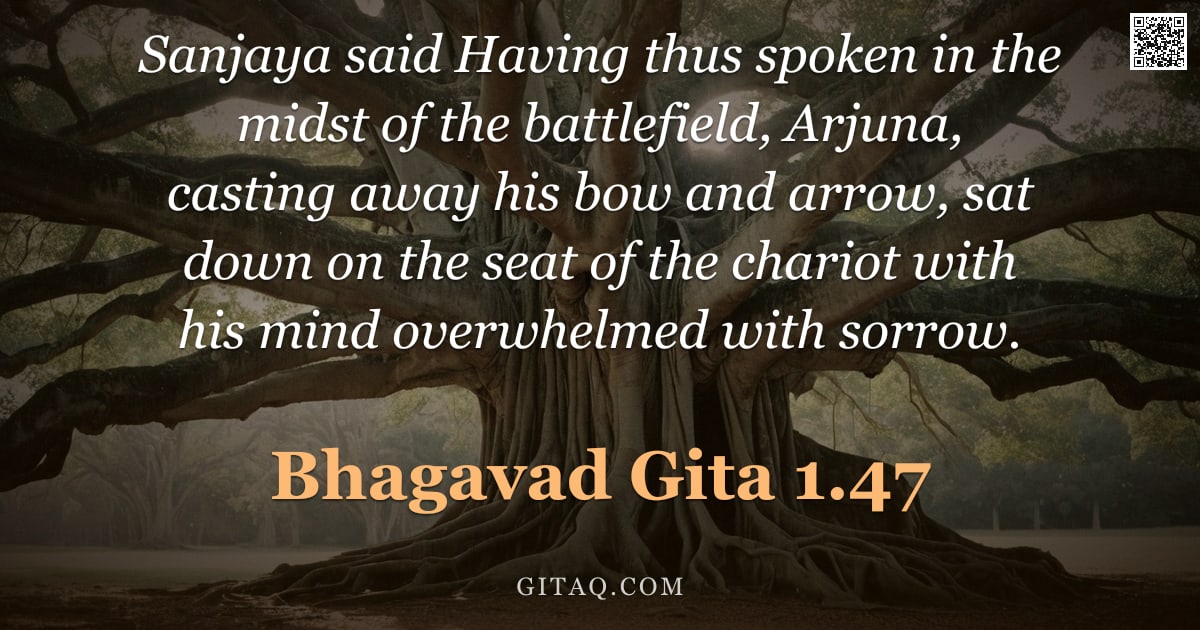
In this verse, the narrator Sanjaya describes Arjuna's reaction after Krishna has challenged his hesitation to fight. Overwhelmed by grief and confusion upon seeing his relatives on both sides of the battlefield, Arjuna drops his bow and arrows and sits down in despair. This moment marks the peak of human emotional conflict where duty clashes with personal attachment, setting the stage for spiritual guidance.
The Teaching Behind It
This verse belongs primarily to the context of Sankhya Yoga and Karma Yoga, illustrating the initial failure of action (kartrtva) due to ignorance and attachment. It develops the concept that without self-realization and detachment from the fruits of action, the mind becomes 'shokasaṃvignam' (distressed by sorrow), rendering one incapable of performing their duty effectively.
Word by Word
Where This Happens
This verse concludes Chapter 1 of the Bhagavad Gita within the epic Mahabharata, set on the battlefield of Kurukshetra. Sanjaya, who has divine sight to witness the war from afar and reports it to King Dhritarashtra, describes Arjuna's emotional collapse after a long speech by Krishna where he questioned Arjuna's resolve. Just moments prior, Arjuna had surveyed both armies, recognized his teachers and kin as enemies, and was paralyzed by deep sorrow (vishada), refusing to fight despite the call of duty.
Living It Out Today
Consider a manager who must deliver difficult feedback or lay off employees they have mentored for years. Like Arjuna in this verse, the fear of causing pain can lead them to freeze, drop their 'bow' of authority, and avoid making the necessary decision due to emotional distress. The lesson here is that while feeling empathy is natural, getting stuck in sorrow prevents one from fulfilling a vital responsibility; acknowledging the emotion but moving forward with clarity is the path through such crises.
Explained for Children
Imagine you are playing a game, but suddenly your best friends tell you to stop because they think it's wrong or too scary. Even if you wanted to play before, now you feel so sad and confused that you just put down your toy sword and sit on the floor with a heavy heart. Arjuna felt exactly like this: he loved his family so much that fighting them seemed impossible, so he gave up trying for a moment.
Daily Reflection
You know well the feeling when a weight becomes too great to carry alone, prompting you to drop everything and simply sit with your grief. It might feel like defeat or weakness to pause here on the battlefield of life, but this verse reminds us that true resolution often begins only after we stop fighting our own internal turmoil.
A Practice for Today
Close your eyes and visualize setting down the heavy burden of an impossible choice, just as Arjuna laid aside his bow. Breathe deeply into that moment of surrender, acknowledging that it is safe to rest in sorrow before finding clarity.
Key Teachings
- The Necessity of Surrender
Arjuna's act of dropping his weapon is not an admission of failure, but a profound surrender that clears the path for divine guidance. True spiritual progress often requires us to let go of our ego-driven strategies before we can receive higher wisdom. - The Validity of Human Emotion
Even in the face of duty, Arjuna's sorrow is acknowledged as a natural and honest human response rather than something to be immediately suppressed. The Gita validates our pain, showing that we do not need to pretend to be stoic heroes while we are still struggling internally. - The Pause Before Revelation
This verse marks the critical transition from confusion and despair into a state of readiness for the Lord's teaching. Without this moment of total collapse, Arjuna would not have been in the necessary posture to receive the eternal truths that follow.
Themes
Related Verses
Read This Next
- 2.47 — This verse introduces Krishna's core teaching on performing duty without attachment, offering a direct antidote to Arjuna's despair.
- 3.30 — Krishna instructs Arjuna to dedicate all actions and their fruits to the Divine, helping him transcend his personal sorrow through devotion.
- 12.15 — This verse describes how Krishna blesses those who are free from distress and equanimous in pleasure or pain, guiding Arjuna toward inner peace.
Recommended Reading
GitaQ earns from qualifying purchases as an Amazon Associate.