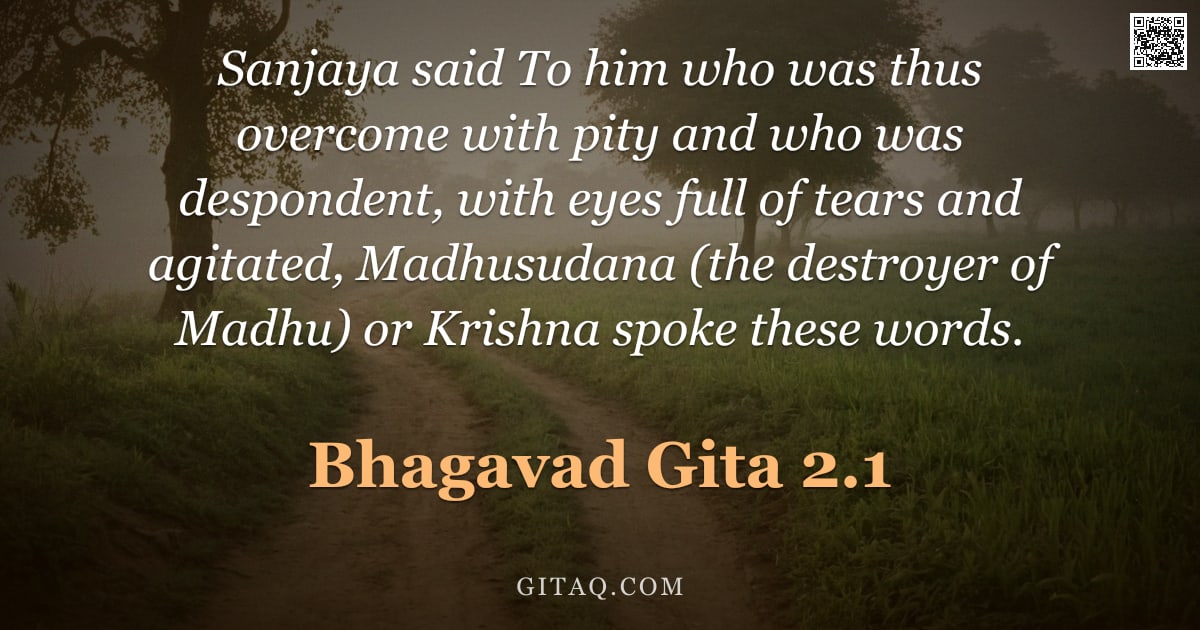
Bhagavad Gita 2.1
Sankhya Yoga · English Translation
सञ्जय उवाच | तं तथा कृपयाविष्टमश्रुपूर्णाकुलेक्षणम् | विषीदन्तमिदं वाक्यमुवाच मधुसूदनः ||२-१||
sañjaya uvāca . taṃ tathā kṛpayāviṣṭamaśrupūrṇākulekṣaṇam . viṣīdantamidaṃ vākyamuvāca madhusūdanaḥ ||2-1||
What Does This Verse Mean?
This verse describes the moment before Lord Krishna begins his spiritual teaching to Arjuna. Sanjaya, the narrator speaking from a distance via divine vision, tells us that Arjuna is overwhelmed by grief and pity on the battlefield, with tears streaming down his face and confusion in his heart. Seeing this deep distress, Krishna addresses him as 'Madhusudana' (the destroyer of evil) to prepare to guide him out of despair. The key teaching here is that divine wisdom arrives precisely when a seeker reaches their lowest point of emotional crisis.
The Teaching Behind It
This verse serves as the practical entry point to Sankhya Yoga (the yoga of analytical knowledge), which begins in Chapter 2. It establishes the foundational concept that spiritual wisdom is not just theoretical but is required when one's intellect and emotions are clouded by attachment and sorrow. The introduction of Krishna's divine title 'Madhusudana' also subtly introduces Bhakti Yoga, emphasizing that surrendering to a higher consciousness is necessary to transcend human suffering.
Word by Word
Where This Happens
This verse marks the beginning of Chapter 2 in the Bhagavad Gita, which forms part of the epic Mahabharata. Sanjaya, the charioteer and narrator for King Dhritarashtra (who is blind), uses his divine sight to describe the scene on the battlefield of Kurukshetra. Just prior to this moment, Arjuna had dropped his bow in refusal to fight a war against his own relatives, teachers, and friends, falling into a state of deep emotional paralysis known as 'vipralabdha' (delusion by grief). Krishna is now identified with His divine title 'Madhusudana,' signaling the start of the spiritual discourse that will resolve this crisis.
Living It Out Today
Consider a professional who has spent years building a company but faces an imminent threat from competitors, causing them to freeze in fear and consider abandoning their life's work. Like Arjuna feeling overwhelmed by pity for losing colleagues or family members, they are paralyzed by anxiety and doubt about the future. This verse teaches us that before any solution can be found, we must first acknowledge our emotional state without judgment; it is from this honest moment of vulnerability that clarity and a new path forward emerge.
Explained for Children
Imagine you are about to play an important game against your best friends, but suddenly you feel so sad and scared that you start crying because you think you can't win or hurt someone's feelings. You freeze up and don't know what to do. That is exactly how Arjuna felt on the battlefield! His wise friend Krishna saw him crying and stopped just long enough to gently tell him, 'Don't worry, I am here with a special message for your heart.' It shows that even when we feel like giving up or are very sad, there is always someone who cares about us ready to help.
Daily Reflection
Even when you feel overwhelmed by pity or despondency, remember that Krishna does not scold Arjuna in his pain; He meets him exactly where he is with compassion. Your tears and agitation are valid parts of the human experience, yet they do not define your ultimate strength. Today, allow yourself to be fully present in this emotional storm without judgment, trusting that clarity will arise from within.
A Practice for Today
Sit quietly and notice where you are holding back tears or resisting the urge to speak, whether from grief or overwhelm. Invite your inner teacher to gently acknowledge that this moment of vulnerability is not a failure, but a sacred opening for wisdom.
Key Teachings
- The Human Face of Divinity
Krishna appears as Madhusudana not just as a warrior but as a compassionate friend who recognizes the intensity of human sorrow. This verse establishes that divine guidance begins with empathy, meeting the seeker in their moment of deepest crisis. - Despondency is Not Final
Arjuna's state of being 'agitated' and 'tearful' shows that spiritual progress often involves a period of intense emotional processing before transformation. The text validates these feelings as the necessary precursor to receiving higher knowledge. - The Timing of Wisdom
Words of profound truth are spoken only after acknowledging and witnessing the student's current state of mind. True teaching does not bypass human emotion but enters into it to heal and elevate.
Themes
Related Verses
Read This Next
- 2.47 — After witnessing Arjuna's grief here, this verse provides the core instruction on how to act without attachment to results.
- 3.30 — This continuation explains the specific practice of offering all actions and thoughts to Krishna as a means to overcome agitation.
- 12.15 — To see how one becomes dear to God by being free from envy, hatred, and excessive emotional reactivity in daily life.
Recommended Reading
GitaQ earns from qualifying purchases as an Amazon Associate.