Bhagavad Gita 1.44
Arjuna Vishada Yoga · English Translation
उत्सन्नकुलधर्माणां मनुष्याणां जनार्दन | नरके नियतं वासो भवतीत्यनुशुश्रुम (or नरकेऽनियतं) ||१-४४||
utsannakuladharmāṇāṃ manuṣyāṇāṃ janārdana . narake niyataṃ vāso bhavatītyanuśuśruma ||1-44||
What Does This Verse Mean?
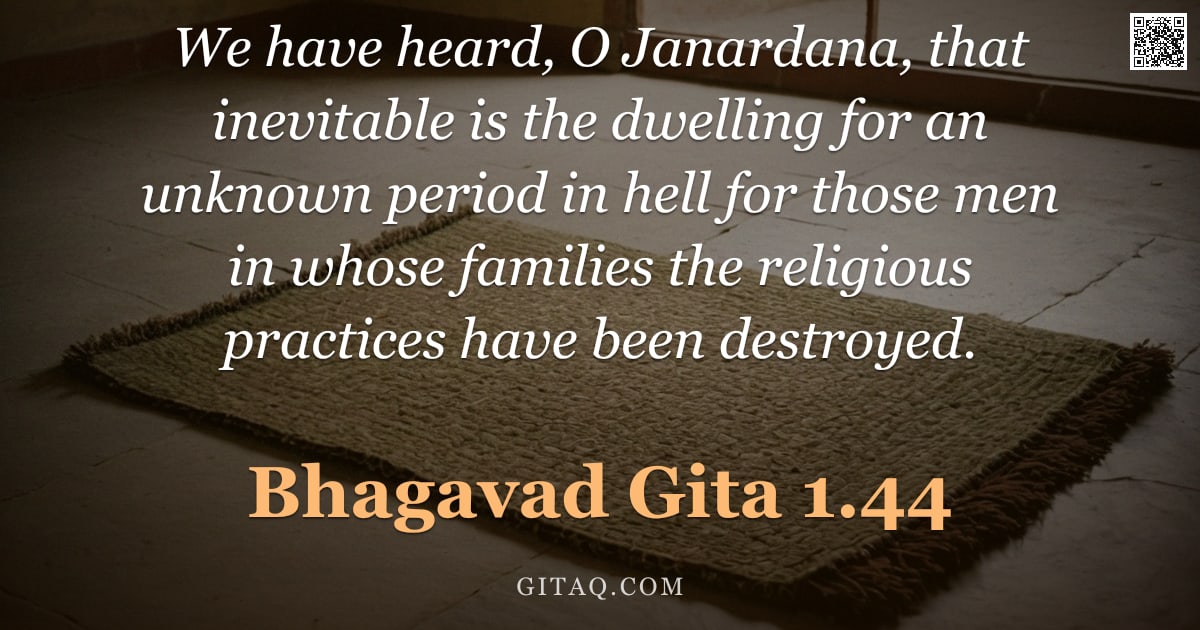
In this verse, Arjuna addresses Krishna as Janardana and expresses a deep fear rooted in ancient wisdom: that destroying the spiritual traditions of a family leads to inevitable suffering for those responsible. He speaks from his current state of despair on the battlefield, where he sees himself forced to kill elders who uphold these customs. The core teaching is the severe consequence of disrupting Dharma (righteous duty) within one's lineage, which Arjuna believes will result in spiritual downfall or hellish existence.
The Teaching Behind It
This teaching is deeply rooted in the concept of Dharma (righteous duty) within the Sankhya philosophy, which distinguishes between action based on cosmic order versus selfish desire. It develops the idea that Karma (action) has inevitable consequences (Phala), specifically highlighting how destructive actions against family traditions create a negative karmic cycle that leads to suffering.
Word by Word
Where This Happens
This verse occurs in Chapter 1 of the Bhagavad Gita during 'Arjuna Vishada Yoga,' where the warrior Prince Arjuna has broken down in grief on the battlefield of Kurukshetra. Just moments before, he surveyed both armies and realized that his own kinsmen stand against him as enemies to be killed. Overwhelmed by fear that killing these elders would destroy their family's religious heritage (Kuladharma), he voices this ancient warning he has heard from sages to Krishna.
Living It Out Today
Consider a modern manager who decides to cut corners on ethical standards or fire loyal, long-term employees just to boost short-term profits. While the immediate result might look like financial gain, the leader may soon face severe internal conflict, loss of team trust, and reputational damage that feels like an inescapable negative consequence. This verse reminds us that actions which dismantle a community's core values often lead to long-term instability or 'hellish' states of anxiety and isolation.
Explained for Children
Imagine if a family stopped following their rules about being kind and honest because everyone started fighting instead; eventually, things would go very wrong for that whole group. This verse is like saying: 'If we break the special traditions that keep our family safe and good, bad things will happen to us.' It's Arjuna telling his friend Krishna he is scared that if they fight their own relatives, it might ruin not just them but also their future generations.
Daily Reflection
When you feel overwhelmed by chaos or see uncertainty in your family, remember that your personal integrity is the first line of defense against spiritual decline. It is not about being perfect but about choosing kindness and duty over convenience when it matters most. Krishna's warning to Arjuna reminds us that our choices ripple outward, shaping the destiny of those around us.
A Practice for Today
Close your eyes and imagine that every duty you perform today, no matter how small, is a pillar holding up the spiritual foundation of your household or community. Ask yourself: 'Am I acting in a way that preserves Dharma (righteousness) for those who look to me?' Let this awareness anchor your actions throughout the day.
Key Teachings
- The Fragility of Dharma
Righteousness is not an abstract concept but a living practice sustained by collective family and social action. When individuals abandon their duties, the entire spiritual ecosystem begins to crumble. - Collective Karmic Responsibility
We are never entirely separate from our families; their moral state is inextricably linked to ours through shared actions and influence. The destruction of religious practice by a few leads to spiritual consequences for the many. - The Severity of Spiritual Neglect
Krishna uses strong language about 'hell' (narake) not as a threat, but to highlight the severe disconnection from one's true nature that occurs when duty is abandoned. This serves as a stern wake-up call against apathy in our moral obligations.
Themes
Related Verses
Read This Next
- 2.47 — Read this next for Krishna's direct solution: performing duty without attachment to results, which preserves Dharma through action rather than inaction.
- 3.30 — This verse expands on the method of selfless surrender (karma-yoga) as a way to maintain spiritual order and prevent the degradation Arjuna fears.
- 12.15 — After contemplating the danger of losing Dharma, read this to understand how Krishna defines a devotee who is dear to Him because they do not disturb others or seek their own comfort at the expense of peace.
Recommended Reading
GitaQ earns from qualifying purchases as an Amazon Associate.