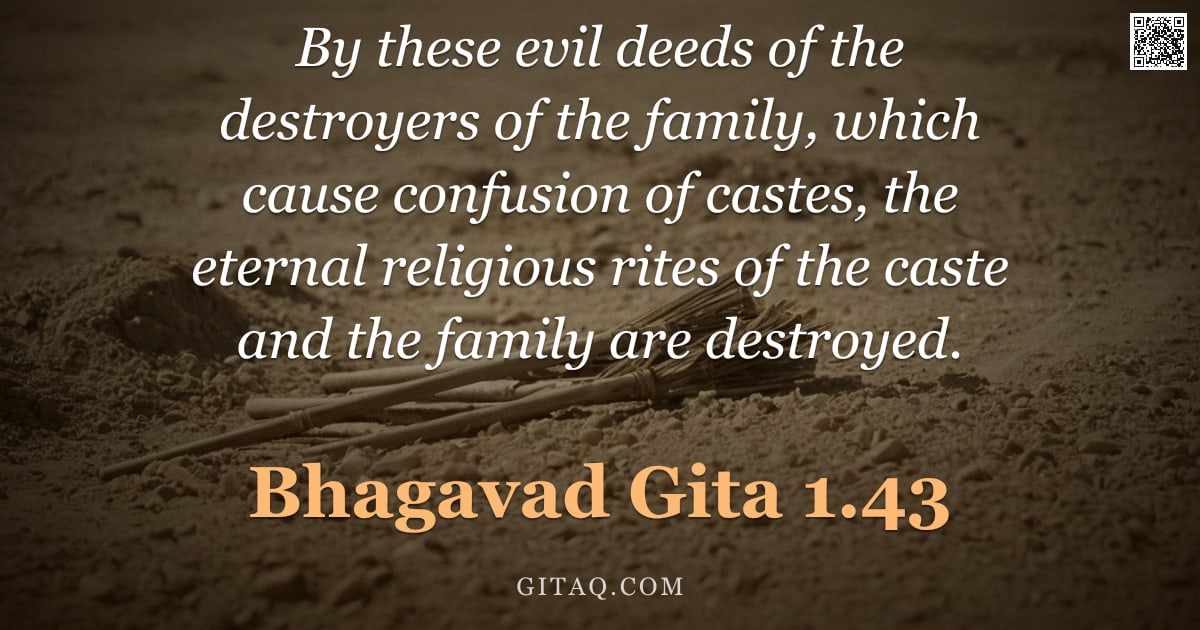
Bhagavad Gita 1.43
Arjuna Vishada Yoga · English Translation
दोषैरेतैः कुलघ्नानां वर्णसङ्करकारकैः | उत्साद्यन्ते जातिधर्माः कुलधर्माश्च शाश्वताः ||१-४३||
doṣairetaiḥ kulaghnānāṃ varṇasaṅkarakārakaiḥ . utsādyante jātidharmāḥ kuladharmāśca śāśvatāḥ ||1-43||
What Does This Verse Mean?
In this verse, Arjuna expresses his deep fear that killing their own relatives will lead to the destruction of family traditions and social order. He argues that by eliminating the elders and committing such evil acts, people cause confusion in caste duties (varna-sankara), which erodes the eternal religious practices of both families and society. This teaching highlights how violence against one's kin creates a ripple effect that destroys the moral foundation of future generations.
The Teaching Behind It
This teaching falls under the framework of Dharma (righteous duty) within Karma Yoga, specifically addressing the consequences of action on social order and spiritual continuity. It develops the concept that individual actions are not isolated; they ripple outward to influence the collective moral fabric (Sanatana Dharma) across generations.
Word by Word
Where This Happens
This verse occurs at the beginning of the Bhagavad Gita on the battlefield of Kurukshetra during the Mahabharata war. The speaker is Arjuna, who has just seen his teachers, uncles, and cousins standing in opposing armies ready to fight a civil war. He feels paralyzed by despair (Vishada) upon realizing that victory through such violence would mean the total collapse of social order and family dharma.
Living It Out Today
Consider a business leader facing pressure to cut corners on safety or ethical standards just to maximize quarterly profits for their shareholders. If they choose this path, it may destroy the company's long-standing culture of trust, causing employees to lose faith in leadership and future recruits to question the organization's values. This verse teaches that short-term gains achieved through unethical means can irreparably damage an institution's core identity.
Explained for Children
Imagine if a group of friends decided to stop following any rules at all, just because they were angry or wanted their own way. If everyone started doing whatever they felt like without caring about right and wrong, families would get confused, and no one would know how to teach the good things that keep us together as a community. Arjuna is worried that if his relatives fight each other badly, all those special family traditions will disappear forever.
Daily Reflection
You are reminded today that our actions ripple far beyond the immediate moment, shaping the spiritual fabric of those who come after us. When we allow greed or anger to cloud our judgment and destroy family unity, we risk erasing the very values that gave meaning to their lives before them. True devotion involves protecting these sacred traditions not out of rigid duty, but with a heart full of love for your ancestors and future generations.
A Practice for Today
Sit quietly and visualize the invisible threads of tradition that hold your family together, feeling their weight as both a burden and a blessing. Ask yourself where you might be unknowingly contributing to 'confusion' by neglecting these duties or allowing destructive habits to take root in your own lineage.
Key Teachings
- The Cost of Destructive Action
Arjuna identifies that the immediate violence of war will lead to long-term spiritual decay by destroying family structures. He teaches us that evil deeds are not isolated events but catalysts for a total collapse of societal and religious order. - The Sanctity of Lineage
Eternal religious rites (kuladharma) serve as the spiritual inheritance connecting past, present, and future generations. This verse emphasizes that our primary duty includes preserving these sacred traditions rather than allowing them to be eroded by personal desire. - The Danger of Caste Confusion
When family members destroy each other due to greed for power, it leads to a blurring or destruction of righteous social roles (varnasankara). The verse warns that without clear adherence to one's duty within the community, chaos ensues and spiritual progress halts.
Themes
Related Verses
Read This Next
- 2.47 — Krishna immediately counters Arjuna's despair with the principle of performing duty without attachment to results.
- 3.30 — This verse expands on surrendering all actions and their fruits, offering a path forward beyond fear of destruction.
- 12.15 — Read this to understand the qualities of a devotee who is dear to Krishna because they do not cause distress to others.
Recommended Reading
GitaQ earns from qualifying purchases as an Amazon Associate.