Bhagavad Gita 1.42
Arjuna Vishada Yoga · English Translation
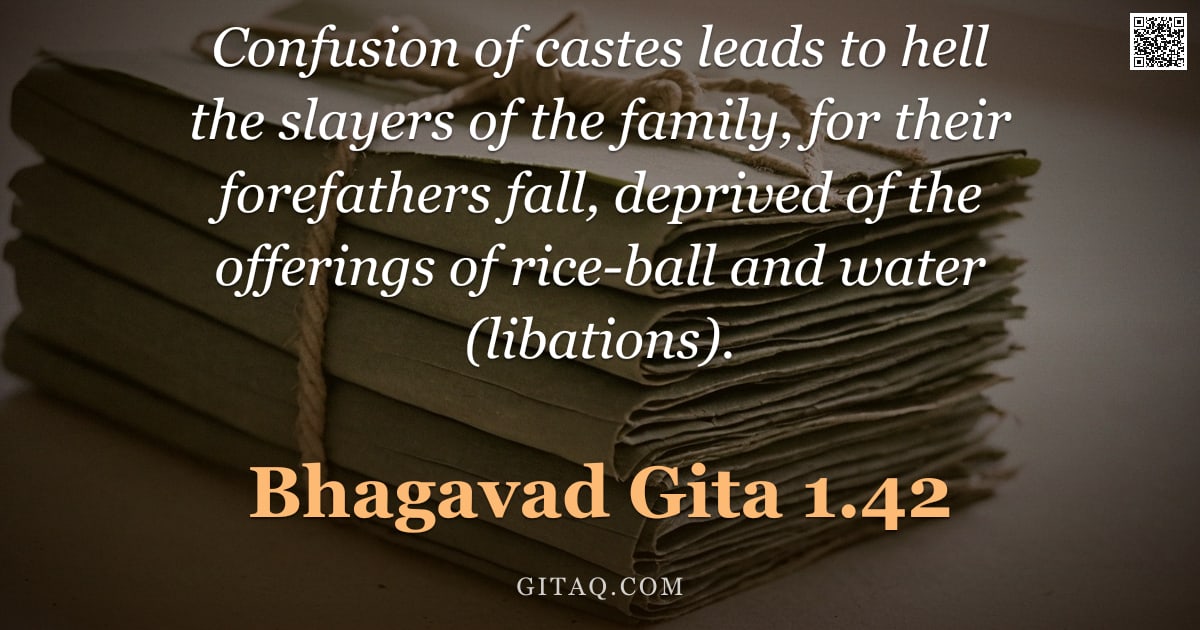
सङ्करो नरकायैव कुलघ्नानां कुलस्य च | पतन्ति पितरो ह्येषां लुप्तपिण्डोदकक्रियाः ||१-४२||
saṅkaro narakāyaiva kulaghnānāṃ kulasya ca . patanti pitaro hyeṣāṃ luptapiṇḍodakakriyāḥ ||1-42||
What Does This Verse Mean?
In this verse, Arjuna warns the elders that destroying their own family through war will lead to a chaotic mixing of social castes and spiritual lineages. He explains that when families are destroyed, religious rituals cease because there is no one left to perform them for ancestors who rely on these offerings. The key teaching is that such moral disorder leads not just to societal collapse but to severe negative consequences in the afterlife for those responsible.
The Teaching Behind It
This verse belongs primarily to the framework of Dharma (righteous duty) within Karma Yoga, which emphasizes that actions have consequences for both the doer and their lineage. It develops the concept that individual moral failure leads to collective spiritual degradation, specifically regarding the continuity of ancestral rites (Shraddha).
Word by Word
Where This Happens
This verse occurs in Chapter 1 of the Bhagavad Gita during 'Arjuna Vishada Yoga,' where Arjuna stands on the battlefield of Kurukshetra facing his cousins and teachers. He has just surveyed the enemy army, realized that killing them means destroying their own lineage, and is overwhelmed by despair at this prospect. Speaking to Krishna (his charioteer), he expresses fear that if they fight, the resulting social chaos will cause ancestors to starve spiritually due to a lack of rituals.
Living It Out Today
Consider a family business on the brink of collapse where two brothers are so focused on who gets more money that they ignore their aging parents and stop performing annual remembrance ceremonies. Arjuna's warning applies here: prioritizing short-term gain over long-term duty can sever the emotional and spiritual connections to one's roots, leading to regret later. The lesson is to make decisions in high-stress situations by considering how they impact future generations and family traditions, not just immediate profits.
Explained for Children
Imagine if a group of people decided to break up their own big family because they were fighting, and then no one ever cooked food or remembered their grandparents anymore. In this story, Arjuna says that when families stop working together and caring for each other, the special rituals we do for our ancestors get forgotten. It's like leaving a garden completely wild without anyone watering it; eventually, everything dies because no one is taking care of it.
Daily Reflection
You often worry about your own future or immediate struggles, but this verse invites you to look deeper at how your choices ripple backward to honor those who came before you. When we let anger or greed destroy the unity of our families, we inadvertently cut off the sacred flow of gratitude that feeds our ancestors' peace. True devotion is found not just in rituals, but in ensuring that your life remains a vessel where love and duty can safely pass from generation to generation.
A Practice for Today
Sit quietly and visualize your lineage as an unbroken chain of light connecting you to the present moment, rather than a fragile structure that can shatter under conflict. Ask yourself: 'Am I protecting the sacred trust of my family's values through non-violence in thought, word, and action today?'
Key Teachings
- The Gravity of Caste Confusion
Sanctity within the family structure is not about rigid social hierarchy, but about preserving Dharma through clear roles and mutual respect. When these boundaries dissolve into chaos or confusion due to selfishness, the spiritual foundation of the entire lineage begins to crumble. - The Consequence of Family Destruction
Those who destroy their own family for personal gain become 'kulaghnas,' or slayers of the clan, incurring severe karmic debt. This act is not merely a social crime but a spiritual suicide that severs one's connection to ancestral blessings. - The Loss of Ancestral Connection
Libations like rice balls and water symbolize the reciprocal bond between the living and their forefathers. When this duty is neglected due to familial destruction, the ancestors fall into a state of distress, highlighting our profound interdependence across time.
Themes
Related Verses
Read This Next
- 2.47 — To understand how Krishna shifts focus from fearful outcomes to performing one's duty without attachment.
- 3.30 — To learn the practical method of offering all actions, including family responsibilities, as a sacrifice to the Divine.
- 12.15 — To discover how cultivating detachment and non-harmlessness leads one away from such destructive paths toward peace.
Recommended Reading
GitaQ earns from qualifying purchases as an Amazon Associate.