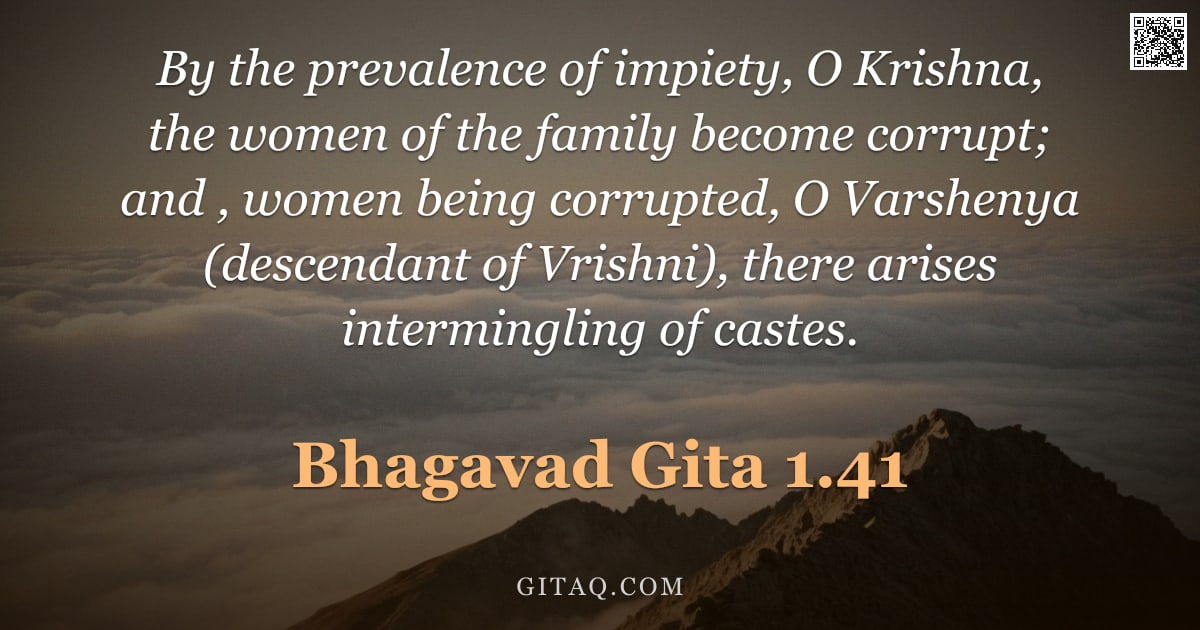
Bhagavad Gita 1.41
Arjuna Vishada Yoga · English Translation
अधर्माभिभवात्कृष्ण प्रदुष्यन्ति कुलस्त्रियः | स्त्रीषु दुष्टासु वार्ष्णेय जायते वर्णसङ्करः ||१-४१||
adharmābhibhavātkṛṣṇa praduṣyanti kulastriyaḥ . strīṣu duṣṭāsu vārṣṇeya jāyate varṇasaṅkaraḥ ||1-41||
What Does This Verse Mean?
In this verse, Arjuna tells Lord Krishna that when a family falls into chaos and moral disorder (adharma), the women of that household lose their dignity and become corrupt. Once these women are corrupted, it leads to 'varnasankara,' which refers to an intermingling or confusion of social castes due to illegitimate births. Arjuna speaks this in deep despair on the battlefield of Kurukshetra, fearing that his own hesitation to fight will trigger a chain reaction destroying their family's lineage and social order.
The Teaching Behind It
This verse belongs to the foundational context of Dharma (righteous duty) and Karma Yoga, specifically highlighting the consequences of inaction against evil forces. It develops the concept that individual choices have ripple effects on collective social structures, illustrating how personal failure to uphold righteousness leads to systemic disorder.
Word by Word
Where This Happens
This verse occurs at the end of Chapter 1 on the battlefield of Kurukshetra, just as Arjuna has laid down his bow in total refusal to fight. Speaking directly to Lord Krishna (whom he addresses here by the patronymic 'Krishna' and then 'Varshneya'), Arjuna outlines a catastrophic chain reaction: if war is not fought with righteousness, impiety will rule the family. The listener, Arjuna, is overwhelmed by anxiety about social collapse and believes that his personal inaction to avoid killing kin will inevitably lead to the destruction of their entire lineage.
Living It Out Today
In a modern workplace scenario, this verse applies when an employee notices leadership ignoring ethical violations or favoritism; if leaders do not stop these actions (adharma), trust erodes among staff. As morale drops and integrity is compromised by 'corruption' in behavior, the team culture fractures into factions that no longer share common values or goals. A manager facing this must intervene immediately to restore order before the confusion spreads to hiring practices or project outcomes.
Explained for Children
Imagine if everyone in your neighborhood stopped following the rules for being kind and honest; eventually, people might start getting hurt or confused about who is safe. Arjuna was worried that because he didn't want to fight his cousins, all the good behavior in their family would disappear. He feared this bad attitude would spread like a cold virus, making everyone sad and causing families not to know who belongs where anymore.
Daily Reflection
You often feel overwhelmed by the fear that your actions might cause chaos or harm to those you love, just as Arjuna feared for his family's future. It is natural to worry about how external events might disrupt order and virtue in our lives. However, true strength comes not from avoiding difficult choices out of fear, but from upholding dharma even when the path seems uncertain. Remember that by grounding your actions in righteousness today, you become a source of stability rather than contributing to confusion.
A Practice for Today
Sit quietly and visualize how your own sense of duty can become clouded by fear or attachment, just as Arjuna did when he saw the chaos approaching his family. Ask yourself: What is one area in my life where I am allowing external circumstances to erode my inner integrity? Breathe deeply and resolve to act from a place of clear conscience rather than reactive emotion.
Key Teachings
- The Ripple Effect of Adharma
When unrighteousness (adharma) prevails within the home or community, it does not stop at one person but spreads corruption through relationships and social structures. The verse illustrates how a breakdown in moral order leads to the degradation of family values and eventually societal stability. - The Sanctity of Varnashrama
In this context, the 'intermingling of castes' refers not merely to social mixing but to a spiritual confusion where duties are abandoned due to lost moral clarity. The verse warns that when individuals ignore their prescribed duties (svadharma), the fundamental structure of society begins to crumble. - Responsibility for Cultural Preservation
Arjuna identifies himself as a guardian who must act decisively to prevent the erosion of family values and cultural heritage. This teaches that preserving dharma is not passive; it requires active, courageous intervention to stop the spread of corruption.
Themes
Related Verses
Read This Next
- 2.47 — This verse provides the direct solution to Arjuna's despair by teaching him to act without attachment to results.
- 3.30 — It expands on the concept of action as a sacrifice, showing how duty performed for the Supreme maintains cosmic order.
- 12.15 — This verse describes the qualities of a devotee who is dear to Krishna and embodies the very steadiness Arjuna seeks.
Recommended Reading
GitaQ earns from qualifying purchases as an Amazon Associate.