Bhagavad Gita 1.40
Arjuna Vishada Yoga · English Translation
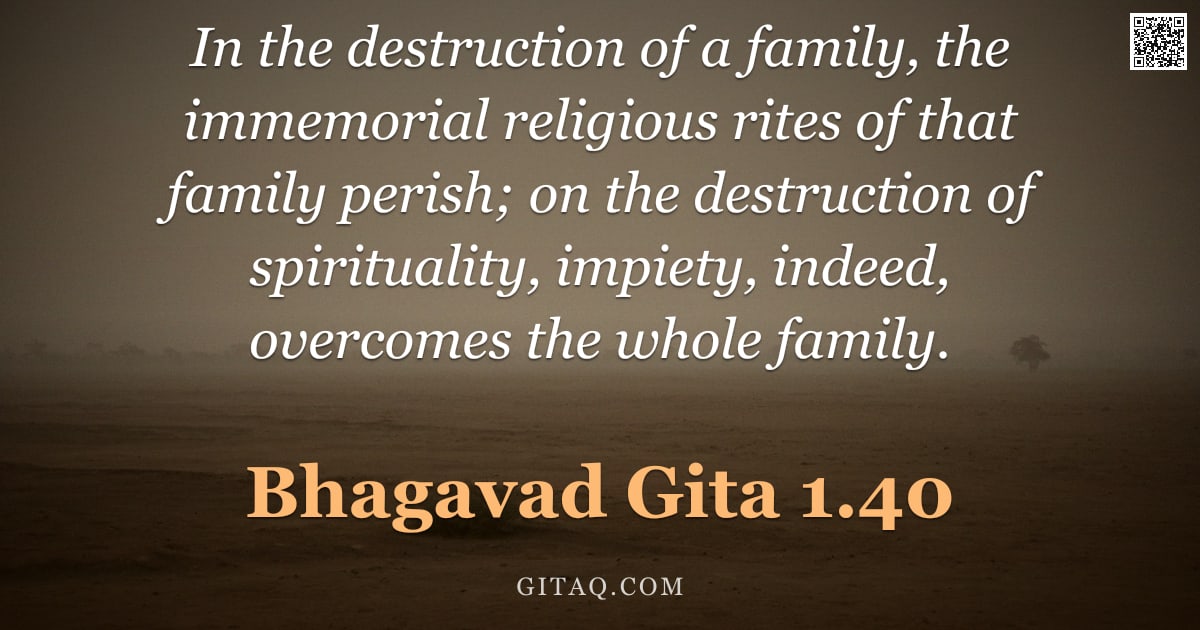
कुलक्षये प्रणश्यन्ति कुलधर्माः सनातनाः | धर्मे नष्टे कुलं कृत्स्नमधर्मोऽभिभवत्युत ||१-४०||
kulakṣaye praṇaśyanti kuladharmāḥ sanātanāḥ . dharme naṣṭe kulaṃ kṛtsnamadharmo.abhibhavatyuta ||1-40||
What Does This Verse Mean?
Arjuna tells Krishna that when a family is destroyed due to war, the ancient traditions and values of that family vanish forever. Once these guiding principles are lost, unrighteousness takes over completely, corrupting everyone in the lineage. The key teaching here is that moral decay begins at home, leading to social chaos if spiritual duties are abandoned.
The Teaching Behind It
This verse introduces the concept of Svadharma (personal duty based on one's station in life) within the framework of Karma Yoga. It establishes that action without adherence to cosmic order and family duties is not just destructive but creates 'Adharmic' chaos, a prerequisite for Krishna's later teaching on performing duty without attachment.
Word by Word
Classical Commentary
Where This Happens
This verse occurs in Chapter 1 during 'Arjuna Vishada Yoga,' as the Kaurava army stands ready for war on the field of Kurukshetra. Arjuna has just realized that he must fight and kill his own grandfather, teachers, cousins, and friends to secure a kingdom throne. Overwhelmed by grief and fear of sinning against his elders, he voices this specific worry about the total collapse of family traditions if they are all killed.
Living It Out Today
Consider a modern scenario where a company culture focused on integrity is destroyed by leadership corruption; soon, unethical behavior spreads to every department. Or in a family dealing with addiction or conflict without resolution, the shared values that once held them together crumble, leading to isolation and resentment among relatives. In both cases, neglecting 'cultural dharma' (how we treat each other) leads to a spiral of negative consequences for everyone involved.
Explained for Children
Imagine a tree where the roots represent your family's good values and rules. If someone cuts down those roots (destroys the family), the whole tree dies and turns into weeds instead of fruits or flowers. Arjuna is saying that without our parents teaching us to be kind and do what is right, bad habits take over quickly.
Daily Reflection
As you move through your day, consider how the 'dust' of impatience or selfishness might be clouding the clear light of your family's values. When challenges arise, remember that true safety lies not in controlling others but in steadfastly upholding your own commitment to what is right and holy. Let this verse remind you that even when things feel uncertain, keeping your spiritual integrity intact protects everything around you from falling into darkness.
A Practice for Today
Sit quietly and imagine the foundation of your daily life as a house built upon timeless traditions; ask yourself what spiritual practices hold that structure together when chaos arises. Visualize replacing fear with the steady flame of dharma, understanding that preserving inner righteousness is more vital than any external outcome.
Key Teachings
- The Fragility of Tradition
Arjuna warns that destroying a family unit inevitably leads to the loss of its sacred customs and ancestral wisdom. Without these living traditions, the moral compass of future generations is lost, leaving them vulnerable. - The Domino Effect of Adharma
When spiritual discipline (dharma) collapses within a home, it creates a vacuum that is instantly filled by unrighteousness. This negative energy does not stay contained but spreads to consume the entire social fabric of the family. - Duty Over Outcome
The verse highlights that our primary responsibility is to protect and uphold dharma, regardless of whether we win or lose a battle. The destruction of righteousness is a far greater tragedy than physical death on the battlefield.
Themes
Related Verses
Read This Next
- 2.47 — Krishna immediately addresses Arjuna's despair by teaching him to act without attachment to the results of preserving dharma.
- 3.30 — This verse expands on the concept of offering all actions to God, which is the practical method for sustaining family and societal spirituality.
- 12.15 — Arjuna learns that those who are free from malice and see equality in all beings are most dear to Krishna, reinforcing the value of unity over destruction.
Recommended Reading
GitaQ earns from qualifying purchases as an Amazon Associate.