Bhagavad Gita 1.36
Arjuna Vishada Yoga · English Translation
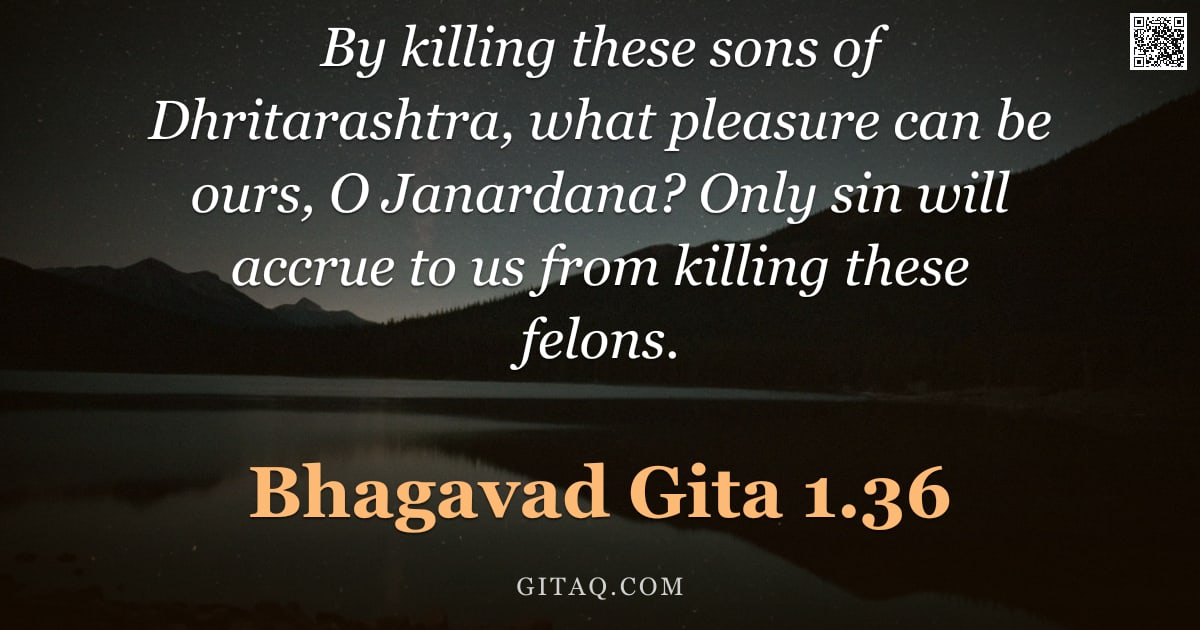
निहत्य धार्तराष्ट्रान्नः का प्रीतिः स्याज्जनार्दन | पापमेवाश्रयेदस्मान्हत्वैतानाततायिनः ||१-३६||
nihatya dhārtarāṣṭrānnaḥ kā prītiḥ syājjanārdana . pāpamevāśrayedasmānhatvaitānātatāyinaḥ ||1-36||
What Does This Verse Mean?
In this verse, Arjuna expresses his deep despair to Lord Krishna (Janardana), arguing that killing even sinful relatives will bring no true happiness but only accumulate sin and guilt. He questions the value of a kingdom or victory if it requires destroying one's own family through violence. The core teaching here highlights the conflict between emotional attachment and moral duty, showing how fear of negative consequences can paralyze decision-making.
The Teaching Behind It
This verse serves as the foundational crisis for Karma Yoga, where one must learn to act without being driven by personal desire or fear of sin. It sets up the philosophical argument that duty (dharma) is not determined by emotional outcomes but by universal order and righteousness. The concept developed here is the distinction between worldly attachment-based morality and spiritual clarity.
Word by Word
Classical Commentary
Where This Happens
This verse occurs at the very beginning of the Bhagavad Gita on the battlefield of Kurukshetra, just after Arjuna has seen his teachers, cousins, and elders arrayed for war. Overwhelmed by compassion and confusion about the consequences of violence against kin, he drops his bow and turns away from battle to speak directly to Krishna as a friend rather than a charioteer. He is articulating his fear that killing these 'felons' (atataayinah) will result in spiritual ruin for him.
Living It Out Today
Consider a manager who must fire long-time employees due to budget cuts, but they are paralyzed by the guilt of destroying those families instead of making the hard decision. Like Arjuna's fear of sin, this person worries that any action taken now is inherently wrong and will lead to regret rather than resolution. The lesson applies when we realize that avoiding a necessary difficult choice out of emotional attachment often causes more long-term harm than facing the short-term pain.
Explained for Children
Imagine you are playing a game where to win, you have to push your favorite friends off a cliff; even if you become the winner, would you feel happy? Arjuna feels exactly like this: he is asking Krishna why fighting his own family and teachers would ever bring joy. He believes that hurting people who might be wrong doesn't make you good or happy; instead, it makes everyone inside feel sad and guilty.
Daily Reflection
Arjuna's despair reminds us how easily love can turn into a barrier for doing what is right. When we cling too tightly to personal desires or relationships, we often forget that true compassion sometimes requires difficult action. Today, ask yourself where your own attachment might be blinding you to the greater good.
A Practice for Today
Sit quietly and acknowledge the heavy burden of attachment that clouds our judgment when faced with conflict or difficult choices. Silently repeat to yourself, 'I seek clarity over consequence,' allowing your heart to release the fear of future sin in favor of present duty.
Key Teachings
- The Illusion of Personal Pleasure
Arjuna questions how any joy could arise from killing his kin because he confuses physical survival with spiritual fulfillment. True happiness is never found in the destruction of life, even when that life belongs to enemies. - The Reality of Karmic Debt
Killing without divine sanction invites 'papa' or sin, which weighs down the soul and obscures one's true nature. We must recognize that violent actions rooted in personal hatred create a cycle of suffering for both perpetrator and victim. - The Call to Transcend Ego
Arjuna speaks as 'Janardana' (Krishna) is the controller of senses, highlighting that our actions must align with a higher order rather than personal fear. The path forward requires surrendering one's limited perspective to see the eternal reality beyond birth and death.
Themes
Related Verses
Read This Next
- 2.47 — Krishna responds directly by teaching that one must act without attachment to results or fear of sinful consequences.
- 3.30 — This verse instructs the devotee to dedicate all actions and their fruits entirely to the Divine, removing personal ego from decision-making.
- 12.15 — Read this to understand how one who causes no trouble and is free from distress becomes dear to Krishna, contrasting Arjuna's current turmoil with divine grace.
Recommended Reading
GitaQ earns from qualifying purchases as an Amazon Associate.