Bhagavad Gita 1.34
Arjuna Vishada Yoga · English Translation
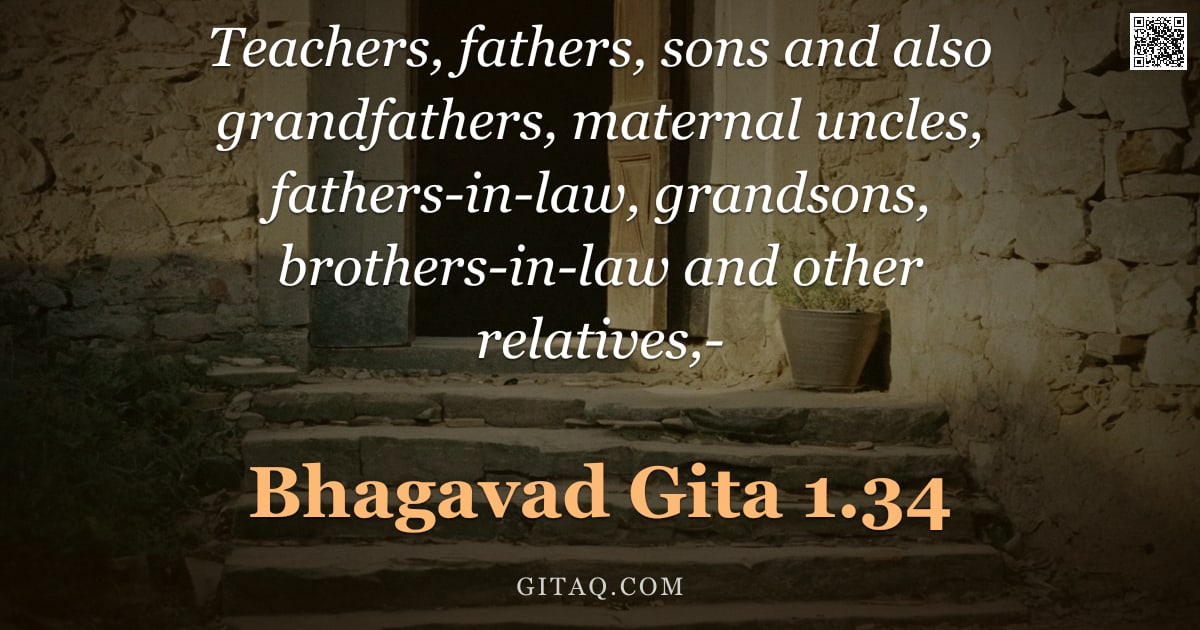
आचार्याः पितरः पुत्रास्तथैव च पितामहाः | मातुलाः श्वशुराः पौत्राः श्यालाः सम्बन्धिनस्तथा ||१-३४||
ācāryāḥ pitaraḥ putrāstathaiva ca pitāmahāḥ . mātulāḥ śvaśurāḥ pautrāḥ śyālāḥ sambandhinastathā ||1-34||
What Does This Verse Mean?
In this verse, Arjuna lists the specific family members and elders he sees arrayed against him on the battlefield of Kurukshetra, including teachers, fathers, grandfathers, uncles, and sons. He is speaking to his charioteer Krishna but expressing his own internal turmoil as he realizes that fighting means killing those whom society holds most sacred. The key teaching here highlights how deep emotional attachments can cloud one's judgment of duty when faced with a moral crisis involving loved ones.
The Teaching Behind It
This verse serves as a pivotal moment in the development of Karma Yoga by illustrating how attachment (Raga) to specific relationships creates mental bondage and obscures Dharma. It sets up the necessity of Jnana Yoga, where one must learn to see beyond temporary family roles to understand the eternal nature of the soul.
Word by Word
Where This Happens
This verse occurs at the very beginning of the Mahabharata's epic war on the field of Kurukshetra. The warrior Prince Arjuna is addressing his friend Krishna but has just surveyed the opposing army led by his cousins, the Kauravas. Having recognized a vast array of respected elders and kin in enemy lines who are ready to fight him for their own gain, he collapses into despair over the prospect of fratricide.
Living It Out Today
Consider a manager who must make the difficult decision to lay off employees from a department they have personally mentored for years. Like Arjuna listing his relatives, this person feels paralyzed by personal affection and loyalty conflicting with their professional responsibility to cut costs or restructure. The lesson is that while acknowledging these emotional bonds is vital, one cannot let them completely paralyze necessary actions required for the greater good of the organization.
Explained for Children
Imagine you are playing a team game, and suddenly the coach tells you to stop because some people on the other side are your own family members—like your dad or teacher. Arjuna was in this exact situation; he saw his elders and relatives ready to fight him and felt too sad to lift his bow. Just like it is hard to argue with someone who taught you how to behave, Arjuna realized that hurting these people would break the rules of love and respect.
Daily Reflection
Today, take a quiet moment to remember the many faces that have formed the foundation of your existence—your mentors who taught you wisdom, parents who gave you life, and relatives who bound you together. It is easy in our busy lives to overlook these sacred connections until they are gone or challenged, yet their presence was never an accident but a divine arrangement for your growth. When you feel overwhelmed by the weight of duty or relationship today, pause and recognize that honoring them honors the very fabric of dharma woven through your family line.
A Practice for Today
Close your eyes and visualize the faces of those who have guided, protected, or loved you throughout your life; acknowledge their presence as sacred pillars holding up your world. As you breathe deeply, hold a moment of gratitude for every teacher, parent, elder, and relative whose influence has shaped your journey.
Key Teachings
- The Sacred Hierarchy of Relationships
This verse catalogues a specific lineage from teachers to grandsons, establishing that spiritual duty is not abstract but deeply rooted in concrete human bonds. Recognizing this hierarchy reminds us that our responsibilities are layered, with each relationship demanding a distinct form of reverence and care. - Dharma Within the Family
Arjuna's list highlights that one's primary duty often begins within the family unit before extending to society at large. The verse teaches that true righteousness requires us to see our relatives not merely as blood, but as vessels of divine grace and historical continuity. - The Burden of Identity
By listing every relationship from grandfathers to brothers-in-law, the text illustrates how deeply entangled we are in a web of social identity. This awareness creates the immediate conflict Arjuna feels: that fulfilling one's duty may require acting against these very bonds. - The Illusion of Separation
Arjuna enumerates these kinsmen to express his attachment, revealing how easily we confuse our spiritual self with our social roles. The verse serves as a mirror for the reader to examine where their devotion is misplaced on temporary forms rather than eternal truth. - The Weight of Lineage
Each title listed represents a chain of karma and duty passed down through generations, creating an unbroken line of expectation. Understanding this weight helps us see that our actions today ripple forward to affect the future of these same descendants.
Themes
Related Verses
Read This Next
- 2.47 — After listing his relatives in despair, Arjuna must learn to act without attachment to these same bonds.
- 3.30 — This verse instructs how to dedicate all actions and relationships to the Divine, transforming duty into worship.
- 12.15 — Here Krishna describes the qualities of a devotee who is dear to Him by being free from envy toward all beings.
Recommended Reading
GitaQ earns from qualifying purchases as an Amazon Associate.