Bhagavad Gita 9.19
Raja Vidya Raja Guhya Yoga · English Translation
तपाम्यहमहं वर्षं निगृह्णाम्युत्सृजामि च | अमृतं चैव मृत्युश्च सदसच्चाहमर्जुन ||९-१९||
tapāmyahamahaṃ varṣaṃ nigṛhṇāmyutsṛjāmi ca . amṛtaṃ caiva mṛtyuśca sadasaccāhamarjuna ||9-19||
What Does This Verse Mean?
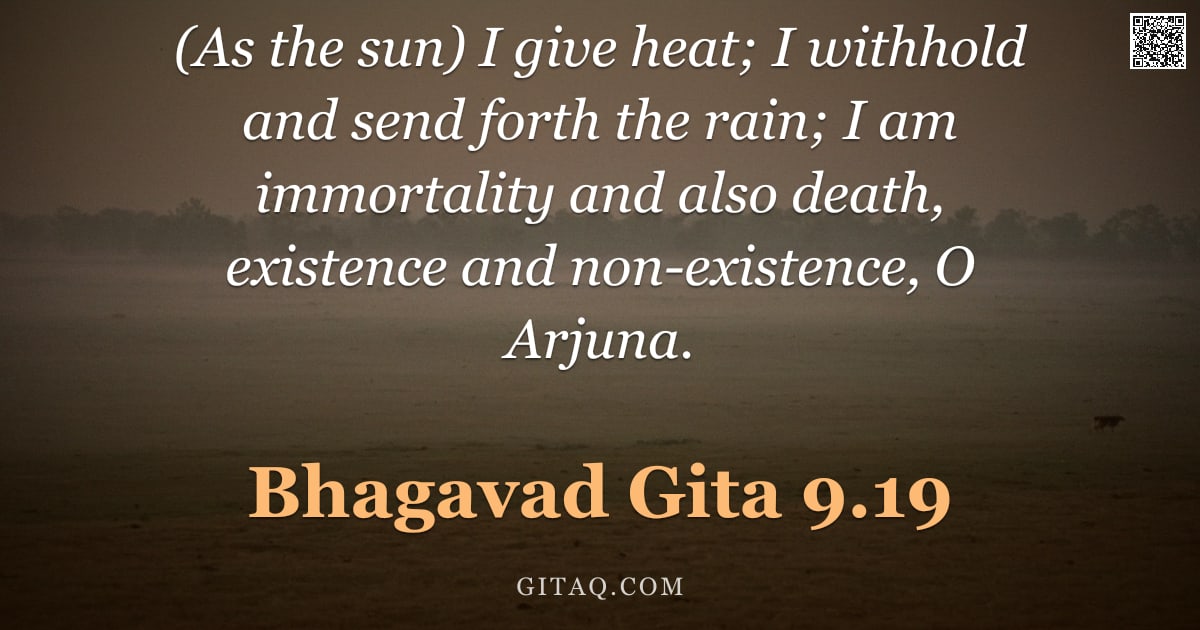
In this verse, Lord Krishna tells Arjuna that He is the ultimate source and controller of all natural forces and life states. Just as the sun gives heat or withholds it to bring rain, Krishna creates and sustains everything in existence while also governing death itself. The core teaching is that there are no opposing forces outside of Him; even immortality and non-existence (death) originate from His divine will.
The Teaching Behind It
This verse is a cornerstone of Jnana Yoga (the yoga of knowledge) as it reveals the non-dual nature of reality where the Creator encompasses all dualities. It establishes Krishna's identity as Brahman, demonstrating that existence and non-existence are not separate from God but expressions of His will.
Word by Word
Classical Commentary
Where This Happens
This verse occurs in Chapter 9 of the Bhagavad Gita, set on the battlefield of Kurukshetra during the great Mahabharata war. Lord Krishna is speaking to Arjuna after revealing his cosmic form (Vishvarupa) and explaining His position as the Supreme Personality of Godhead. At this moment, Arjuna has just realized that he was fighting against his own relatives due to attachment, yet now Krishna assures him that He controls both the creation and destruction of worlds.
Living It Out Today
When you face a sudden job loss or financial crisis (a 'death' phase), remember that these are not random failures but part of a larger cycle of growth. Just as winter follows summer inevitably, difficult times eventually give way to new opportunities if your perspective remains steady. Instead of feeling like a victim of circumstance, trust the process and focus on your duty now, knowing that both success and failure are temporary states managed by a higher order.
Explained for Children
Imagine the sky as a giant playground run by one special friend named Krishna who does all the jobs to keep things running smoothly. Sometimes he sends sunshine so flowers can grow, other times he holds back the sun or lets it rain when needed. He is also like life itself: sometimes we feel very alive and strong (immortality), and sometimes things end or change (death). Nothing happens by accident; everything comes from him because he loves us all.
Daily Reflection
In moments where you feel overwhelmed by life's fluctuations, remember that both your joys and challenges are expressions of the same divine presence within you. You are not separate from the cycle of creation; rather, you participate in the eternal rhythm of giving and receiving, living and releasing fear. Trust that even in times of apparent silence or loss, the seed of immortality is being nurtured beneath the surface.
A Practice for Today
Close your eyes and visualize yourself as the sun, radiating warmth to all beings without discrimination or exhaustion. Contemplate how you can hold space for others' growth even when they seem distant, just as the sun holds back rain during a drought.
Key Teachings
- The Dual Nature of Divine Action
God manifests as both the giver and restrainer of nature's forces, such as heat and rain. This teaches that every experience, whether pleasant or difficult, serves a specific purpose in the cosmic order. - Beyond Life and Death
The Supreme Self is simultaneously immortality (amrita) and death (mṛtyu), transcending the binary of existence. This means our true identity remains unchanged regardless of physical birth or dissolution. - Existence in Non-Existence
The Divine encompasses both 'sat' (eternal reality) and 'asat' (the transient world). Understanding this helps the seeker see the eternal truth hidden within temporary phenomena.
Themes
Related Verses
Read This Next
- 2.47 — Read this next to understand how to act without attachment to results while accepting divine control over outcomes.
- 3.30 — This verse complements the theme of surrender, offering a practical method for dedicating all actions and their fruits back to the Divine.
- 12.15 — After contemplating God's power over life and death, this verse reveals how such realization leads to being pleasing to Krishna through selflessness.
Recommended Reading
GitaQ earns from qualifying purchases as an Amazon Associate.