Bhagavad Gita 9.16
Raja Vidya Raja Guhya Yoga · English Translation
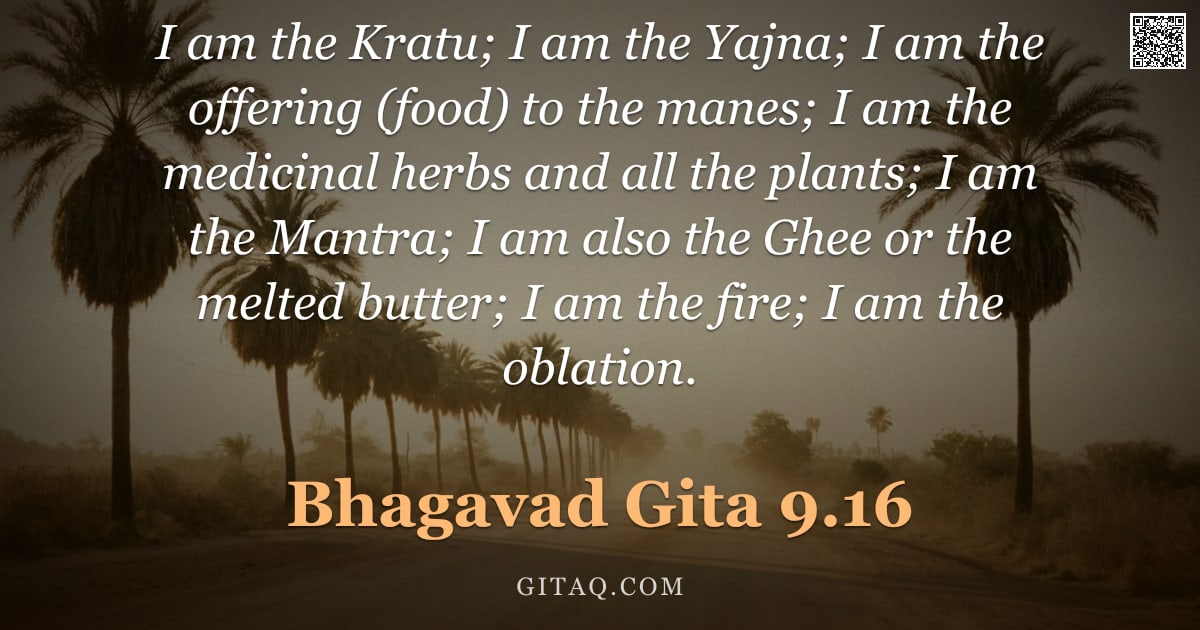
अहं क्रतुरहं यज्ञः स्वधाहमहमौषधम् | मन्त्रोऽहमहमेवाज्यमहमग्निरहं हुतम् ||९-१६||
ahaṃ kraturahaṃ yajñaḥ svadhāhamahamauṣadham . mantro.ahamahamevājyamahamagnirahaṃ hutam ||9-16||
What Does This Verse Mean?
In this verse, Lord Krishna reveals to Arjuna that He is the source and essence of every ritual act performed with devotion. By stating 'I am the fire' and 'I am the offering,' He teaches that there is no separation between the worshiper, the tool used for worship, or the object being worshipped; everything ultimately rests in Him. This declaration shifts the focus from performing rituals to gain results toward recognizing the Divine presence within every action of life.
The Teaching Behind It
This verse belongs primarily to the strand of Bhakti Yoga supported by Jnana (knowledge), illustrating the concept of Sarva-karma-maya-brahman or that Brahman is the substance of all actions. It develops the non-dualistic teaching that the ritual, the officiant, and the Supreme Lord are not distinct entities but a single reality manifesting in various forms.
Word by Word
Classical Commentary
Where This Happens
This verse occurs during Chapter 9 on the battlefield of Kurukshetra, where Arjuna has just received a glimpse of Krishna's universal form (Vishvarupa) in the previous chapter. Overwhelmed by fear and awe at seeing the entire universe within his friend, Arjuna is now being reassured that this terrifying vision also contains the familiar comfort of daily life and devotion. As part of the 'Raja Vidya' (Royal Knowledge), Krishna transitions from showing His cosmic power to explaining how He permeates even the most humble Vedic sacrifices.
Living It Out Today
When facing a high-stakes project at work where you feel like just one small cog in a machine, remember that your effort is not separate from the outcome or the purpose of the task. Instead of viewing the deadline as an external pressure (the fire) and your report as a burden (the offering), see your entire workflow—from your focus to the final submission—as a unified act of service. This mindset transforms stress into engagement, allowing you to perform with clarity because you realize the work itself is sacred.
Explained for Children
Imagine you are baking a cake with your mom and giving it as a gift to God. In this verse, Krishna says He is not just receiving the cake; He is also the oven that bakes it, the butter inside the cake, the recipe book (mantra), and even the love behind why we baked it in the first place. Just like you can't have a party without all these different parts working together for one purpose, Krishna shows us that He is everywhere—in the fire of the stove, the food itself, and the act of sharing.
Daily Reflection
You often feel like a small individual performing rituals or making offerings in isolation from God, but this verse invites you to see yourself as both the priest and the sacrifice. When you serve others with love, that service is not just an action; it is Krishna himself acting through your hands because He has become every part of the process. Let go of the ego that claims credit for good deeds, knowing instead that the entire universe is a single divine play where God manifests as everything.
A Practice for Today
Close your eyes and visualize every action you perform today—eating, working, speaking—as an offering of yourself to the Divine within. With each breath, silently affirm that there is no separation between the fire of effort, the fuel of life, and the One who witnesses it all.
Key Teachings
- The Divine Immanence in Ritual
Krishna reveals that He does not merely witness rituals from afar but constitutes every essential element of the sacrifice, including the fire and the offerings. This teaches us that true worship is not about external performance but recognizing the sacred presence within the act itself. - Non-Duality in Service
By identifying as both the performer (the one who offers) and the recipient (the food or ghee), God dissolves the duality between the devotee and the divine. This transforms all action into a seamless flow of devotion where no separation exists. - The Universe as Sacred Oblation
Every natural element, from medicinal herbs to the fire that burns them, is understood here as a manifestation of the Supreme Self. This shifts our perspective from seeing nature as material resources to viewing it as living expressions of God's energy.
Themes
Related Verses
Read This Next
- 2.47 — To understand how to perform action without attachment after realizing God's presence in all things.
- 3.30 — To learn the practical method of offering every work and its fruits specifically to Krishna as a sacrifice.
- 12.15 — To see how one who is not disturbed by these divine visions becomes dear to God, completing the path of devotion.
Recommended Reading
GitaQ earns from qualifying purchases as an Amazon Associate.