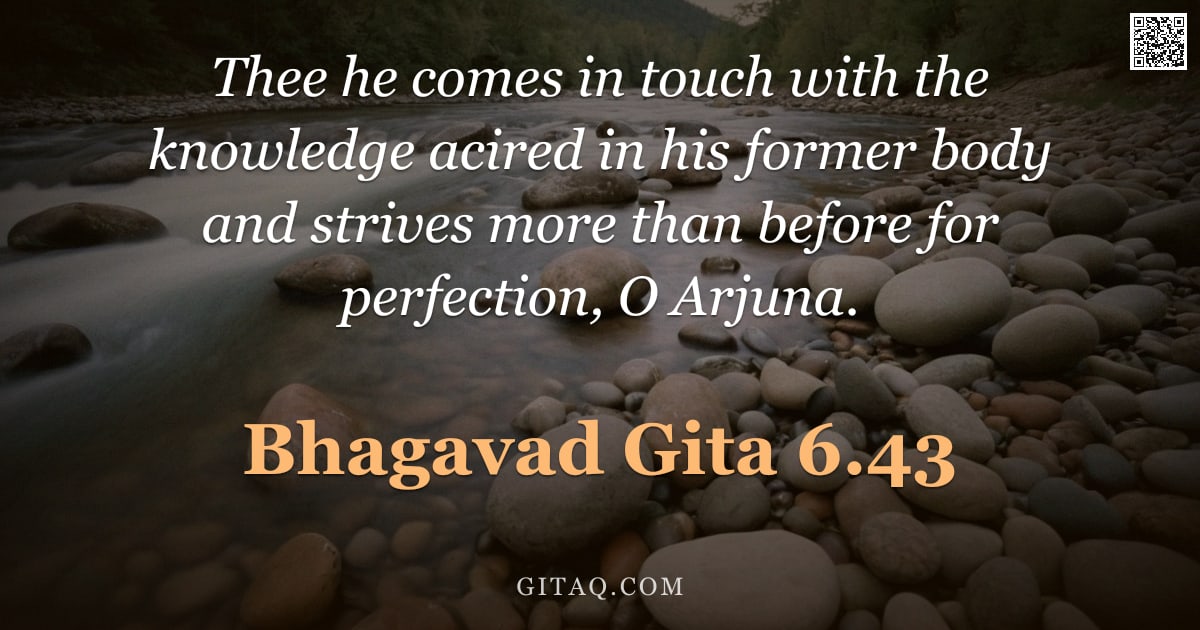
Bhagavad Gita 6.43
Dhyana Yoga · English Translation
तत्र तं बुद्धिसंयोगं लभते पौर्वदेहिकम् | यतते च ततो भूयः संसिद्धौ कुरुनन्दन ||६-४३||
tatra taṃ buddhisaṃyogaṃ labhate paurvadehikam . yatate ca tato bhūyaḥ saṃsiddhau kurunandana ||6-43||
What Does This Verse Mean?
In this verse, Lord Krishna explains to Arjuna what happens after a person who practiced meditation dies before achieving full perfection. It teaches that the spiritual progress made in one lifetime is never lost; instead, the soul carries forward its accumulated wisdom and intuitive understanding into the next life. As a result, that individual naturally feels drawn back to their spiritual path with even greater intensity than before. This assures seekers that every sincere effort toward self-realization contributes directly to their ultimate liberation.
The Teaching Behind It
This teaching belongs to the synthesis of Karma Yoga (action) and Dhyana Yoga (meditation), underpinned by the Sankhya philosophy of an eternal, indestructible Self. It develops the concept that spiritual consciousness is cumulative rather than transactional; the 'buddhi-samyoga' or union with intellect formed in past lives creates a permanent latent tendency (samskara) that propels the soul toward liberation without regression.
Word by Word
Classical Commentary
Where This Happens
This verse occurs within the Bhagavad Gita's sixth chapter, 'Dhyana Yoga,' spoken by Lord Krishna on the battlefield of Kurukshetra. At this moment in the dialogue, Arjuna is overwhelmed with doubt after hearing about the rigorous and difficult path of meditation; he worries that anyone who attempts it but fails will be lost forever. Krishna addresses these fears by assuring him that no spiritual effort is ever wasted, offering hope to those struggling with discipline or distracted by worldly life.
Living It Out Today
Consider a professional who begins learning Spanish for career advancement but has to pause their studies due to a sudden family emergency and moves to a new country. Years later, when they finally return to the language classroom, they do not feel like a complete beginner; instead, they recall vocabulary and grammar structures effortlessly and pick up speaking skills much faster than someone starting from scratch today. This verse applies directly: that period of interrupted effort was not wasted but created a subconscious foundation for future success.
Explained for Children
Imagine you are playing a video game where you save your progress after beating a difficult level but then have to log out for the night. When you come back tomorrow, you don't start from scratch; you remember all the skills you learned and can jump right into harder levels with more confidence than before. This verse is like that: it tells us that if we try hard to be good or meditate today but stop before finishing our goal, next time around (in a new life), we will already know what to do. We won't have to start from zero; we will just pick up right where we left off and get even better faster.
Daily Reflection
Have you ever felt like an old soul in a new body? This verse reminds us that the spiritual progress we make today is built upon seeds planted long ago, perhaps even before our current consciousness fully remembered them. Do not despair if your path seems difficult; know that your spirit remembers what it has learned and now possesses a unique strength to strive for perfection again.
A Practice for Today
Close your eyes and visualize the threads of wisdom you have gathered from past experiences, acknowledging that no effort is ever truly lost but merely stored for future growth. Breathe deeply, offering a silent gratitude to your higher self for carrying this accumulated insight forward into this current moment.
Key Teachings
- The Continuity of Consciousness
This verse establishes the spiritual law that consciousness is continuous across lifetimes, carrying forward its accumulated wisdom. It assures us that no spiritual practice is wasted; every moment of effort adds to a reservoir of latent knowledge. - The Power of Previous Accumulation
We are not starting from zero in this life but rather building upon the foundation laid by our 'former body.' This prior acquisition allows for an accelerated spiritual awakening and a natural inclination toward higher truths. - Sudden Acceleration of Effort
Once that stored wisdom is awakened, the seeker strives with renewed intensity ('bhūyaḥ') to achieve perfection. This dynamic creates a self-reinforcing cycle where past effort fuels present enthusiasm for spiritual realization.
Themes
Related Verses
Read This Next
- 2.13 — Read this to understand the fundamental concept of the soul changing bodies and continuing its journey.
- 6.40 — This preceding verse addresses doubts about those who fail, setting up the promise of grace found in 6.43.
- 12.5 — Read this to see how Krishna describes the difficulty and beauty of the path for one trying to realize the Self.
Recommended Reading
GitaQ earns from qualifying purchases as an Amazon Associate.