Bhagavad Gita 6.44
Dhyana Yoga · English Translation
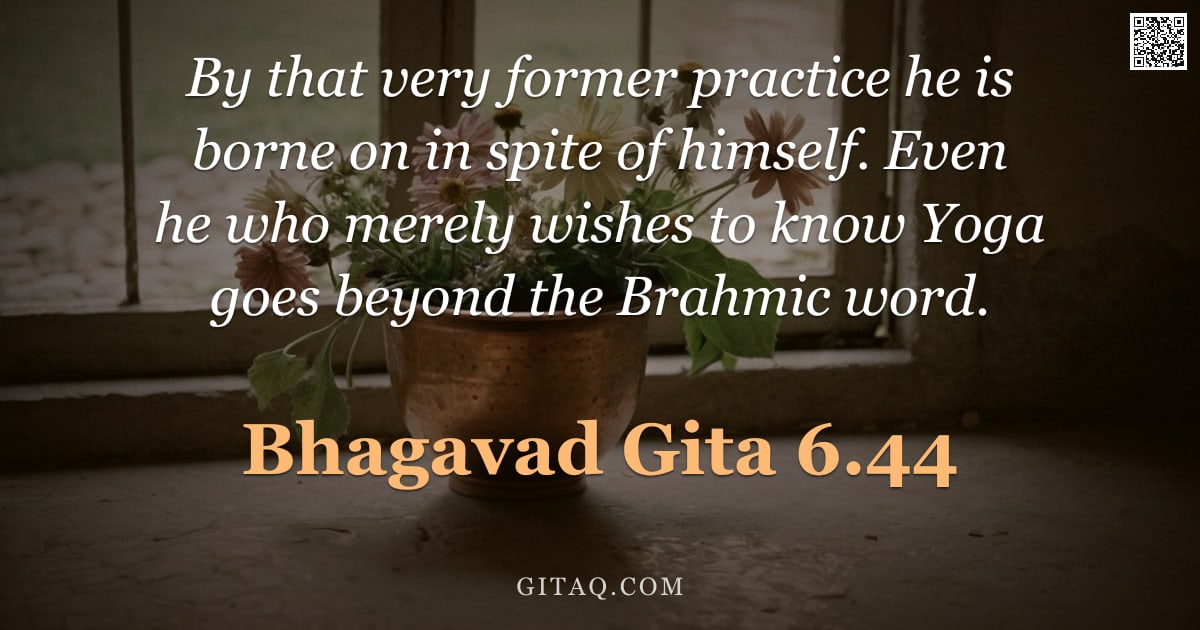
पूर्वाभ्यासेन तेनैव ह्रियते ह्यवशोऽपि सः | जिज्ञासुरपि योगस्य शब्दब्रह्मातिवर्तते ||६-४४||
pūrvābhyāsena tenaiva hriyate hyavaśo.api saḥ . jijñāsurapi yogasya śabdabrahmātivartate ||6-44||
What Does This Verse Mean?
Lord Krishna explains to Arjuna that a person who has previously practiced yoga but fell short will never lose the progress they made; their past efforts carry them forward automatically, even if they are struggling or unwilling at first. This verse assures us that spiritual practice is never wasted and creates an invisible momentum in our lives. Even someone just beginning with curiosity about Yoga is quickly drawn toward a deeper understanding of reality beyond mere words.
The Teaching Behind It
This teaching belongs primarily to the strand of Dhyana Yoga (the path of meditation) and supports the concept of Adhikara Bheda, or varying levels of spiritual eligibility based on past karma. It develops the principle that effort in yoga is cumulative and eternal; the soul's journey is a continuous stream where no positive action is ever lost to time.
Word by Word
Classical Commentary
Where This Happens
This verse appears in Chapter 6 of the Bhagavad Gita during Lord Krishna's conversation with Arjuna on the battlefield of Kurukshetra. At this point, Krishna has just finished explaining the difficulties and dangers that can arise for a yogi who loses their way or fails to reach perfection through meditation alone. He is speaking directly to Arjuna, who feels overwhelmed by his duty as a warrior but also deeply curious about the path of spiritual discipline (Dhyana Yoga). The context serves as Krishna's comforting reassurance that no sincere attempt at self-improvement ever goes unnoticed by the universe.
Living It Out Today
Consider a professional in their mid-40s who tried to establish a daily meditation routine five years ago but had to abandon it due to career demands and family stress. They may feel they have 'failed' or lost all progress, leading them to skip sessions for months. However, the moment they return with even a small intention to try again, their mind finds peace much faster than a complete beginner would; past neural pathways formed by that previous practice now work automatically in spite of their current anxiety. This verse validates that restarting is not starting from zero but resuming an existing flow.
Explained for Children
Imagine you learned to ride a bike last summer, but then stopped for a few months because it was raining. When the sun comes back out and you try again, your body remembers how to balance perfectly without you even thinking about it! Krishna is saying that if we ever tried to be kind or meditated in a past life (or earlier this year), our heart keeps those good habits inside us forever. So, don't worry if you feel like giving up; the practice you did before will gently push you forward again.
Daily Reflection
You may feel like you are struggling to make progress today, but remember that nothing in your spiritual journey is ever truly lost. Even a fleeting wish for connection sets a momentum within your soul that will eventually carry you beyond mere words and concepts. Trust that the efforts of your past self have already laid the foundation for this moment's awakening.
A Practice for Today
Close your eyes and gently recall a moment of sincere effort from the past, no matter how long ago it was. Visualize that seed of practice as an invisible current now carrying you forward through this very breath.
Key Teachings
- The Inevitability of Momentum
Sincere spiritual effort creates a force of habit (samskara) that propels us forward even when our conscious will falters. This verse assures seekers that no good attempt is ever wasted, as the momentum built in previous lives or earlier days becomes an automatic guide. - The Power of Aspiration
There is a profound distinction between mere intellectual curiosity and genuine spiritual desire; even the simple wish to know Yoga (jijñāsu) carries immense transformative power. This aspiration acts as the seed that eventually blossoms into direct realization, bypassing the limitations of scriptural study alone. - Transcending Scriptural Limits
While words and scriptures (śabda-brahma) are essential for beginners, true practice leads one beyond them to a direct experience of the divine. The ultimate goal is not just knowing about Yoga but becoming it through lived intuition that supersedes verbal definitions.
Themes
Related Verses
Read This Next
- 2.47 — To understand the foundational discipline of action without attachment that fuels this future practice.
- 3.30 — To see how dedicating all actions to the Divine creates the purity required for deeper meditation.
- 12.15 — To learn about the qualities of a devotee who has transcended duality and is beloved by Krishna, representing the fruit of this practice.
Recommended Reading
GitaQ earns from qualifying purchases as an Amazon Associate.