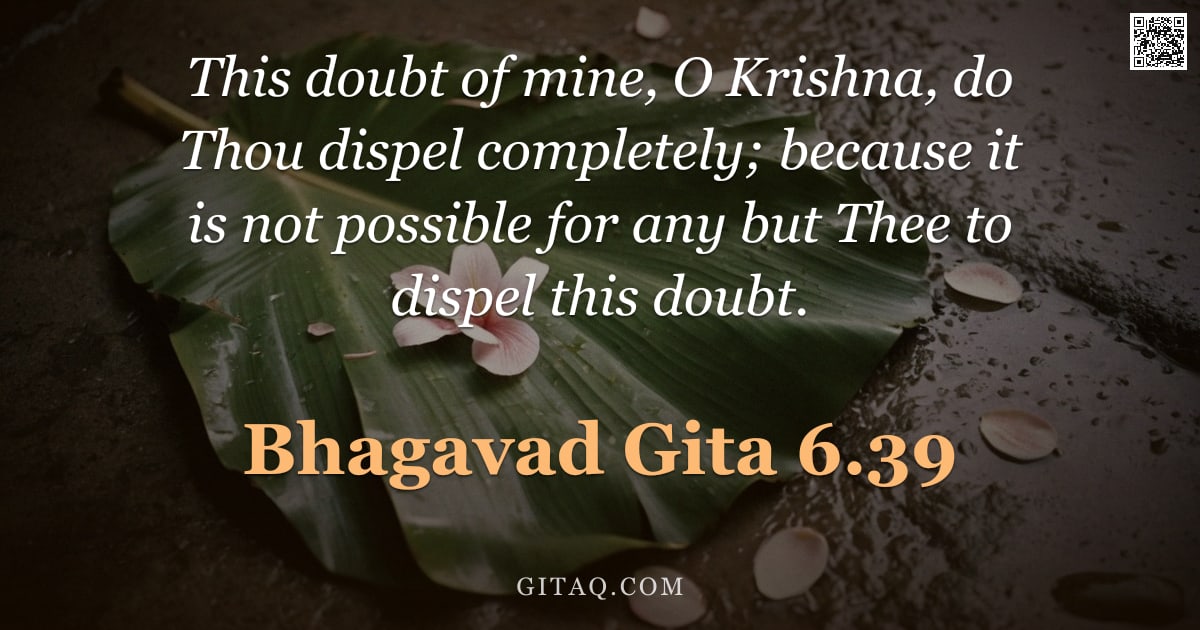
Bhagavad Gita 6.39
Dhyana Yoga · English Translation
एतन्मे संशयं कृष्ण छेत्तुमर्हस्यशेषतः | त्वदन्यः संशयस्यास्य छेत्ता न ह्युपपद्यते ||६-३९||
etanme saṃśayaṃ kṛṣṇa chettumarhasyaśeṣataḥ . tvadanyaḥ saṃśayasyāsya chettā na hyupapadyate ||6-39||
What Does This Verse Mean?
In this verse, Arjuna speaks directly to Lord Krishna, asking Him to remove the doubts clouding his mind after a deep discussion on meditation and spiritual practice. He acknowledges that while he has heard many teachings, only Krishna possesses the wisdom and authority to fully resolve these lingering uncertainties. The core teaching is that ultimate clarity comes not from one's own intellect alone, but through surrender and guidance from a true spiritual master or divine source.
The Teaching Behind It
This verse sits at the intersection of Dhyana Yoga (meditation) and Bhakti Yoga (devotion), highlighting that self-realization requires both personal effort and divine grace. It develops the concept of 'Acharya Prasad' or surrender to a spiritual preceptor, asserting that intellectual understanding alone is insufficient without the dispelling power of higher wisdom found in the Guru.
Word by Word
Classical Commentary
Where This Happens
This verse occurs during Chapter 6 of the Bhagavad Gita on the battlefield of Kurukshetra, immediately after Krishna has explained the difficult mechanics and challenges of Dhyana Yoga (meditation). Arjuna is feeling overwhelmed by a new doubt: if meditation fails or one falls from it due to lack of discipline, what happens to their spiritual progress? Speaking with deep humility, he turns to Krishna not just as his charioteer but as the Supreme Personality to resolve this existential anxiety about the fate of imperfect practitioners.
Living It Out Today
Consider a professional navigating a complex career change where they feel stuck between fear and ambition; despite reading books or listening to mentors, the internal doubt persists. Instead of trying to force a solution through sheer willpower, the individual recognizes their own limitations in that specific moment and seeks counsel from an experienced guide who has walked this path before. By trusting the expert's perspective completely, they gain the clarity needed to make a confident decision rather than remaining paralyzed by overthinking.
Explained for Children
Imagine you are lost in a big forest with a map that has some parts torn out; no matter how hard you look at the stars or think about it, you still don't know which way to go. Arjuna is like a kid who feels confused and asks his wise teacher (Krishna) for help because he knows only the teacher can show him the right path. He says, 'I trust you more than anyone else in the world; please tell me where I am going so I don't get lost anymore.'
Daily Reflection
It takes courage to admit when your own mind has led you astray and cannot untangle the knots of doubt. Today, try surrendering a specific worry not by trying harder to solve it yourself, but by trusting that there is wisdom greater than yours waiting to guide you through. You are never truly lost or alone in these moments of uncertainty.
A Practice for Today
Close your eyes and acknowledge any confusion or doubt arising within you, offering it silently to the Divine presence. Visualize this inner turmoil dissolving into a vast, silent space as you whisper 'You are my only refuge.' Rest in that certainty for three breaths, knowing no other force can resolve what is meant to be resolved by grace.
Key Teachings
- The Limits of Human Intellect
Arjuna's honest admission reveals that the ego and personal reasoning often circle endlessly around deep spiritual questions without resolution. True clarity requires stepping beyond the limited capacity of the individual mind. - Exclusive Reliance on the Divine
The verse establishes Krishna as the sole dispeller of profound doubt, highlighting a relationship where the seeker fully depends on the teacher and God. This exclusivity is not about diminishing others but recognizing the source of ultimate truth. - Honesty as a Spiritual Practice
The path to dispelling doubt begins with the courageous act of confessing it rather than hiding or pretending. Arjuna's vulnerability becomes the catalyst for receiving divine grace and guidance.
Themes
Related Verses
Read This Next
- 2.47 — Read this to understand how Krishna first addresses Arjuna's confusion by teaching detachment from results.
- 3.30 — This verse continues the theme of surrender, instructing one to offer all actions and their fruits to the Divine.
- 12.15 — Read this to see how Krishna describes those who are dear to Him because they cause no distress through doubt or fear.
Recommended Reading
GitaQ earns from qualifying purchases as an Amazon Associate.