Bhagavad Gita 6.24
Dhyana Yoga · English Translation
सङ्कल्पप्रभवान्कामांस्त्यक्त्वा सर्वानशेषतः | मनसैवेन्द्रियग्रामं विनियम्य समन्ततः ||६-२४||
saṅkalpaprabhavānkāmāṃstyaktvā sarvānaśeṣataḥ . manasaivendriyagrāmaṃ viniyamya samantataḥ ||6-24||
What Does This Verse Mean?
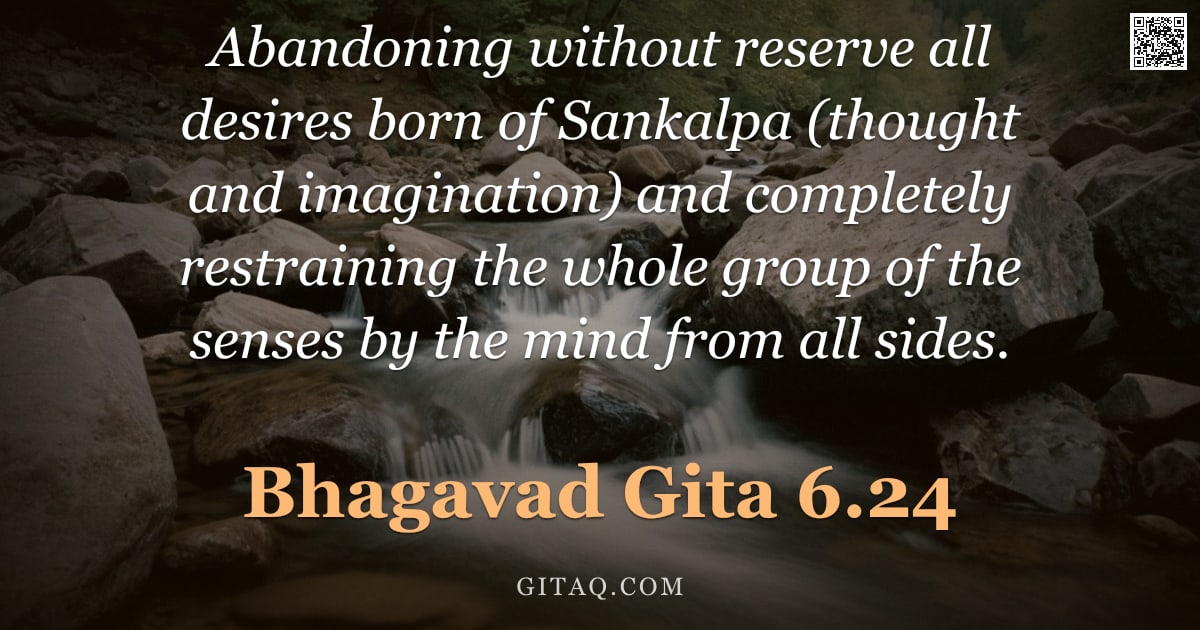
In this verse, Lord Krishna instructs Arjuna on the final steps of entering deep meditation. He teaches that before one can truly focus the mind, all desires born from mental imagination and speculation must be completely abandoned without exception. The practitioner must then use their own intellect to strictly control every sense organ in all directions, preventing them from wandering outward toward distractions.
The Teaching Behind It
This verse is central to Dhyana Yoga (the path of meditation) within the broader framework of Karma Yoga and Sankhya philosophy. It develops the critical concept that true yoga requires not just physical posture, but the total subjugation of the mind over the senses by cutting off the root of desire: imaginative speculation.
Word by Word
Classical Commentary
Where This Happens
This verse appears in Chapter 6 of the Bhagavad Gita, where Lord Krishna is addressing Arjuna amidst the tension of the Kurukshetra battlefield. After explaining the nature of yoga and the qualified practitioner in previous verses, Krishna now provides specific technical instructions on how to begin the practice of meditation (Dhyana Yoga). At this moment, Arjuna has just agreed to fight but still feels overwhelmed by confusion; he is seeking practical methods to steady his mind amidst chaos.
Living It Out Today
Consider a professional facing a high-stakes negotiation where their anxiety triggers intrusive thoughts about 'what if I fail' or imagining scenarios that haven't happened yet. This verse advises them to first consciously discard those imagined outcomes (Sankalpa) and then deliberately pull the focus of their eyes, ears, and nervous system back into the present moment. By doing this, they stop leaking energy toward phantom problems and gain the mental clarity required to make a sound decision right now.
Explained for Children
Imagine your brain is like a garden full of colorful flowers (your thoughts). Sometimes, we imagine things that aren't real yet—like wishing for a giant ice cream mountain—and this makes it hard to listen or play. To have a quiet mind, Krishna says you need to gently put away all those pretend wishes and hold the reins tight on your five senses (eyes, ears, etc.) so they don't run off looking at everything outside.
Daily Reflection
You often find yourself restless not because of what you lack, but because your own imagination has conjured endless 'what-ifs' that feel urgent and real today. This verse invites you to pause before reacting to those fleeting impulses born from Sankalpa, realizing they are just mental projections rather than necessities. When you choose to restrain the senses with a steady mind instead of giving them free rein, you discover a profound inner stillness waiting beneath the noise.
A Practice for Today
Close your eyes and gently trace the origin of any rising desire to its source—the initial thought that sparked it. With each breath, visualize dissolving these imagined cravings by turning the mind inward like a shield against external pulls. Rest in this silence where the senses are no longer chasing but are held firmly within.
Key Teachings
- The Root of Suffering is Imagination
Desires are not external forces but are born internally from our own 'Sankalpa' or creative thought. By identifying that suffering stems from imagined futures rather than present reality, we can begin to cut the root cause. - The Mind as the Ultimate Restraint
True control over the senses does not come through force but by using the mind itself as a guardian and filter. When the intellect is trained, it naturally withdraws the senses from their chaotic engagement with the world. - The Necessity of Total Renunciation
Partial effort to control desire often fails; the verse demands abandoning all cravings born of thought 'without reserve.' This complete internal surrender creates a state of total equilibrium where no part of the self is pulled outward.
Themes
Related Verses
Read This Next
- 2.47 — This verse follows up by clarifying that one's focus must remain on duty rather than the fruits, which are often fueled by the very desires mentioned in Chapter 6.
- 3.30 — It expands on the mechanism of detachment, teaching to offer all actions and their results back to the Divine as a form of surrendering the ego's claims.
- 12.15 — To conclude this study path, read how Krishna describes the ideal devotee who is not disturbed by others' disturbances, reflecting the stability achieved in Chapter 6.
Recommended Reading
GitaQ earns from qualifying purchases as an Amazon Associate.