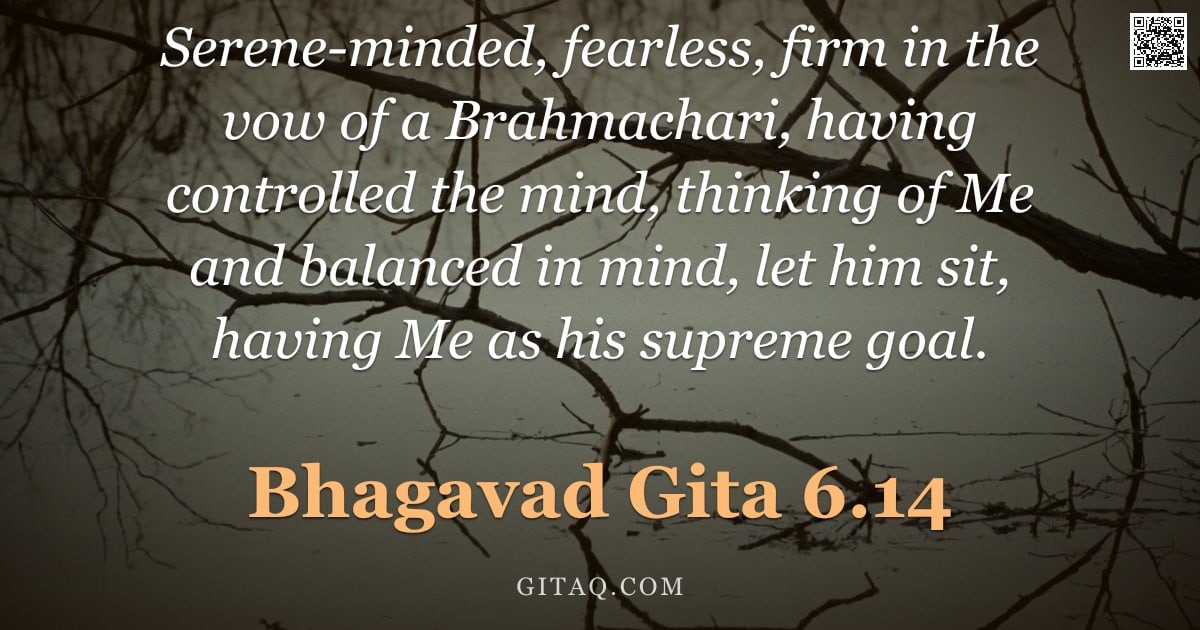
Bhagavad Gita 6.14
Dhyana Yoga · English Translation
प्रशान्तात्मा विगतभीर्ब्रह्मचारिव्रते स्थितः | मनः संयम्य मच्चित्तो युक्त आसीत मत्परः ||६-१४||
praśāntātmā vigatabhīrbrahmacārivrate sthitaḥ . manaḥ saṃyamya maccitto yukta āsīta matparaḥ ||6-14||
What Does This Verse Mean?
In this verse, Lord Krishna instructs Arjuna on the essential mental state required for successful meditation. He describes a meditator as someone who is calm and free from fear, committed to self-discipline, and whose mind is fully focused on the Divine. The core teaching is that true spiritual practice requires inner stability, emotional control, and making God the ultimate priority in one's life.
The Teaching Behind It
This verse is central to Dhyana Yoga (the yoga of meditation) and integrates elements of Bhakti Yoga by establishing 'Machitta' (thinking on Me). It develops the concept that mental discipline and self-control are prerequisites for realizing the Self, as a restless mind cannot perceive the Divine. The teaching emphasizes that true balance arises not from suppressing emotions but from grounding them in spiritual devotion.
Word by Word
Classical Commentary
Where This Happens
This verse occurs during the Bhagavad Gita's sixth chapter, 'Dhyana Yoga,' where Krishna is detailing the practical steps of meditation for Arjuna on the battlefield of Kurukshetra. After explaining that one must be detached from material outcomes in previous chapters, Krishna now outlines the specific character traits and physical posture needed to stabilize the mind. Arjuna, who was previously overwhelmed by grief and confusion about fighting his kinsmen, is being guided toward an internal state where he can find clarity amidst external chaos.
Living It Out Today
Consider a professional facing a high-stakes presentation or crisis management scenario; instead of panicking from fear (vigatabhīḥ), they first pause to calm their nervous system and center their thoughts on the ultimate goal rather than immediate failure. By consciously controlling distractions (manas-samyamya) and maintaining ethical integrity in their approach, they achieve a state of flow where they can execute decisions with clarity. This shift from anxiety to serene focus allows them to navigate complex challenges effectively, just as the Gita advises balancing action with inner devotion.
Explained for Children
Imagine you are trying to take a really important photo of a butterfly; if your hands shake or you feel scared, it won't work well. Krishna says being ready for meditation is like having steady hands: you need to be calm inside, not afraid of anything, and keep all your focus on one special thing (like God) without letting your mind wander off to play. When you are brave and quiet in your heart, sitting still becomes easy and happy.
Daily Reflection
You find true courage not by shouting down the noise around you, but by cultivating an internal quietude where fear cannot take root. When you anchor your mind in something greater than yourself, the chaotic fluctuations of daily life lose their power to disturb your heart's stillness. Today, try to move through your tasks with a gentle firmness, knowing that your peace is not dependent on external circumstances but flows from within.
A Practice for Today
Begin by closing your eyes and taking three deep breaths, consciously releasing any fear that arises from the day's events. Visualize yourself as a student of inner peace, firmly rooted in simplicity and silence while gently guiding your scattered thoughts back to a single point of devotion.
Key Teachings
- The Foundation of Fearlessness
True fearlessness (vigatabhī) arises naturally when one lives with integrity and has no cause for regret or anxiety. It is the state of a mind that knows it is protected by its own purity rather than external shields. - The Discipline of Simplicity
Firmness in the vow of Brahmacharya represents more than physical restraint; it signifies channeling all vital energy toward spiritual realization. This conservation of life force creates a stability that allows the practitioner to stand firm against worldly distractions. - The Balance of Devotion
Meditation requires a dual focus: internal control through mastering the mind and external orientation by fixing consciousness on the Divine. This balance transforms meditation from mere concentration into a dynamic state of loving surrender to the Supreme Goal.
Themes
Related Verses
Read This Next
- 2.47 — To understand how to perform one's duty without attachment, which supports the 'fearless' aspect of this verse.
- 3.30 — To deepen the understanding of surrendering all actions and their fruits as a path to mental equilibrium.
- 12.15 — To see how Krishna describes the qualities of His dear devotees who embody the very serenity and fearlessness described here.
Recommended Reading
GitaQ earns from qualifying purchases as an Amazon Associate.