Bhagavad Gita 5.20
Karma Sanyasa Yoga · English Translation
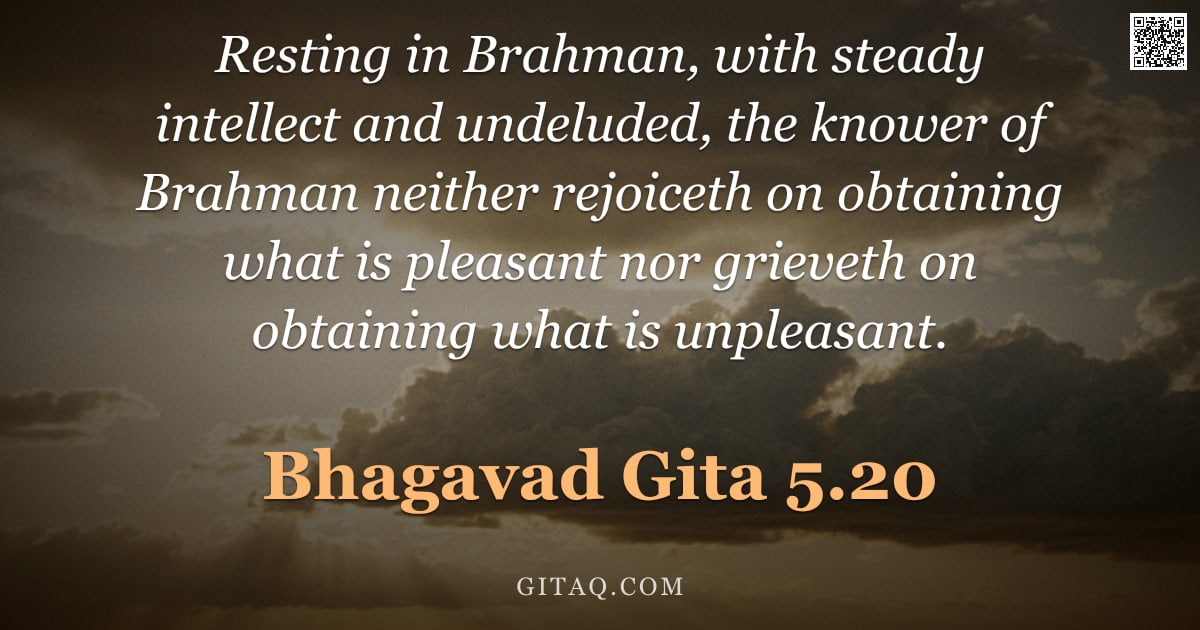
न प्रहृष्येत्प्रियं प्राप्य नोद्विजेत्प्राप्य चाप्रियम् | स्थिरबुद्धिरसम्मूढो ब्रह्मविद् ब्रह्मणि स्थितः ||५-२०||
na prahṛṣyetpriyaṃ prāpya nodvijetprāpya cāpriyam . sthirabuddhirasammūḍho brahmavid brahmaṇi sthitaḥ ||5-20||
What Does This Verse Mean?
In this verse, Lord Krishna describes the state of a person who has realized their true nature as Brahman (the ultimate reality). Such a wise individual maintains perfect emotional balance, remaining neither overjoyed by gaining something pleasant nor depressed when facing something unpleasant. This stability comes from having a steady intellect and understanding that temporary experiences do not define one's eternal self.
The Teaching Behind It
This verse synthesizes Karma Yoga (action without attachment) with Jnana Yoga (knowledge of the self), illustrating that true renunciation is an internal state rather than just external action. It develops the concept of 'Sthira Buddhi' or steady intellect, which is essential for a knower of Brahman to remain established in the Absolute while engaging with the world.
Word by Word
Classical Commentary
Where This Happens
This teaching occurs on the battlefield of Kurukshetra during the Mahabharata war, where Arjuna has just laid down his weapons in despair over fighting his own relatives and teachers. Krishna has been guiding him through various philosophies to overcome this confusion and attachment to outcomes. Here, specifically within Chapter 5 titled 'Karma Sanyasa Yoga', Krishna is defining the qualities of a true sage (sthitaprajna) who has transcended dualities like pleasure and pain.
Living It Out Today
Consider a professional facing an unexpected job rejection after working hard for months; instead of spiraling into self-doubt or anger, they remain grounded by understanding their worth is not tied to this single outcome. Similarly, when the same person receives a sudden promotion, they do not become arrogant or lose sleep over maintaining status, but continue with steady focus on duty and service.
Explained for Children
Imagine you are playing your favorite game and suddenly win, or maybe you lose a round; both make you feel strong emotions in the moment. But think of a calm friend who knows they will be fine no matter what happens next—they don't get too excited when winning because it's just one game, and they don't cry over losing because they know tomorrow is another day to try again. This verse teaches us that true strength is staying happy inside even when outside things change.
Daily Reflection
Today, notice how often you tie your happiness to external events getting just right for you. The path to peace isn't about controlling every outcome, but cultivating a steady mind that remains grounded whether life brings gifts or challenges. When you stop reacting with immediate joy or grief, you discover the unshakeable calm of Brahman within.
A Practice for Today
Close your eyes and visualize a stone resting firmly on the riverbank, unmoved whether water rushes over it gently or crashes against it with force. In this stillness, acknowledge that your true nature is not the shifting waves of pleasure or pain, but the silent awareness beneath them all.
Key Teachings
- The Stability of Steady Intellect
A true knower possesses a 'sthirabuddhi,' an intellect that does not waver based on fleeting sensory inputs. This steadiness allows one to remain centered regardless of whether the world offers pleasant or unpleasant experiences. - Transcending Dualities
The verse instructs us to cease the cycle of excessive rejoicing at gain and intense distress over loss, recognizing both as temporary fluctuations. By transcending these dualities, we free ourselves from the emotional volatility that binds consciousness. - Abiding in Brahman
The state described is not merely self-control but a profound realization where one rests established in the Absolute (Brahma). This establishes that true freedom comes from identifying with the eternal Self rather than the transient body-mind complex. - Freedom from Delusion
The knower of Brahman is described as 'asammudha,' meaning free from confusion about what is real and what is illusory. This clarity ensures that one's actions are never driven by the delusion that pleasure or pain defines their existence.
Themes
Related Verses
Read This Next
- 2.47 — This verse complements the current teaching by instructing one to focus on duty without attachment to results.
- 3.30 — Reading this next shows how offering all actions to the Divine helps maintain that steady intellect during active engagement in life.
- 12.15 — This verse describes a devotee who is dear to Krishna precisely because they are free from agitation, mirroring the state of stability described here.
Recommended Reading
GitaQ earns from qualifying purchases as an Amazon Associate.