Bhagavad Gita 5.21
Karma Sanyasa Yoga · English Translation
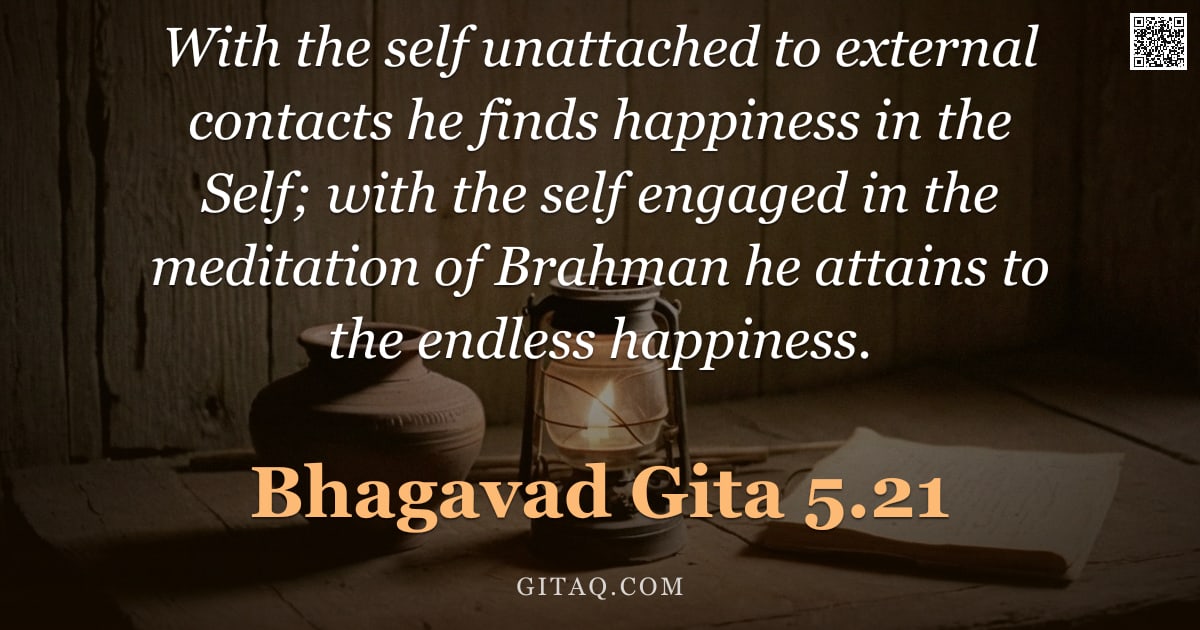
बाह्यस्पर्शेष्वसक्तात्मा विन्दत्यात्मनि यत्सुखम् | स ब्रह्मयोगयुक्तात्मा सुखमक्षयमश्नुते ||५-२१||
bāhyasparśeṣvasaktātmā vindatyātmani yatsukham . sa brahmayogayuktātmā sukhamakṣayamaśnute ||5-21||
What Does This Verse Mean?
In this verse, Lord Krishna explains to the confused warrior Arjuna how a wise person finds true happiness by withdrawing their senses from external distractions and finding joy within themselves instead of relying on fleeting worldly pleasures. The key teaching is that when one detaches from sense objects like sights or sounds, they discover an inner peace that does not depend on changing circumstances. This state of being connected with the divine through meditation leads to a lasting happiness that never diminishes.
The Teaching Behind It
This verse is central to the synthesis of Jnana Yoga (the path of knowledge) and Dhyana Yoga (meditation), specifically illustrating how self-knowledge leads to liberation from sense bondage. It develops the concept that true bliss (Ananda) is inherent in the Atman (Self) rather than being an external object to be acquired, aligning with the Vedantic teaching of Brahman as the source of endless joy.
Word by Word
Classical Commentary
Where This Happens
This verse is spoken by Lord Krishna on the battlefield of Kurukshetra during the great war described in the Mahabharata. He has just finished explaining to Arjuna the difference between renouncing actions and performing them with detachment, a concept known as Karma Sanyasa Yoga. Arjuna, who was previously overwhelmed by grief and attachment to his relatives on the opposing side, is now being guided toward a state of mental equilibrium where external chaos cannot disturb his inner peace.
Living It Out Today
Consider a professional facing sudden layoffs or intense pressure at work; instead of letting their self-worth crumble based on job titles or immediate feedback (external contacts), they can anchor themselves in their intrinsic values and skills. By shifting focus from the anxiety of 'what will happen next' to the stability of 'who I am,' the individual finds a reservoir of calm that allows them to make clear decisions without panic. This internal shift transforms a crisis into an opportunity for growth, ensuring emotional resilience regardless of external outcomes.
Explained for Children
Imagine you are at a loud and crowded party where everyone is shouting and running around; it might feel scary or exhausting, but if you close your eyes and find a quiet corner inside your heart, you can feel calm no matter what is happening outside. This verse teaches that the happiest people aren't those who always have new toys or games to play with, but those who know how to be happy from within themselves without needing anything else. When we learn to enjoy our own company and stay peaceful like a quiet lake even when the wind blows hard, we find a special kind of happiness that never goes away.
Daily Reflection
In our rush to find joy in what we see or hear around us, it is easy to feel unsettled when circumstances change. You are invited today to discover that a deeper happiness exists right inside you, independent of the noise outside. When you anchor your awareness there, you will notice how this inner stability brings an unshakeable and endless peace.
A Practice for Today
Close your eyes and gently withdraw your senses from external sounds, sights, and sensations for a moment. Turn your awareness inward to the quiet space within where true peace resides, undisturbed by outside events.
Key Teachings
- Detachment from Sensory Objects
True freedom begins when the mind ceases to cling or recoil at external sensory contacts. By not letting happiness depend on what we see, hear, or touch, we break the cycle of constant craving. - The Source of Inner Bliss
This verse reveals that genuine joy is found by turning inward to find the Self rather than looking outward. It teaches us that our essential nature is a reservoir of happiness available whenever we look within. - Union with Brahman as Eternal Peace
When one remains established in this inner self, they are effectively engaged in the yoga of union with the Divine. This state leads to an inexhaustible bliss that cannot be diminished by time or change.
Themes
Related Verses
Read This Next
- 2.47 — Read this to understand how performing duty without attachment creates the necessary stability for inner focus.
- 3.30 — This verse complements 5.21 by offering a practical method of dedicating all actions to God, reducing external distraction.
- 12.15 — Read this next to see how a person who finds happiness in the Self becomes dear to Krishna and peaceful for others.
Recommended Reading
GitaQ earns from qualifying purchases as an Amazon Associate.