Bhagavad Gita 4.42
Jnana Karma Sanyasa Yoga · English Translation
तस्मादज्ञानसम्भूतं हृत्स्थं ज्ञानासिनात्मनः | छित्त्वैनं संशयं योगमातिष्ठोत्तिष्ठ भारत ||४-४२||
tasmādajñānasambhūtaṃ hṛtsthaṃ jñānāsinātmanaḥ . chittvainaṃ saṃśayaṃ yogamātiṣṭhottiṣṭha bhārata ||4-42||
What Does This Verse Mean?
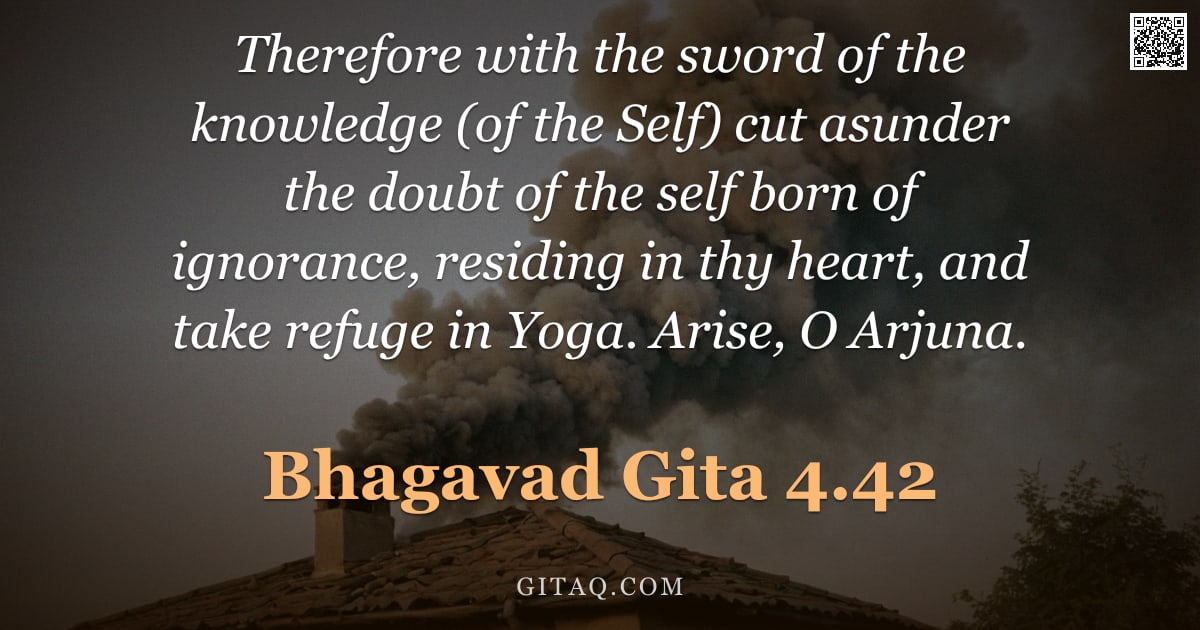
In this verse, Lord Krishna urges Arjuna to eliminate the doubt clouding his mind by using knowledge as a sharp sword. He explains that uncertainty arises from ignorance about one's true nature and can only be cut away through spiritual wisdom. Once this confusion is removed, Arjuna should firmly establish himself in Yoga (spiritual discipline) and rise up with confidence. This teaching emphasizes that clarity of thought is the prerequisite for taking decisive action.
The Teaching Behind It
This verse belongs primarily to Jnana Yoga (the path of knowledge), which is essential for clearing obstacles before one can fully practice Karma Yoga or Bhakti. It develops the concept that 'Avidya' (ignorance) is the root cause of all suffering and hesitation, and only direct realization ('Vidya') acts as the weapon to destroy it.
Word by Word
Classical Commentary
Where This Happens
This verse occurs on the battlefield of Kurukshetra within Chapter 4, a section dedicated to imparting spiritual knowledge (Jnana Yoga). Lord Krishna has just finished explaining the science of yoga and how he appears across ages. Arjuna is still struggling with deep confusion regarding his duty as a warrior versus his personal attachments to family members on the opposing side. The 'doubt' mentioned here refers specifically to this paralyzing hesitation before taking up arms.
Living It Out Today
Consider a professional who has been offered a promotion that requires relocating, but they are paralyzed by fear of failure and uncertainty about their future stability. Instead of letting anxiety keep them stuck in indecision for months, they should study the facts to understand that change is natural and apply knowledge (skill-building) as a tool to cut through the 'fog' of irrational fear. By doing so, they can confidently accept the challenge, trusting in their ability to adapt rather than staying comfortable but stagnant.
Explained for Children
Imagine you are standing at a fork in the road during a storm, unsure which path to take because it's so foggy. That fog represents confusion born from not knowing things clearly. Krishna tells us to use our knowledge like a bright flashlight or a sharp sword to cut through that fog and see exactly where we need to go. Once you know for sure what is right, don't stand still in the rain; get up confidently and walk your path!
Daily Reflection
Do you feel stuck by uncertainty about which direction to take? That hesitation is not a sign of weakness but often stems from hidden ignorance clouding your true nature. By applying the sharp blade of self-knowledge, you can slice through that fog and find clarity in who you really are. Once doubt is gone, simply step forward with devotion into the yoga of action.
A Practice for Today
Sit quietly and visualize a sharp, luminous sword of wisdom resting within your heart. Silently invoke the courage to cut through any doubt or confusion that clouds your path today. Then, gently place your trust in steady action and rise with purpose.
Key Teachings
- The Sword of Knowledge
Intellectual understanding alone cannot remove deep-seated doubts; one must wield knowledge as a decisive weapon. This wisdom is not abstract but a practical tool designed to sever the root of confusion instantly. - Ignorance Resides in the Heart
Doubt is born from ignorance and takes up residence within our emotional center, creating hesitation against our true potential. This internal barrier must be identified as foreign to the Self before it can be removed. - Arise into Action
The removal of doubt is not an end in itself but a preparation for immediate engagement with life's duties. Krishna urges Arjuna not to remain passive after gaining clarity, but to rise and perform his yoga.
Themes
Related Verses
Read This Next
- 2.47 — Establishes the foundational principle of acting without attachment after doubt is removed.
- 3.30 — Reinforces the instruction to dedicate all actions and surrender them, deepening the practice of Yoga mentioned here.
- 12.15 — Describes the qualities of a devotee who has overcome doubt through devotion, complementing the call to 'arise' in this verse.
Recommended Reading
GitaQ earns from qualifying purchases as an Amazon Associate.