Bhagavad Gita 4.40
Jnana Karma Sanyasa Yoga · English Translation
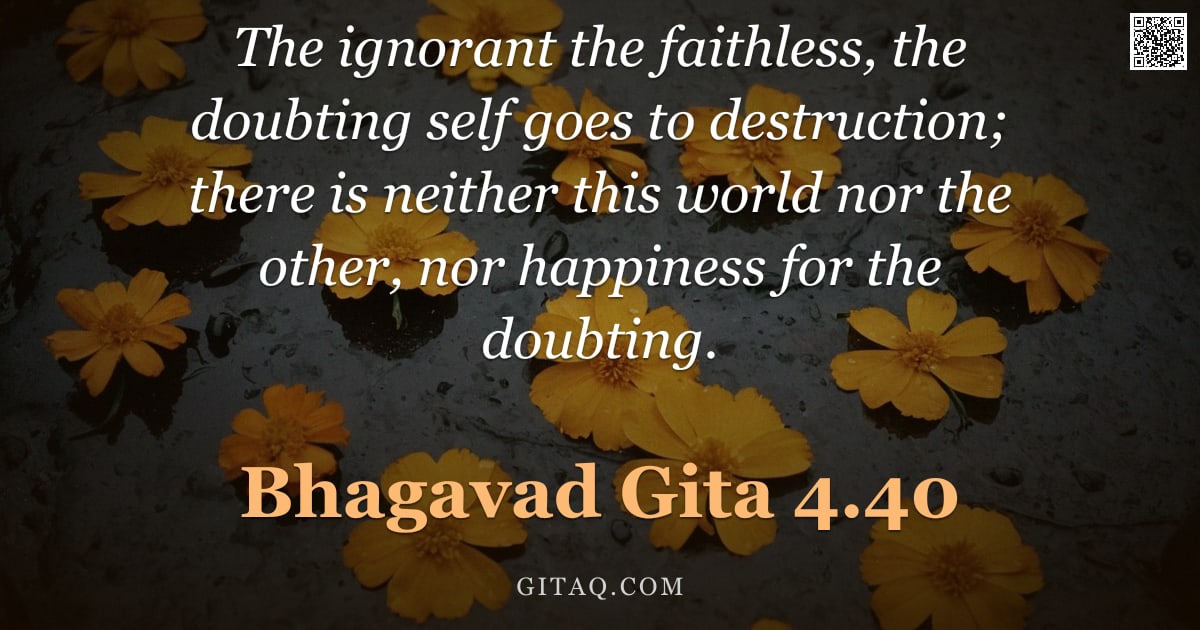
अज्ञश्चाश्रद्दधानश्च संशयात्मा विनश्यति | नायं लोकोऽस्ति न परो न सुखं संशयात्मनः ||४-४०||
ajñaścāśraddadhānaśca saṃśayātmā vinaśyati . nāyaṃ loko.asti na paro na sukhaṃ saṃśayātmanaḥ ||4-40||
What Does This Verse Mean?
In this verse, Lord Krishna warns Arjuna that a person who lacks knowledge, faith, and confidence will ultimately fail to find success or peace. The core teaching is that doubt acts as a destructive force, preventing one from experiencing happiness in either their current life or any future existence. Without firm conviction and action based on spiritual wisdom, the mind remains trapped in uncertainty.
The Teaching Behind It
This teaching belongs primarily to the path of Jnana Yoga (Knowledge), emphasizing that intellectual clarity and faith are prerequisites for spiritual realization. It develops the concept that doubt is an obstacle (vighna) rooted in ignorance, which severs the connection between the individual self and the ultimate reality.
Word by Word
Classical Commentary
Where This Happens
This verse appears during a critical moment on the battlefield of Kurukshetra where Lord Krishna is instructing his friend Arjuna, who has fallen into deep despair and hesitation before the war. After explaining the eternal nature of the soul in previous chapters, Krishna addresses the specific obstacle of 'samyasa' (doubt) that prevents spiritual progress. At this point, Arjuna is overwhelmed by emotional attachment to his relatives, causing him to question whether fighting for righteousness is actually right.
Living It Out Today
Consider a professional who knows they are qualified for a promotion but hesitates because of 'imposter syndrome' and fear of failure; their constant doubt prevents them from submitting the application or performing at their best. This verse teaches that such hesitation leads to stagnation, where one misses out on career growth (this world) and personal fulfillment (the other). Overcoming this requires taking a decisive step based on self-trust rather than waiting for perfect certainty.
Explained for Children
Imagine you are trying to answer a question on a test but your brain keeps whispering 'Maybe I'm wrong' over and over again; eventually, you get so confused that you can't write down any answers at all. This verse is like telling us that if we let doubt take control of our minds, we won't be able to find happiness or do good things in this world or the next. Krishna says that having faith and knowing what is right helps us move forward confidently instead of getting stuck.
Daily Reflection
You may find yourself paralyzed not by external obstacles, but by an internal voice whispering that you are unworthy or lost. This verse gently reminds you that doubt is not just a lack of faith, but a barrier that cuts you off from peace and joy here and now. When you choose to let go of the need for absolute certainty before acting, you open yourself to the flow of grace.
A Practice for Today
Rest your mind in stillness and ask yourself, 'Where am I letting doubt cloud my vision today?' Imagine a clear sky above the storm of uncertainty; allow that clarity to replace fear with trust in the divine order.
Key Teachings
- The Threefold Barrier
Destruction arises when ignorance, lack of faith, and self-doubt converge in one person. These three states prevent the seeker from engaging with spiritual truth or finding happiness. - The Illusion of Doubt
Doubt creates a false reality where neither this world nor the next offers any true solace to the doubter. It traps the mind in a cycle of indecision that blocks all paths to liberation. - The Necessity of Faith
True faith is not blind belief but an active trust that dissolves the paralysis of uncertainty. Without this anchor, even spiritual knowledge remains inaccessible and ineffective for the seeker.
Themes
Related Verses
Read This Next
- 2.47 — Follows up on the duty of action without attachment, which is impossible when doubt dominates.
- 3.30 — Reinforces surrender as the antidote to anxiety and indecision in performing one's duties.
- 12.15 — Describes the qualities of a beloved devotee, showing how faith leads to peace rather than destruction.
Recommended Reading
GitaQ earns from qualifying purchases as an Amazon Associate.