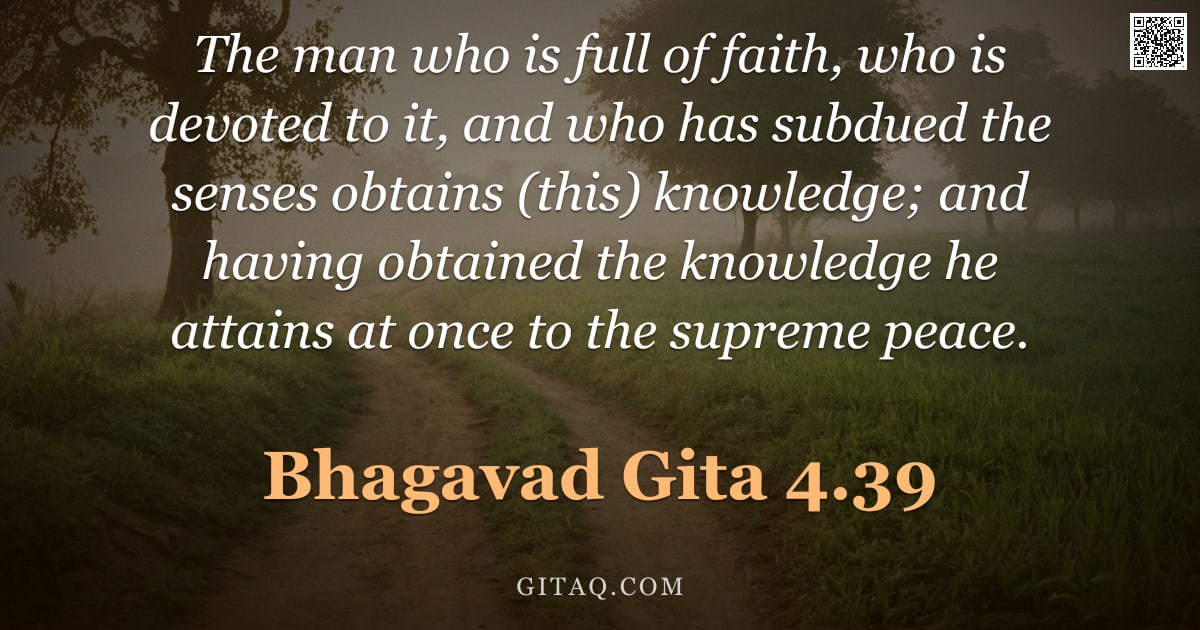
Bhagavad Gita 4.39
Jnana Karma Sanyasa Yoga · English Translation
श्रद्धावाँल्लभते ज्ञानं तत्परः संयतेन्द्रियः | ज्ञानं लब्ध्वा परां शान्तिमचिरेणाधिगच्छति ||४-३९||
śraddhāvā.Nllabhate jñānaṃ tatparaḥ saṃyatendriyaḥ . jñānaṃ labdhvā parāṃ śāntimacireṇādhigacchati ||4-39||
What Does This Verse Mean?
Lord Krishna tells Arjuna that true spiritual knowledge is only accessible to those who possess deep faith, wholehearted devotion, and control over their senses. He explains that such a person does not just learn about the truth intellectually but internalizes it through disciplined living. Once this inner wisdom takes root, the seeker immediately experiences profound peace of mind, free from anxiety or confusion.
The Teaching Behind It
This verse sits at the intersection of Bhakti Yoga (devotion) and Jnana Yoga (knowledge), emphasizing that devotion is the essential gateway to true wisdom. It develops the concept that intellectual understanding alone is insufficient; knowledge must be coupled with spiritual faith and sensory discipline to yield 'parama shanti' or supreme peace.
Word by Word
Classical Commentary
Where This Happens
This teaching occurs during Chapter 4 of the Bhagavad Gita on the battlefield of Kurukshetra, where Prince Arjuna is paralyzed by grief and moral confusion. Krishna has just revealed the secret of His divine nature and how knowledge transcends ritualistic actions to bring liberation. Arjuna's mind is still clouded with doubt about his duty as a warrior versus the sin of killing kin, making him receptive to this promise that faith brings immediate clarity.
Living It Out Today
Consider a professional facing an unexpected career crisis where they must choose between staying in a familiar but unfulfilling role or starting a new venture. By maintaining deep belief in their ability (faith), focusing entirely on the necessary steps rather than worrying about others' opinions (subdued senses), and committing fully to this path, they can cut through their confusion instantly. Instead of spiraling into anxiety over the unknown, they will find an immediate sense of inner calm that allows them to make clear decisions.
Explained for Children
Imagine you want to solve a really hard puzzle; if you are sure you can do it (faith), stay focused on solving it without looking at toys around you (subduing senses), and keep trying with all your heart (devotion), the answer will suddenly click! When that happens, you feel so happy and calm inside. This verse teaches us that having faith and controlling what we see or touch helps our minds understand big truths quickly.
Daily Reflection
You might feel that you need more knowledge or better circumstances before peace can find you, but Krishna reveals that faith and self-restraint are actually the very keys to unlocking it. When you align your senses with a sincere heart, the noise of doubt quiets down, allowing supreme tranquility to arise naturally within you today.
A Practice for Today
Begin by settling into stillness and silently affirming your own capacity for faith, not as a blind belief but as a deep trust in the path of wisdom. Visualize your senses turning inward like arrows returning to their quiver, finding rest within this devotion rather than scattering outward.
Key Teachings
- Faith as the Foundation
True knowledge does not emerge from intellectual skepticism alone but requires śraddhā, a firm and active faith in the possibility of liberation. This initial trust acts as the fertile soil without which the seeds of wisdom cannot sprout or take root. - The Discipline of Senses
Obtaining knowledge is not merely an intellectual exercise but requires saṃyata, a deliberate subduing and mastery over the restless senses. When the mind is no longer dragged outward by sensory impulses, it becomes stable enough to receive higher truths. - Peace as the Immediate Fruit
The ultimate result of gaining this wisdom is not power or status but śānti, a supreme and enduring peace that follows instantly upon realization. This tranquility is not dependent on external conditions but arises from within once ignorance is dispelled by true understanding.
Themes
Related Verses
Read This Next
- 2.47 — Read this next to understand how right action without attachment supports the discipline required for gaining knowledge.
- 3.30 — This verse expands on surrendering actions, showing how devotion leads to the purification of mind necessary for wisdom.
- 12.15 — Read this to see Krishna describing those who have attained supreme peace and become dear to all beings through their detachment.
Recommended Reading
GitaQ earns from qualifying purchases as an Amazon Associate.