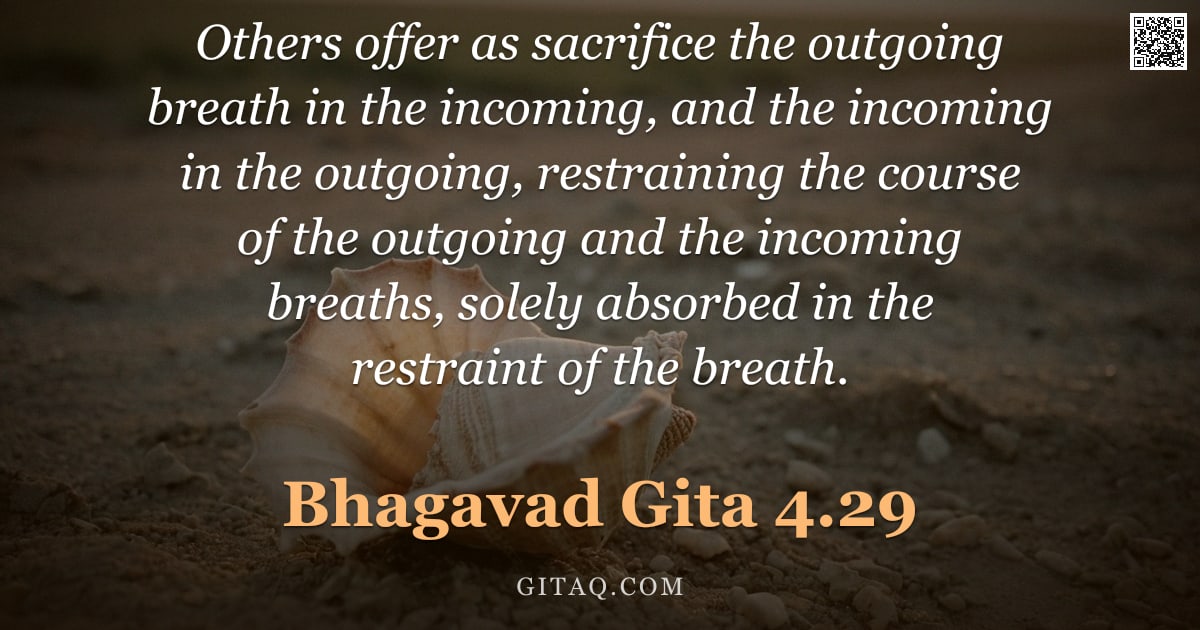
Bhagavad Gita 4.29
Jnana Karma Sanyasa Yoga · English Translation
अपाने जुह्वति प्राणं प्राणेऽपानं तथापरे | प्राणापानगती रुद्ध्वा प्राणायामपरायणाः ||४-२९||
apāne juhvati prāṇaṃ prāṇe.apānaṃ tathāpare . prāṇāpānagatī ruddhvā prāṇāyāmaparāyaṇāḥ ||4-29||
What Does This Verse Mean?
In this verse, Lord Krishna describes a specific path of spiritual practice where individuals offer their breath as a sacrifice to themselves. The practitioner balances the incoming and outgoing breaths (Prana and Apana), effectively neutralizing them through deep control known as Pranayama. This act is not merely physical exercise but represents a form of internal renunciation, symbolized by offering one's vital life force into another to transcend duality.
The Teaching Behind It
This verse belongs primarily to the framework of Karma Yoga through the lens of Jnana (knowledge) and Dhyana (meditation), specifically illustrating how physical actions can be transformed into spiritual offerings. It develops the concept that true sacrifice is not just giving material goods, but offering one's own vital life forces as an act of self-transcendence to realize the unity of existence.
Word by Word
Classical Commentary
Where This Happens
This teaching occurs during Lord Krishna's discourse with Arjuna in Chapter 4, set amidst the battlefield of Kurukshetra. After explaining various forms of sacrifice and knowledge yoga, Krishna is detailing how different types of people approach spiritual liberation through specific disciplines like breath control. The listener, Arjuna, who was previously paralyzed by confusion and grief over fighting his kin, is being shown that even physical actions can become profound acts of devotion if performed with the right awareness.
Living It Out Today
When you feel overwhelmed by a high-pressure deadline at work or a heated family argument, instead of reacting impulsively to your 'outgoing' stress (anger/exhaustion) and internal anxiety ('incoming' tension), pause to regulate your breathing. By consciously slowing down both the exhale and inhale for just sixty seconds, you create a mental buffer that stops the cycle of reactivity. This momentary restraint allows you to step out of emotional turbulence and make a clear-headed decision rather than an impulsive one.
Explained for Children
Imagine your breath is like a ball you toss up and catch down; sometimes the air goes out (Apana) and comes back in (Prana). In this special practice, people learn to gently stop the ball from moving so much that it stays perfectly still. It's like holding your breath for just a moment of pure calm to feel peaceful inside, which helps them focus their mind on something bigger than themselves.
Daily Reflection
You often feel overwhelmed by the rush of daily tasks and the constant chatter of your mind, but this verse invites you to find stillness within that very motion. By consciously blending your breaths together, you discover that peace is not a distant place to go, but a state found right in the center of your own respiration. Today, try letting go of the need to control every outcome and instead trust in the natural balance of giving and receiving.
A Practice for Today
Sit comfortably and bring your full attention to the natural rhythm of your breath, noticing how every exhale flows into an inhale like a continuous circle. As you breathe, silently offer the outgoing air as a sacrifice entering the incoming stream, feeling both distinct yet unified in their dance.
Key Teachings
- The Alchemy of Breath
This teaching reveals that prana (outgoing) and apana (incoming) are not opposing forces but complementary energies meant to merge in harmony. When we synchronize them, the dualities of action and reaction begin to dissolve into a single flow of consciousness. - Sacrifice as Internalization
The verse redefines sacrifice (homa) not as an external ritual with fire and offerings, but as an internal act where the breath itself is offered. This transforms every moment of breathing into a sacred offering that purifies the practitioner from within. - Restraint Leading to Stillness
True restraint (nirodha) described here does not mean suppressing life, but regulating the flow so it becomes steady and still. This balanced state of pranaayama serves as a bridge from physical discipline to deep spiritual absorption.
Themes
Related Verses
Read This Next
- 2.47 — After understanding internal sacrifice through breath, this verse teaches performing action without attachment to results.
- 3.30 — This passage expands on the concept of offering all actions to the Divine, complementing the theme of renunciation found in 4.29.
- 12.15 — To conclude this study sequence, read about the qualities of a devotee who has transcended duality and finds peace in all beings.
Recommended Reading
GitaQ earns from qualifying purchases as an Amazon Associate.