Bhagavad Gita 3.36
Karma Yoga · English Translation
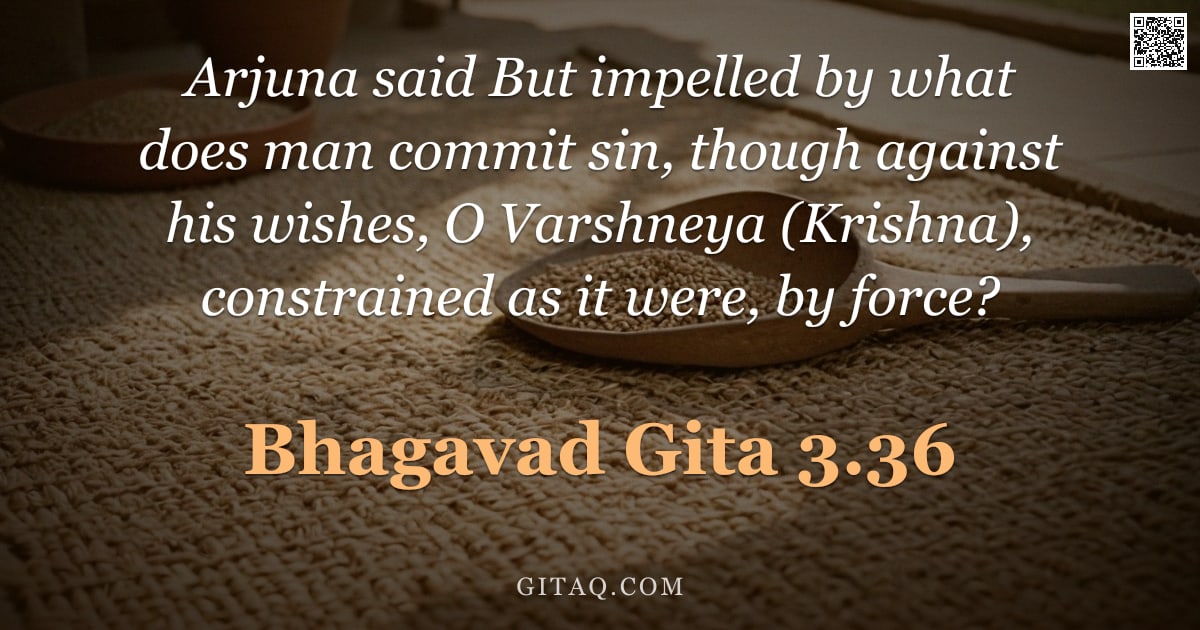
अर्जुन उवाच | अथ केन प्रयुक्तोऽयं पापं चरति पूरुषः | अनिच्छन्नपि वार्ष्णेय बलादिव नियोजितः ||३-३६||
arjuna uvāca . atha kena prayukto.ayaṃ pāpaṃ carati pūruṣaḥ . anicchannapi vārṣṇeya balādiva niyojitaḥ ||3-36||
What Does This Verse Mean?
In this verse, Arjuna asks Krishna a profound question while standing on the battlefield of Kurukshetra: What force compels a person to commit sinful acts even when they do not want to? He compares this internal struggle to being pushed by an overwhelming external power. The key teaching is that there is a hidden, coercive energy within every human that drives us toward actions we know are wrong, creating a sense of helplessness against our own will.
The Teaching Behind It
This verse belongs to the core of Karma Yoga (the path of selfless action) and explores the psychological mechanics of human behavior through the concept of desire. It introduces the idea that 'Rajas' (passion/desire) acts as a coercive force, binding individuals to actions they do not intellectually wish to perform.
Word by Word
Classical Commentary
Where This Happens
This verse occurs during the first chapter of the Bhagavad Gita's dialogue on the battlefield of Kurukshetra. Arjuna has just witnessed his own kinsmen arrayed for war and feels a deep, paralyzing sorrow that prevents him from fighting. After Krishna begins to explain the nature of duty in Chapter 2, Arjuna still struggles with an internal conflict; he realizes that even if he wants to do good, something else drives him toward what looks like sin or failure. He seeks the root cause of this inner coercion before he can proceed.
Living It Out Today
Consider a professional who knows their current job is unethical but feels compelled to continue because of financial pressure and fear of losing their livelihood. They may make excuses daily, yet feel trapped as if an invisible force is driving them toward actions that clash with their conscience. This verse helps us identify the specific internal driver—be it greed, anger, or insecurity—that overrides our better judgment in high-pressure moments.
Explained for Children
Imagine you really want to eat your vegetables because they make you strong, but suddenly you feel like eating only candy instead. You didn't plan to be mean or unhealthy; it felt like a giant invisible hand pushed you toward the sweets. Arjuna is asking Krishna about this feeling: What makes us do things we know are bad even when our hearts say no? It's like having two friends inside your head, where one tries to guide you right and another pushes you wrong.
Daily Reflection
Have you ever felt like you were being pushed into doing something wrong against your own will? Arjuna's question in the Gita reveals that we are all familiar with this painful split between knowing what is right and feeling compelled by impulse. When you notice yourself acting out of character, try to pause and recognize the power driving you rather than spiraling into self-blame. This moment of recognition is your first step toward breaking free from that compulsive force.
A Practice for Today
Sit quietly and observe the inner resistance that pulls you toward actions contrary to your better judgment, acknowledging it as a force rather than a personal failure. Visualize this force not as an enemy to be fought with anger, but as a heavy weight waiting to be understood through compassionate awareness.
Key Teachings
- The Illusion of Forced Action
Krishna teaches us that even when we act against our wishes, it feels like external compulsion or fate. This verse highlights the deceptive nature of the ego and senses, which can hijack our free will. - Identifying the Inner Impeller
The root cause is not a mysterious outside force but an internal desire (Kama) that arises from passion. By asking 'by what am I impelled?', we begin to identify the specific impulse driving our unwise actions. - Distinguishing Will from Force
We often attribute sin to a lack of willpower, but the Gita suggests that desire is so powerful it mimics external coercion. True freedom comes when we realize this force can be mastered through spiritual discipline.
Themes
Related Verses
Read This Next
- 2.62 — Read this next to see how attachment leads to anger and delusion, explaining exactly what happens when desire takes hold.
- 3.40 — This verse identifies the senses as the coverer of wisdom by fire, directly addressing the 'force' Arjuna questions in 3.36.
- 12.15 — Read this to find Krishna's description of a devotee who is free from such compulsive drives and acts with pure equanimity.
Recommended Reading
GitaQ earns from qualifying purchases as an Amazon Associate.