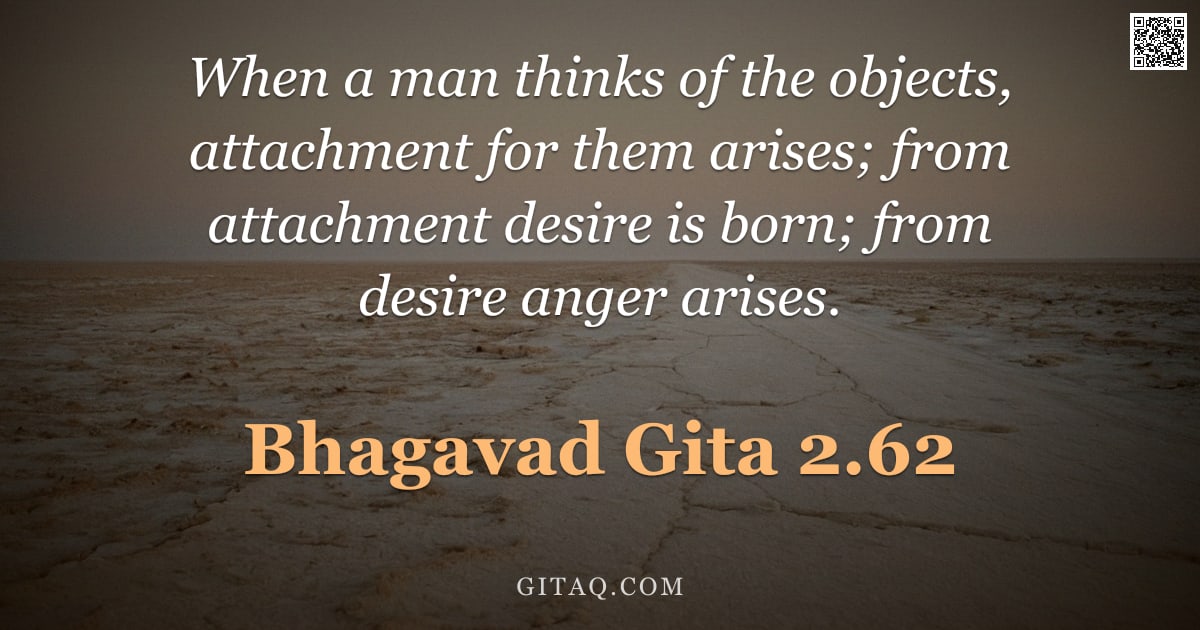
Bhagavad Gita 2.62
Sankhya Yoga · English Translation
ध्यायतो विषयान्पुंसः सङ्गस्तेषूपजायते | सङ्गात्सञ्जायते कामः कामात्क्रोधोऽभिजायते ||२-६२||
dhyāyato viṣayānpuṃsaḥ saṅgasteṣūpajāyate . saṅgātsañjāyate kāmaḥ kāmātkrodho.abhijāyate ||2-62||
What Does This Verse Mean?
In this verse, Lord Krishna explains the chain reaction that leads to anger and mental distress. He tells Arjuna that constantly dwelling on sensory objects creates attachment, which breeds insatiable desire, and finally erupts as destructive anger when those desires are thwarted. The core teaching is that our external suffering often begins with an internal fixation on material things rather than the events themselves.
The Teaching Behind It
This verse is foundational to Sankhya Yoga (the path of knowledge) within Chapter 2, specifically developing the psychological mechanics of bondage. It illustrates how ignorance leads to attachment, which fuels desire, ultimately resulting in anger that clouds judgment and binds the soul to the material world. This causal chain serves as a primary argument for practicing detachment through Self-realization.
Word by Word
Classical Commentary
Where This Happens
This verse occurs during the Bhagavad Gita's dialogue on the battlefield of Kurukshetra, where Prince Arjuna is paralyzed by grief and confusion before fighting his own relatives. Lord Krishna has just begun teaching him about the eternal nature of the soul (Atman) to dispel this despair. At this specific moment in Chapter 2, Krishna transitions from discussing duty to explaining how the mind's attachment to sensory pleasures creates a cycle that traps Arjuna in fear and sorrow.
Living It Out Today
Consider a modern scenario where an employee fixates on getting a promotion they feel entitled to after working hard. By obsessing over this single outcome (dhyāyato viṣayān), they develop intense attachment, leading to desperate desire for the role. When the company instead offers a different position or delays the decision, that pent-up frustration instantly explodes into anger towards their manager and resentment toward colleagues, ruining their work relationships.
Explained for Children
Imagine you really want a new video game but keep thinking about it all day long until your mind gets stuck on just wanting to play. That strong feeling of 'I must have this' is like attachment, and when you finally can't get it or someone says no, you might start shouting or crying in anger. Krishna teaches us that if we don't let our minds wander too much about things we want, we stay calm and happy instead.
Daily Reflection
Have you noticed how quickly a fleeting thought about something we desire can transform into an intense need or even frustration when it is blocked? This verse invites us to pause right at that first spark of attention before the chain reaction takes hold. By catching ourselves early while simply thinking, we reclaim our freedom from the cycle where attachment births desire and desire eventually breeds anger.
A Practice for Today
Close your eyes and gently observe where your mind lingers when you are alone; notice if thoughts of past pleasures or future acquisitions begin to weave a subtle thread of longing around them. With every breath, visualize that thread dissolving as you consciously redirect your awareness from the object itself to the silence within, recognizing that true peace lies not in grasping, but in witnessing without attachment.
Key Teachings
- The Seed of Attachment
Arjuna learns that suffering begins not with external events, but internally when the mind dwells obsessively on sense objects. This contemplation creates a subtle bond or 'attachment' (sanga) that roots us to the material world. - The Birth of Craving
From this attachment arises an insatiable desire for possession, which acts as the fuel for further agitation. The mind shifts from simple appreciation to a demanding need, believing that happiness depends on acquiring these objects. - The Fire of Anger
When our intense desires are inevitably thwarted by reality or delay, they instantly invert into anger and frustration. This emotional storm clouds judgment and leads to actions that cause suffering for oneself and others.
Themes
Related Verses
Read This Next
- 2.47 — Read this next to understand Krishna's instruction on performing duty without attachment, which is the practical antidote to the cycle described here.
- 3.6 — This verse addresses those who control their bodies but still dwell in sense objects with their minds, offering a crucial distinction relevant to this topic.
- 12.15 — Read this later to see the qualities of one who is free from such anger and attachment, serving as an ideal for your spiritual journey.
Recommended Reading
GitaQ earns from qualifying purchases as an Amazon Associate.