Bhagavad Gita 2.63
Sankhya Yoga · English Translation
क्रोधाद्भवति सम्मोहः सम्मोहात्स्मृतिविभ्रमः | स्मृतिभ्रंशाद् बुद्धिनाशो बुद्धिनाशात्प्रणश्यति ||२-६३||
krodhādbhavati sammohaḥ sammohātsmṛtivibhramaḥ . smṛtibhraṃśād buddhināśo buddhināśātpraṇaśyati ||2-63||
What Does This Verse Mean?
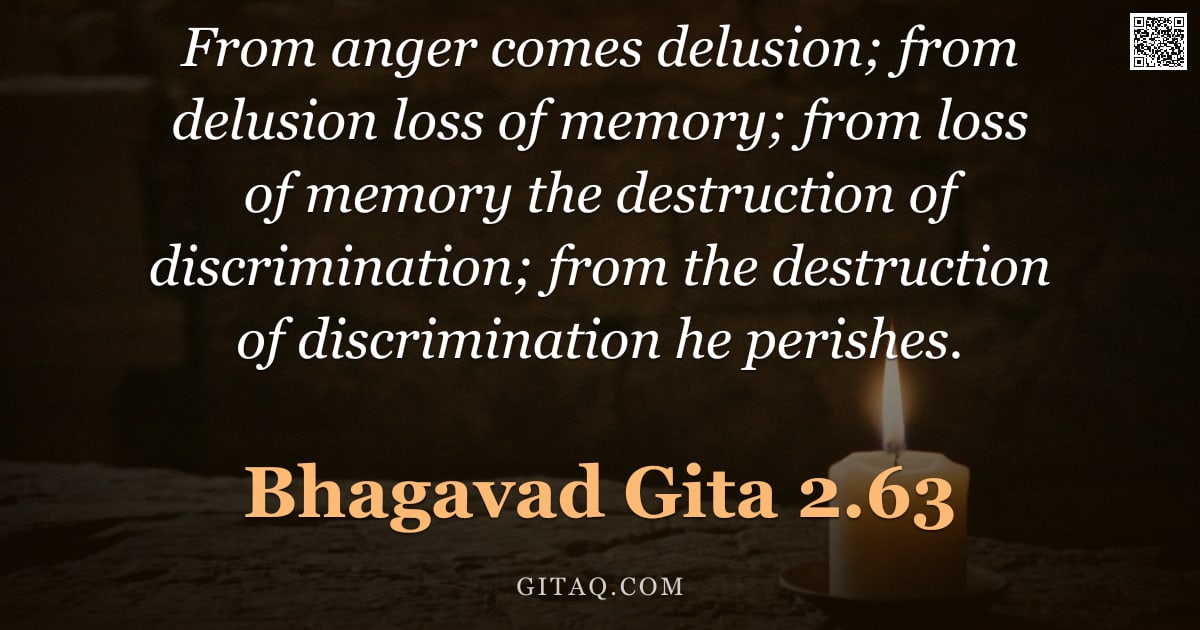
In this verse, Lord Krishna explains the dangerous chain reaction that begins with unchecked anger and ends in total ruin. He tells Arjuna that anger clouds judgment (delusion), which causes us to forget what is right or wrong (loss of memory). When we lose our ability to discriminate between good and bad actions, we make fatal mistakes that lead to spiritual and physical destruction.
The Teaching Behind It
This verse is a cornerstone of the Sankhya Yoga chapter, focusing on the psychology of action and the necessity of self-control as a prerequisite for spiritual knowledge. It develops the concept that emotional discipline (samatva) is required to maintain buddhi (intellect/discrimination), which is essential for performing Karma Yoga without attachment.
Word by Word
Classical Commentary
Where This Happens
This teaching occurs on the battlefield of Kurukshetra during the Mahabharata war, where Prince Arjuna has just refused to fight his own relatives and teachers due to overwhelming grief and confusion. Lord Krishna is responding directly to Arjuna's emotional paralysis by revealing the hidden psychological mechanism behind it: that deep sorrow often stems from suppressed anger or attachment which turns into delusion when faced with difficult duty. The listener, Arjuna, is currently in a state of mental collapse, unable to distinguish his moral duty (dharma) from personal affection.
Living It Out Today
Consider a modern professional who receives harsh criticism at work and immediately reacts with anger toward their boss or team. That initial fury causes them to misinterpret the feedback as a personal attack rather than constructive advice (delusion), leading them to forget past training on how to handle conflict gracefully (loss of memory). Consequently, they snap back rudely or make poor strategic decisions based on emotion instead of logic (destruction of discrimination), which can result in losing their job or damaging long-term relationships.
Explained for Children
Imagine you are playing a video game when your character gets really angry at the screen. Because you are so mad, you start pressing random buttons instead of the right ones (delusion). Soon, you forget which button does what or how to win the level (loss of memory), and before you know it, you lose all your lives and have to restart from the beginning. This verse teaches us that staying calm helps our brain work correctly so we can make good choices.
Daily Reflection
You often find that a small moment of annoyance triggers a chain reaction where clarity fades and poor choices follow. When you catch yourself in this spiral, remember that stopping at the first flash of anger can save you from losing your way entirely. Your true nature remains steady even when emotions try to shake it; simply witnessing them allows discrimination to return.
A Practice for Today
Pause to notice any spark of irritation within you today, and trace it back to its root without judgment or reaction. Ask yourself if this anger is clouding your memory of who you truly are beyond the moment's frustration.
Key Teachings
- The Cascade of Confusion
This verse reveals that anger is not an isolated emotion but the catalyst for a destructive chain reaction. It demonstrates how one unchecked feeling can dismantle our entire mental landscape, leading from delusion to spiritual ruin. - Memory as a Anchor of Identity
The loss of memory (smriti) in this context refers not just to forgetting facts, but losing the recollection of one's higher self and dharma. Without this inner anchor, we lose our ability to distinguish right from wrong. - Discrimination as the Lifeboat
Buddhi (discriminative intelligence) is the faculty that guides us through life's complexities; its destruction leads directly to spiritual perishing. The verse teaches that protecting our discernment requires mastering our initial emotional responses.
Themes
Related Verses
Read This Next
- 2.47 — Read this next to understand how performing duty without attachment is the practical antidote to the agitation that leads to anger.
- 3.30 — This verse follows up by instructing you to offer all actions to the Divine, a practice that dissolves the ego-attachment which fuels anger and delusion.
- 12.15 — Here Krishna describes the qualities of His dear devotee who is not disturbed by others nor disturbs them in return, embodying the stability that prevents this downward spiral.
Recommended Reading
GitaQ earns from qualifying purchases as an Amazon Associate.