Bhagavad Gita 3.35
Karma Yoga · English Translation
श्रेयान्स्वधर्मो विगुणः परधर्मात्स्वनुष्ठितात् | स्वधर्मे निधनं श्रेयः परधर्मो भयावहः ||३-३५||
śreyānsvadharmo viguṇaḥ paradharmātsvanuṣṭhitāt . svadharme nidhanaṃ śreyaḥ paradharmo bhayāvahaḥ ||3-35||
What Does This Verse Mean?
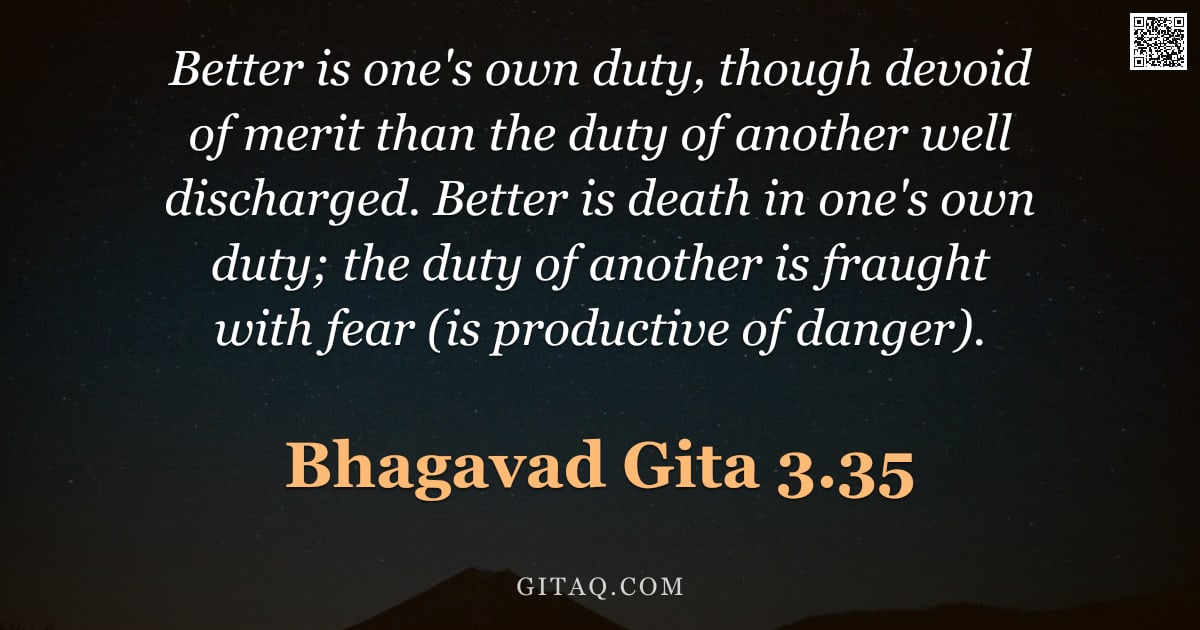
In this verse, Lord Krishna advises Arjuna that it is far better to perform one's own natural duty imperfectly than to perfectly execute someone else's role. He emphasizes that following a path not meant for you creates inner conflict and fear, even if the external results look impressive. The core teaching is that spiritual safety lies in authenticity rather than borrowing another person's life or responsibilities.
The Teaching Behind It
This verse is a cornerstone of Karma Yoga (the yoga of selfless action) as it defines the proper scope of action based on Svadharma, or intrinsic duty. It develops the concept that spiritual progress comes from aligning one's actions with one's inherent nature rather than imitating others, thereby reducing mental agitation and fear.
Word by Word
Classical Commentary
Where This Happens
This verse appears in Chapter 3 of the Bhagavad Gita on the battlefield of Kurukshetra during a moment of deep crisis for Arjuna. Just before this, Krishna has explained that everyone must act according to their nature and urged Arjuna not to abandon his duty out of delusion or fear. Arjuna is currently paralyzed by grief and attachment, tempted to renounce the battlefield entirely because it feels like he cannot be a good warrior while fighting his own relatives.
Living It Out Today
Consider an employee who has been promoted into a high-level executive role they are not qualified for yet; they might achieve short-term success but will live in constant anxiety and lose their sense of self. Instead, it is more fulfilling to excel in the role where your natural talents lie, even if that path seems less prestigious or offers lower pay initially. Choosing to stay true to one's core strengths prevents burnout and builds a reputation for authenticity rather than fear-driven performance.
Explained for Children
Imagine there are two games: one where everyone knows your team colors but you're still learning how to play it well, and another game where someone else forces you to wear a uniform of a different team. Even if the other team plays perfectly on paper, being in the wrong place makes you scared and confused because that isn't really who you are. It is much better to be brave at your own game, even if you make mistakes, than to pretend to play someone else's game where you feel unsafe.
Daily Reflection
You often feel pulled toward paths that look impressive from a distance while neglecting the quiet work right before your feet. Yet, true peace is found only when you honor the unique rhythm of your own life rather than mimicking someone else's script. Even if your path seems less polished or successful to others, staying faithful to it brings a safety and integrity that borrowed roles can never offer.
A Practice for Today
Close your eyes and recall a task you have been avoiding because it feels mundane or unglamorous compared to others' achievements; breathe into that feeling of comparison and gently let go. Visualize performing this specific duty with full presence, not for the result, but simply as an offering of who you are in this moment.
Key Teachings
- The Integrity of Svadharma
Your innate nature dictates the specific duties you must perform; following this internal compass is inherently more valuable than excelling at tasks imposed by external expectations. A flawed execution of one's true calling is superior to a perfect performance in an alien role. - The Danger of Disguised Roles
Attempting to live another person's life creates internal friction and spiritual danger, as the soul resists acting against its own constitution. This dissonance leads to fear because you are constantly fighting your own nature rather than flowing with it. - Death in Duty vs. Living a Lie
It is spiritually better to face death while faithfully fulfilling one's own purpose than to survive by sustaining a false identity. Authenticity, even at the cost of life, preserves the soul's alignment with cosmic order.
Themes
Related Verses
Read This Next
- 2.47 — This verse establishes the foundational principle of performing action without attachment, which supports why one should focus on their own duty rather than results or others' paths.
- 3.30 — Following 3.35, this verse instructs how to surrender all actions to the Divine, completing the shift from personal ego-driven effort to selfless devotion in one's specific role.
- 12.15 — Reading about Krishna describing a devotee who disturbs no one and is not disturbed by others helps understand how mastering Svadharma leads to the peace described in this verse.
Recommended Reading
GitaQ earns from qualifying purchases as an Amazon Associate.