Bhagavad Gita 3.22
Karma Yoga · English Translation
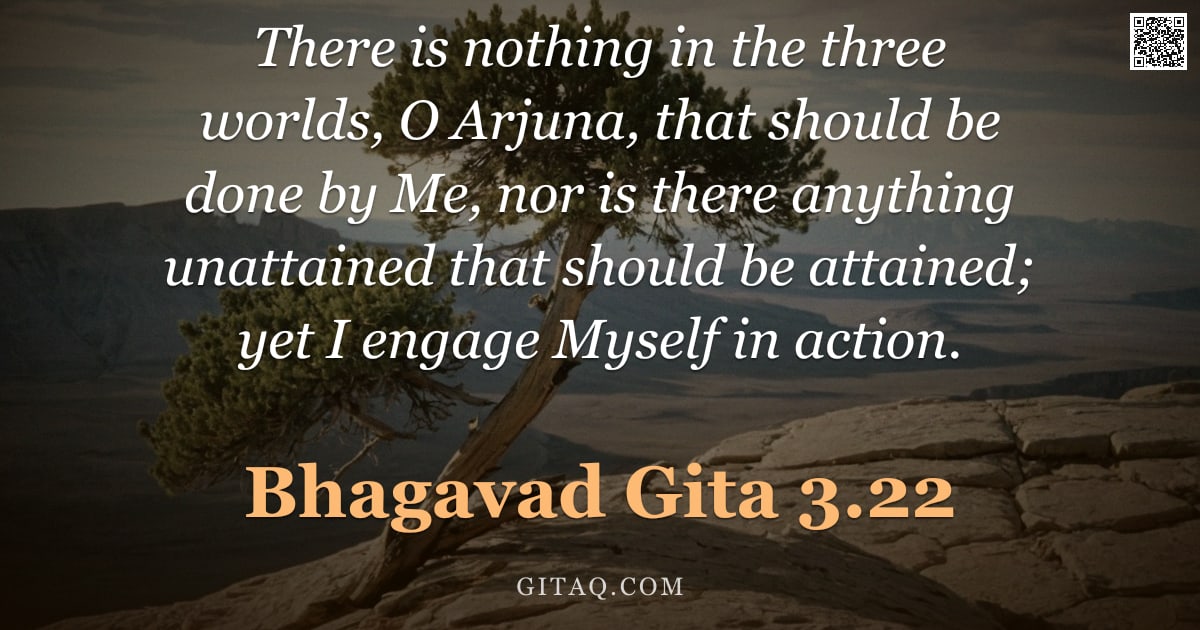
न मे पार्थास्ति कर्तव्यं त्रिषु लोकेषु किञ्चन | नानवाप्तमवाप्तव्यं वर्त एव च कर्मणि ||३-२२||
na me pārthāsti kartavyaṃ triṣu lokeṣu kiñcana . nānavāptamavāptavyaṃ varta eva ca karmaṇi ||3-22||
What Does This Verse Mean?
In this verse, Lord Krishna speaks to Arjuna from the battlefield of Kurukshetra, clarifying that as the Supreme Controller, He has no personal duties to fulfill and nothing left to achieve in any realm of existence. Despite having everything already accomplished and needing nothing more for His own benefit, Krishna continues to engage actively in action. The key teaching is that one should perform their prescribed duties not out of a sense of lack or desire for reward, but simply because it is the right thing to do.
The Teaching Behind It
This verse is a cornerstone of Karma Yoga (the path of selfless action) which integrates Jnana (knowledge) by establishing that the true Self lacks nothing. It illustrates the concept of 'loka-sangraha' or maintaining the welfare of the world, where one acts without attachment to results because they realize their divine nature is already complete.
Word by Word
Classical Commentary
Where This Happens
This verse occurs during the Bhagavad Gita's dialogue on the battlefield of Kurukshetra, where Prince Arjuna has dropped his bow and refused to fight against his own relatives out of overwhelming grief and confusion. Lord Krishna is explaining that while He, as the divine controller, does not require anything from this world or its outcomes, He continues to act to set an example for humanity. At this moment in the narrative, Arjuna feels paralyzed by attachment and doubt about duty, prompting Krishna to reveal His own transcendental state of being.
Living It Out Today
Consider a senior manager who has already achieved their career goals and secured their financial future; they have no personal need to work late or take on extra projects. Yet, when the team faces a critical deadline, this manager steps in to lead the effort not for praise or money, but because it is necessary for the company's success and the well-being of their colleagues. This mindset shifts one from working out of anxiety about failure or greed for gain to acting with clarity and calmness focused purely on service.
Explained for Children
Imagine you have already finished all your homework and built every toy on your shelf; there is nothing left for you to prove. Even though you don't *need* to play anymore to feel happy or complete, you still choose to pick up a ball and run outside because playing brings joy and helps others learn too. Krishna teaches us that even if we have everything we need in our hearts, we should still do good things like helping friends or studying hard just for the love of doing them.
Daily Reflection
You may feel overwhelmed by the endless list of things you must achieve or attain in life, yet Krishna gently reminds us that even the Divine acts without any sense of lack. When you shift your focus from 'what I need' to 'how I serve,' the weight of expectation lifts and action becomes a natural flow rather than a desperate pursuit. Today, try to engage fully with what is before you not because it fills a void, but simply as an expression of love for life itself.
A Practice for Today
Rest your awareness in the quiet understanding that you are not bound by any lack or duty to prove yourself through action, as Krishna demonstrates perfect engagement without need. Sit with this paradox: perform your duties fully today while knowing internally that nothing is truly missing and no future goal can add to your wholeness.
Key Teachings
- The Paradox of Divine Action
Krishna reveals that action arises from perfect fulfillment rather than personal need or desire. This teaches us to act not out of compulsion, but as a spontaneous overflow of inner completeness. - Freedom from the Cycle of Lack
The verse dismantles the human tendency to believe we must achieve something to become whole again. True freedom is found in realizing that our essential nature is already complete regardless of external achievements. - Action as a Model for Humanity
Even without any need, Krishna continues to act, establishing the principle of selfless engagement (Karma Yoga) as a guide for humanity. We are invited to follow this example by performing our duties with dedication while remaining detached from the results.
Themes
Related Verses
Read This Next
- 2.47 — This verse establishes the foundational principle of doing one's duty without attachment to results, directly supporting Krishna's motivation for action.
- 3.30 — It expands on how to dedicate all actions to the Divine, completing the thought process initiated in this verse about selfless engagement.
- 12.15 — This description of Krishna's devotee who is dear to him illustrates the ultimate fruit of living a life free from personal desire and need for action.
Recommended Reading
GitaQ earns from qualifying purchases as an Amazon Associate.