Bhagavad Gita 3.17
Karma Yoga · English Translation
यस्त्वात्मरतिरेव स्यादात्मतृप्तश्च मानवः | आत्मन्येव च सन्तुष्टस्तस्य कार्यं न विद्यते ||३-१७||
yastvātmaratireva syādātmatṛptaśca mānavaḥ . ātmanyeva ca santuṣṭastasya kāryaṃ na vidyate ||3-17||
What Does This Verse Mean?
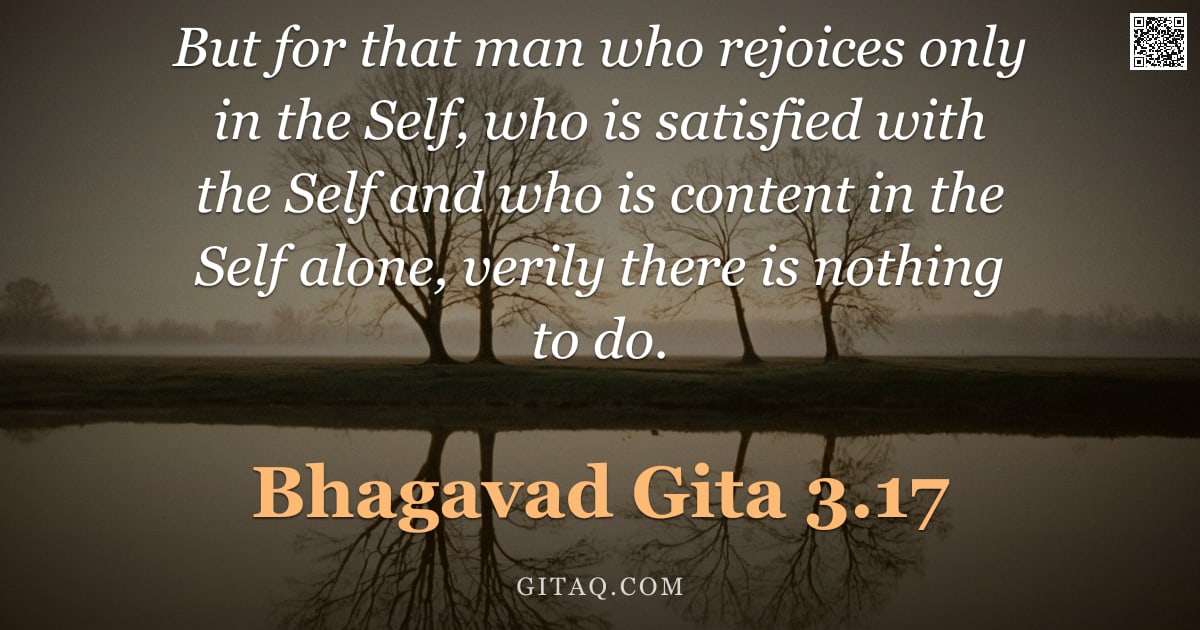
In this verse, Lord Krishna speaks to Arjuna about the state of a person who has found complete fulfillment within their own true Self (Atman). Such an individual finds joy and satisfaction not in external achievements or objects but in realizing their spiritual nature. Because their inner needs are fully met, they have no compulsive need to perform actions for personal gain or reward. This teaching describes the highest stage of Karma Yoga where action becomes effortless because there is no lack driving it.
The Teaching Behind It
This verse belongs to the core teaching of Karma Yoga as interpreted through Advaita Vedanta (non-dualism). It develops the concept that true action arises naturally when one transcends the ego's sense of incompleteness and realizes their identity with the Self. When a person is 'ātmarati' (rejoicing in the Self), they have realized that no external object can provide lasting satisfaction, rendering fruitive actions unnecessary.
Word by Word
Classical Commentary
Where This Happens
This verse appears in Chapter 3 during the dialogue on the battlefield of Kurukshetra, where Lord Krishna is instructing Arjuna on Karma Yoga (the path of selfless action). Just prior to this, Krishna has explained that one cannot attain freedom by merely abstaining from work; instead, one must act without attachment. Arjuna was feeling confused and tempted to abandon his duty as a warrior due to emotional distress regarding fighting relatives. Krishna uses this verse to describe the ideal state of consciousness where an enlightened person acts naturally out of fullness rather than obligation or desire.
Living It Out Today
Consider a professional leader who is deeply anxious about their next promotion, constantly working overtime just to prove their worth and secure financial safety nets. When they shift their focus inward—perhaps through meditation or deep reflection on their values—they realize their self-worth exists independently of their job title. Suddenly, the pressure to 'do more' dissolves because their internal sense of completeness is no longer dependent on external validation. They continue to work diligently and lead effectively, but now it flows from a place of contribution rather than fear or lack.
Explained for Children
Imagine a child who is so full of love and happiness from playing with their friends that they don't feel hungry anymore, even if dinner time arrives; they aren't eating to fill an empty stomach. This verse talks about someone whose heart feels just like that—completely filled with joy because they know who they truly are inside. When your heart is this full of good feelings, you don't have to do things just to feel better or get a toy. You can still play and help others, but it's out of love, not because you feel empty.
Daily Reflection
Today, you are invited to pause before seeking validation from outside sources and instead look inward for your sense of wholeness. When you find joy resting quietly in who you truly are, the frantic need to prove yourself through action naturally subsides. This is not a call to stop living, but an invitation to act from a place of inner abundance rather than inner lack.
A Practice for Today
Close your eyes and visualize yourself as a lamp that requires no external oil, shining solely from its own inner flame of consciousness. Rest the mind in this sensation of being completely full within itself, where any urge to achieve or acquire simply dissolves into peace.
Key Teachings
- Self-Rejoicing as Ultimate Joy
True happiness does not depend on external achievements or sensory objects but arises when one delights in the Self alone. This internal state transforms every action into a natural expression rather than a desperate attempt to fill a void. - The End of Compulsive Duty
For those fully satisfied by their own nature, external obligations lose their binding power as sources of anxiety or compulsion. Action ceases to be a burden and becomes spontaneous flow because the drive for reward has been extinguished. - Santushti: Contentment in the Self
The verse defines ultimate contentment not as having enough of what one wants, but being complete without wanting anything at all. This state of 'ātmatṛpta' (satisfied with the Self) is the hallmark of a liberated soul who acts freely.
Themes
Related Verses
Read This Next
Recommended Reading
GitaQ earns from qualifying purchases as an Amazon Associate.