Bhagavad Gita 3.1
Karma Yoga · English Translation
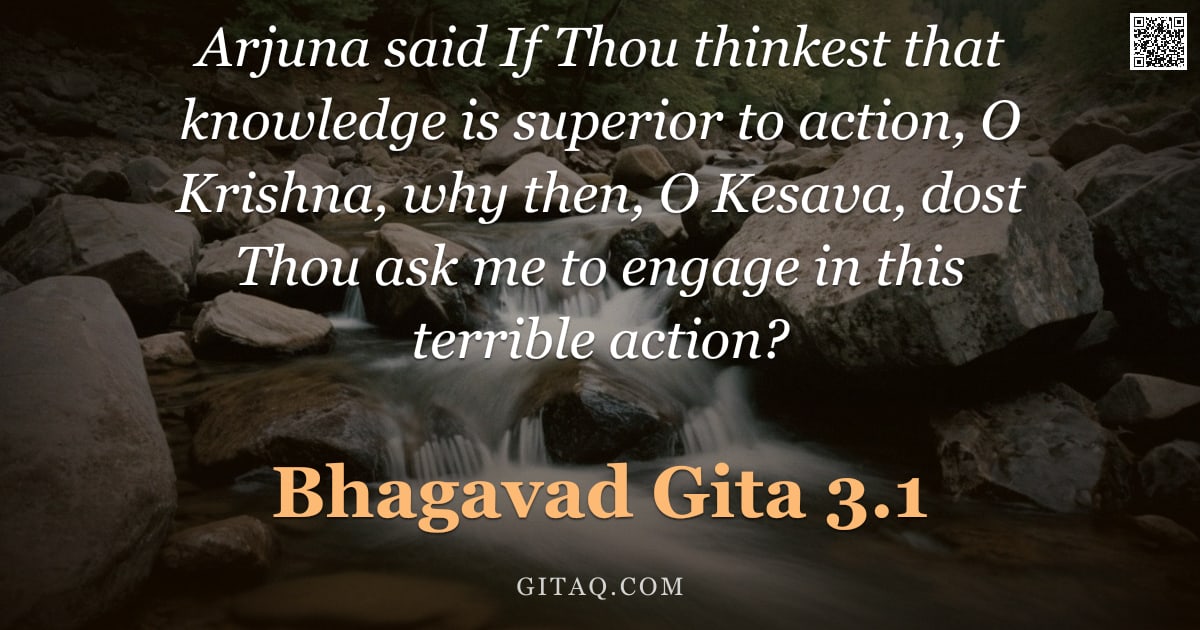
अर्जुन उवाच | ज्यायसी चेत्कर्मणस्ते मता बुद्धिर्जनार्दन | तत्किं कर्मणि घोरे मां नियोजयसि केशव ||३-१||
arjuna uvāca . jyāyasī cetkarmaṇaste matā buddhirjanārdana . tatkiṃ karmaṇi ghore māṃ niyojayasi keśava ||3-1||
What Does This Verse Mean?
In this verse, Arjuna questions Lord Krishna's teaching by pointing out an apparent contradiction: if spiritual knowledge (Buddhi) is superior to action, why does Krishna now insist that he must fight in the war? Speaking from a battlefield where he feels deep confusion and moral distress, Arjuna struggles to understand how one can choose between renouncing worldly deeds and performing necessary duties. This moment marks the beginning of his internal debate about whether true wisdom lies in abandoning action or engaging in it with detachment.
The Teaching Behind It
This verse initiates the practical discourse of Karma Yoga (the path of selfless action), bridging the gap between Jnana Yoga (knowledge) and Bhakti Yoga (devotion). It introduces the core concept that renunciation is not about abandoning duties, but rather performing actions without attachment to results. Krishna will soon clarify in subsequent verses how one can act while remaining spiritually free.
Word by Word
Classical Commentary
Where This Happens
This verse occurs at the start of Chapter 3 on the battlefield of Kurukshetra, just after Krishna has completed his discourse in Chapters 1 and 2 explaining that one can attain liberation through knowledge. Arjuna, having been convinced intellectually but emotionally paralyzed by fear for his family's lives, is now trying to reconcile these teachings with the immediate reality of war. He speaks to Krishna as a confused student who perceives an inconsistency between the superiority of wisdom and the command to engage in what he views as a terrible action.
Living It Out Today
Consider a professional manager facing a difficult decision: they know that meditating on long-term strategy (knowledge) is philosophically superior, yet their team needs them to make immediate, tough operational choices today. Like Arjuna, the leader might feel paralyzed by the conflict between wanting to retreat into planning and having to execute a harsh but necessary action now. The lesson here is not to choose one over the other based on fear, but to recognize that right action performed with clarity can itself be an expression of higher wisdom.
Explained for Children
Imagine you are learning that reading books is better than playing outside, but then your teacher suddenly tells you to go run a race instead! That's how Arjuna feels confused. He thinks Krishna told him that thinking and understanding is the best thing to do, so why does he want him to fight in a scary battle? It's like being told one rule when you are studying math, but then hearing a different rule right before you have to take an exam.
Daily Reflection
Have you ever felt paralyzed by the gap between knowing what is right and actually doing something difficult? Like Arjuna on the battlefield of Kurukshetra, it is natural to question why we must engage in 'terrible' tasks when our minds crave peace or retreat. The Gita does not ask us to ignore this fear; instead, it invites you to bring that very doubt into your practice as a sacred offering. When you move forward with action despite the dread of its difficulty, you transform hesitation into devotion.
A Practice for Today
Sit quietly and acknowledge the tension between what you believe is right to do mentally and the actions demanded of you by your current situation. Ask yourself: Am I hesitating because the path ahead feels 'ghora' (terrible), or simply because it challenges my comfort? Rest in the understanding that true wisdom reveals itself not through avoiding action, but through performing necessary duties with a clear heart.
Key Teachings
- The Conflict Between Theory and Practice
Arjuna's question highlights the common human struggle where intellectual agreement on a truth clashes with emotional resistance to executing it. This verse teaches that spiritual knowledge becomes incomplete if we refuse to apply it in real-world, challenging circumstances. - Reframing 'Terrible' Action
The word used for action here, 'ghore', suggests something terrifying or overwhelming, yet Krishna's instruction is not to avoid the difficult but to face it. This teaches that spiritual growth often requires engaging with the very situations we fear most. - Divine Guidance in Confusion
Arjuna voices his confusion directly to Krishna, modeling that doubt is a valid and necessary part of sincere inquiry rather than an obstacle. The verse establishes that true surrender involves asking the hard questions about our duty. - The Necessity of Duty
Even when action seems contradictory to one's understanding of peace or superior knowledge, the call to perform svadharma (one's own duty) remains paramount. This teaching emphasizes that inaction is not a solution for spiritual clarity.
Themes
Related Verses
Read This Next
- 2.47 — This verse provides Krishna's direct answer to Arjuna's hesitation by defining the discipline of performing action without attachment to results.
- 3.8 — Krishna commands Arjuna to fight, reinforcing that duty must be performed regardless of personal desire or fear of difficulty.
- 12.15 — To see the ultimate fruit of this path, read how a devotee who engages in action without ego becomes dear to Krishna and thus truly peaceful.
Recommended Reading
GitaQ earns from qualifying purchases as an Amazon Associate.