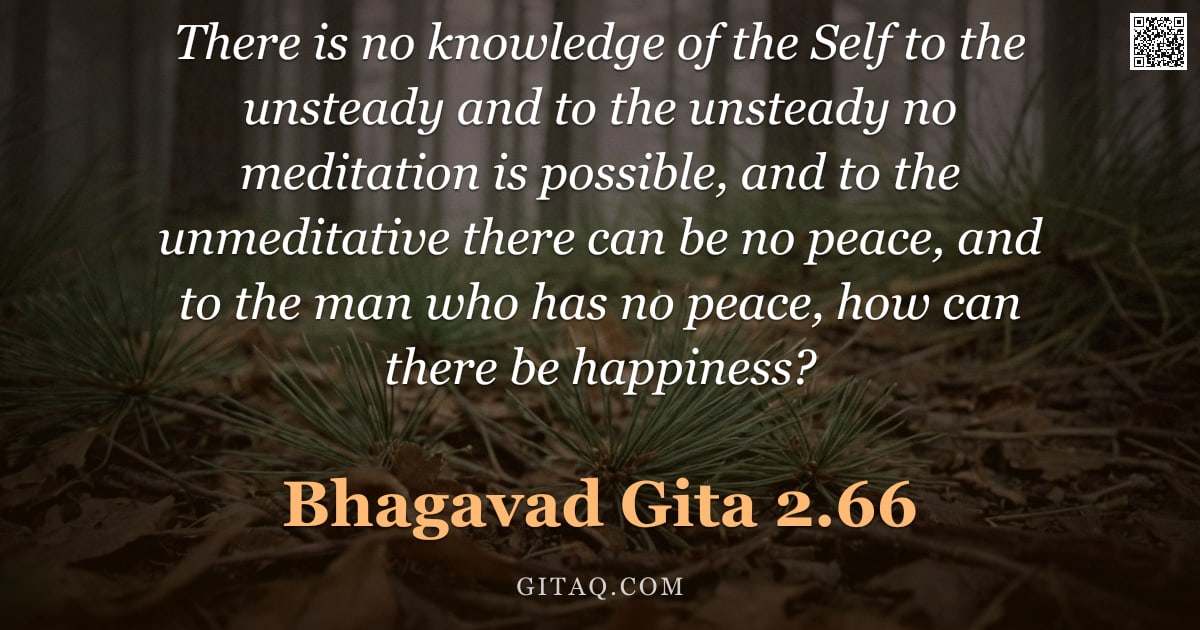
Bhagavad Gita 2.66
Sankhya Yoga · English Translation
नास्ति बुद्धिरयुक्तस्य न चायुक्तस्य भावना | न चाभावयतः शान्तिरशान्तस्य कुतः सुखम् ||२-६६||
nāsti buddhirayuktasya na cāyuktasya bhāvanā . na cābhāvayataḥ śāntiraśāntasya kutaḥ sukham ||2-66||
What Does This Verse Mean?
Lord Krishna explains to Arjuna that a person who lacks mental focus cannot attain true knowledge of the Self, and without such meditation, inner peace is impossible. This verse establishes a direct chain reaction: if you are unsteady in mind, you lose your ability to meditate; without meditation, you lack peace; and without peace, happiness can never exist. The core teaching is that mental stability (equanimity) is the absolute prerequisite for spiritual wisdom and lasting joy.
The Teaching Behind It
This verse is foundational to Jnana Yoga (the path of knowledge) and Sankhya philosophy within the Gita's framework. It develops the concept that 'Buddhi' (intellect/wisdom) cannot arise without a steady mind, establishing mental steadiness as the gateway to Self-realization.
Word by Word
Classical Commentary
Where This Happens
This verse occurs on the battlefield of Kurukshetra during the Mahabharata, where Lord Krishna is counseling his friend Arjuna. Just before this shloka, Krishna has been explaining Sankhya Yoga (transcendental knowledge) to counteract Arjuna's confusion and grief over fighting his relatives. At this moment, Arjuda feels overwhelmed by sorrow and fear, having dropped his bow in a state of mental paralysis; Krishna is diagnosing the root cause: an unsteady mind that blocks all peace.
Living It Out Today
Consider a professional facing a high-stakes presentation who has spent hours worrying about potential mistakes instead of preparing. Because their mind is scattered with anxiety (unsteady), they cannot focus on the core message or rehearse effectively, leading to a lack of clarity. This mental chaos prevents them from finding inner calm during the meeting, resulting in poor performance and deep regret afterward. To succeed, one must first practice calming techniques like breathing exercises to stabilize the mind before attempting complex tasks.
Explained for Children
Imagine trying to hear a whisper while someone else is shouting loudly nearby—you just can't understand what they are saying because your ears are too distracted. Similarly, if our minds are jumping around like monkeys from one thought to another, we cannot think clearly or feel calm inside. Krishna tells us that when we learn to quiet our busy thoughts through practice, a special kind of peace settles in, and that is the only way real happiness can find its home.
Daily Reflection
You might feel overwhelmed today because you are seeking happiness while your inner world remains turbulent. The Gita reminds us that just as a calm lake reflects the sky clearly, only a steady mind can reflect true peace and lasting joy. It is not about forcing silence but understanding that meditation flows naturally from stability, which in turn births tranquility. When you feel anxious, remember to first seek stillness before chasing happiness.
A Practice for Today
Begin by pausing to notice if your mind feels scattered or steady right now; acknowledge that without this inner steadiness, true contemplation cannot take root. Silently affirm the sequence: 'My peace is not found in external events, but cultivated through a settled mind.' Rest for three minutes simply observing the breath, allowing distractions to settle before inviting any deeper focus.
Key Teachings
- The Prerequisite of Steadiness
Krishna establishes that spiritual knowledge (buddhi) is inaccessible to a mind disturbed by emotional turbulence. Without this foundational steadiness, the seeker remains disconnected from their true nature and divine potential. - The Chain of Being: Meditation Leads to Peace
There exists an unbreakable causal link where meditation (bhavana) is only possible for those who have cultivated a steady focus. This deep contemplation then naturally births the profound peace (shanti) that the world cannot give. - The Paradox of Seeking Happiness
Happiness (sukha) cannot be found by someone whose mind is in a state of unrest or agitation. The verse concludes with a rhetorical question to highlight that true joy is the fruit of inner tranquility, not an external pursuit.
Themes
Related Verses
Read This Next
- 2.47 — This verse follows up by explaining how to maintain that steadiness during action without attachment.
- 3.30 — It offers a practical method of surrendering the fruits of action, which stabilizes the mind for meditation.
- 12.15 — This verse describes the qualities of one who has achieved such peace and becomes dear to all beings.
Recommended Reading
GitaQ earns from qualifying purchases as an Amazon Associate.