Bhagavad Gita 2.65
Sankhya Yoga · English Translation
प्रसादे सर्वदुःखानां हानिरस्योपजायते | प्रसन्नचेतसो ह्याशु बुद्धिः पर्यवतिष्ठते ||२-६५||
prasāde sarvaduḥkhānāṃ hānirasyopajāyate . prasannacetaso hyāśu buddhiḥ paryavatiṣṭhate ||2-65||
What Does This Verse Mean?
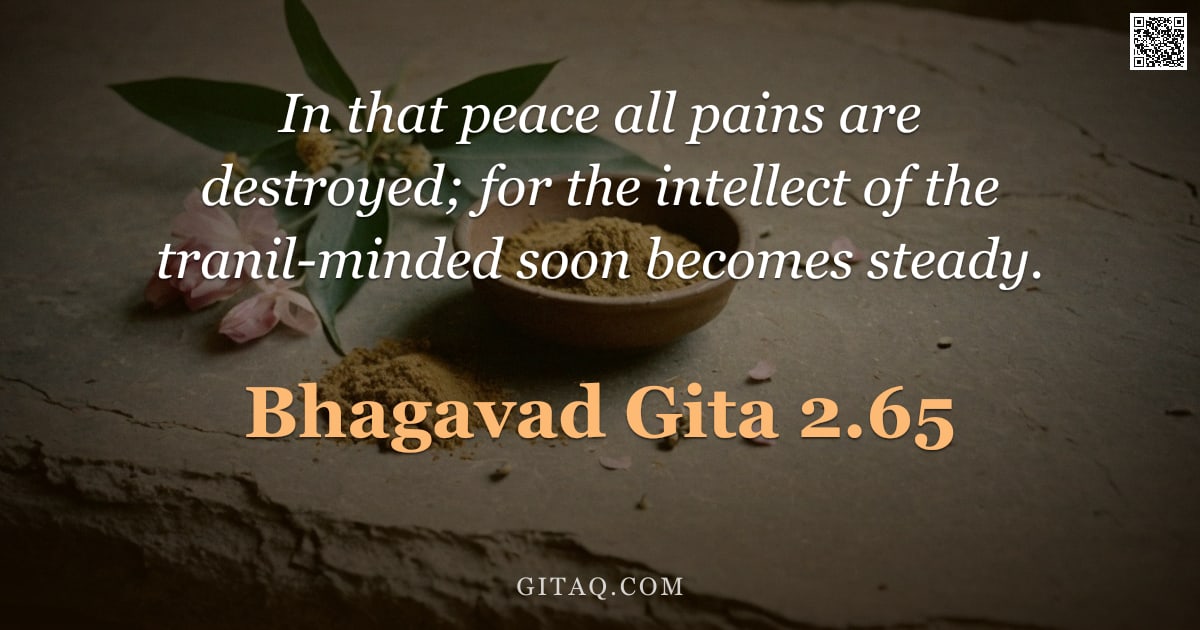
In this verse, Lord Krishna tells Arjuna that when the mind becomes calm and free from distress through divine grace or inner peace, all suffering ceases to exist for that person. He explains a direct cause-and-effect relationship: as one's mental state clears of agitation, their intellect naturally settles into perfect stability. This steady wisdom allows individuals to see reality clearly without being clouded by fear or confusion.
The Teaching Behind It
This verse is central to Jnana Yoga (the path of knowledge) and Sankhya philosophy within the Gita's framework. It develops the concept that intellectual instability stems from emotional turbulence and that true wisdom ('buddhi') can only function when the mind is tranquil and undisturbed by external circumstances.
Word by Word
Classical Commentary
Where This Happens
This teaching occurs on the battlefield of Kurukshetra during the Bhagavad Gita's Sankhya Yoga chapter. Lord Krishna is speaking to Arjuna, who has just fallen into despair after seeing his relatives in enemy ranks, and he has dropped his bow. After explaining the nature of the eternal soul earlier, Krishna now describes the immediate result of attaining a calm mind: the cessation of all mental suffering.
Living It Out Today
When facing a high-stakes job interview or a difficult negotiation where your heart is racing with anxiety, you may find yourself unable to articulate your thoughts clearly. If you take a moment to center yourself and achieve that inner 'prasada' (peace), the chaotic noise in your mind will fade away instantly. This sudden clarity allows your natural intelligence to guide your words effectively, turning a potential disaster into an opportunity for success.
Explained for Children
Imagine you are trying to balance on one foot while shaking hands; it is almost impossible if your body is trembling from the cold! But when you warm up and feel calm, suddenly balancing becomes easy. This verse teaches that just like a still hand helps you hold a cup steady, a peaceful mind helps us think clearly and solve problems without getting scared or confused.
Daily Reflection
Have you ever noticed how quickly your worries multiply the moment your inner peace is disturbed? This verse reminds us that true stability of mind isn't forced through willpower alone but blooms as a natural result of divine grace and inner serenity. When you allow yourself to rest in that state where pain loses its grip, your understanding sharpens instantly, guiding you with clarity rather than confusion.
A Practice for Today
Close your eyes and recall a moment of deep inner calm you have recently experienced, letting that sense of peace fill every cell of your body. As the mind settles into this tranquility, silently affirm: 'In this peace, my sorrows dissolve.' Rest in the feeling that a steady intellect naturally arises when the heart is free from agitation.
Key Teachings
- The Power of Serene Grace
True spiritual progress begins not with striving against suffering but with invoking a state of inner grace that naturally dissolves all pain. This divine favor creates the fertile ground where mental disturbances cannot take root. - Intellect as a Steady Companion
When consciousness is calm and clear, the intellect ceases to be erratic and becomes a reliable instrument of discrimination. It swiftly stabilizes itself, allowing one to navigate life's complexities without being swept away by emotional turbulence. - The Sequence of Healing
There is a specific causal order where the destruction of sorrow precedes and enables the steadiness of wisdom. One cannot expect unwavering clarity while the heart remains burdened by unresolved grief or agitation.
Themes
Related Verses
Read This Next
- 2.47 — This foundational verse establishes the duty to act without attachment to results, which is the primary method for cultivating the peace mentioned in 2.65.
- 3.30 — Read this next to understand how dedicating all actions to the Divine acts as a catalyst for achieving the mental tranquility described here.
- 12.15 — This verse describes the qualities of one who is dear to Krishna, highlighting the peace and steadiness that come from being free from envy and agitation.
Recommended Reading
GitaQ earns from qualifying purchases as an Amazon Associate.