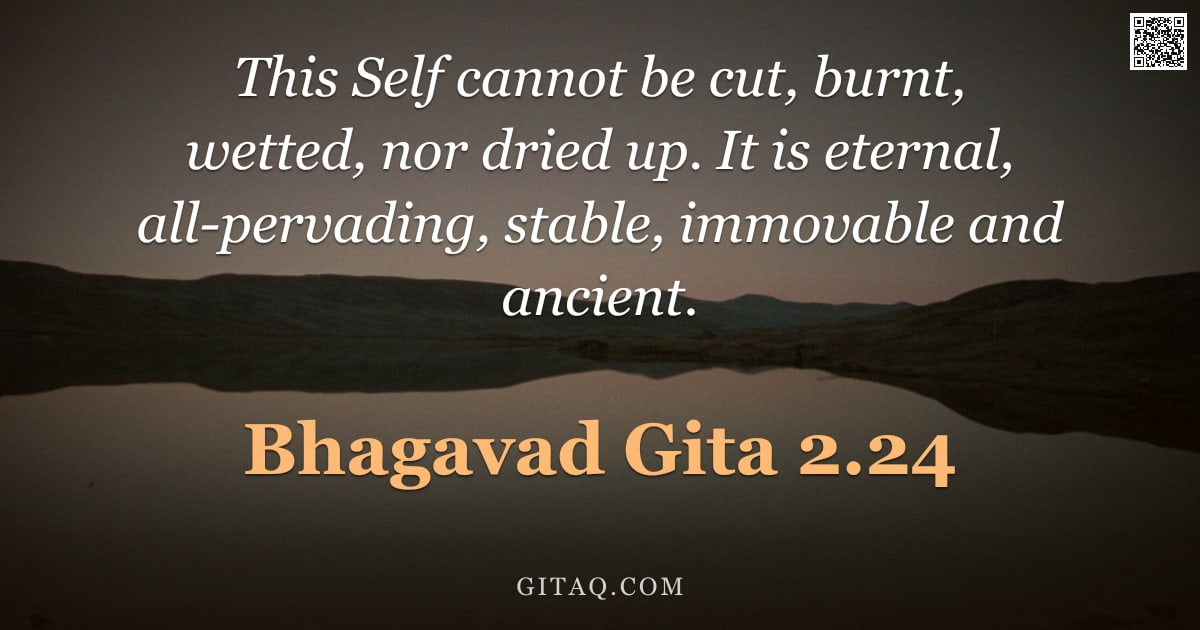
Bhagavad Gita 2.24
Sankhya Yoga · English Translation
अच्छेद्योऽयमदाह्योऽयमक्लेद्योऽशोष्य एव च | नित्यः सर्वगतः स्थाणुरचलोऽयं सनातनः ||२-२४||
acchedyo.ayamadāhyo.ayamakledyo.aśoṣya eva ca . nityaḥ sarvagataḥ sthāṇuracalo.ayaṃ sanātanaḥ ||2-24||
What Does This Verse Mean?
In this verse, Lord Krishna explains to the grieving warrior Arjuna that the true Self (Atman) is indestructible and beyond physical changes like cutting or burning. He teaches that just as a body can be worn out but never destroyed by elements, our inner essence remains untouched by time, pain, or death. This knowledge aims to remove fear of loss and help one understand their eternal nature.
The Teaching Behind It
This verse is foundational to Jnana Yoga (the path of knowledge) within the Sankhya philosophy presented in Chapter 2. It establishes the concept of Atman as distinct from Sharira (the body), defining the Self through negative attributes (neti-neti) and positive eternal qualities like being all-pervading and unchanging.
Word by Word
Classical Commentary
Where This Happens
This verse occurs on the battlefield of Kurukshetra in the Mahabharata during Chapter 2, known as Sankhya Yoga. Lord Krishna has just begun his teachings to Prince Arjuna, who is overwhelmed by grief and hesitation about fighting his own relatives in the war. After seeing a vision of death for everyone involved, Arjuna drops his bow; Krishna uses this verse to counter Arjuna's attachment to physical bodies with the truth of the eternal soul.
Living It Out Today
When you are facing an unchangeable crisis at work or a painful family separation that feels like it is breaking your spirit, remember that your core identity remains intact despite external circumstances. Just as fire cannot burn water in its essence and wind cannot dry up the sky, these events affect your situation but not who you truly are inside. This perspective allows you to make clear-headed decisions from a place of stability rather than panic.
Explained for Children
Imagine you have a special flashlight inside your heart that can't ever go dark, even if you try to smash it with a hammer, burn it in a fire, soak it in water, or dry it out. No matter what happens to the outside world or your body, this inner light stays safe and bright forever. It is like being made of pure sunshine instead of clay; nothing can break it because it was never born and cannot die.
Daily Reflection
You may feel battered and worn by life's circumstances, as if your spirit could be burned or broken, but today remember that these are only passing winds. The core of who you truly are remains untouched, ancient, and perfectly whole regardless of the storms raging around you. When fear tries to dry up your hope or sadness seeks to soak you in despair, simply recall that your inner essence is fireproof and immovable.
A Practice for Today
Close your eyes and visualize your true Self as an indestructible diamond, untouched by the flames of anger or the waters of sorrow that wash over it today. Rest in this certainty: nothing can cut you down because there is no surface for a blade to strike; rest instead in the unshakable stability of what has always been.
Key Teachings
- The Indestructible Nature
This teaching reveals that the Soul (Atman) exists beyond the physical laws of destruction. No weapon can cut it, no fire burn it, nor water wet or dry its eternal substance. - Eternal and Unchanging
The Self is described as 'Nitya' (eternal) and 'Sthana' (permanent), meaning it has never begun to exist and will never cease. Unlike the changing body, this consciousness remains the same stable witness through all time. - All-Pervading Presence
The verse describes the Self as 'Sarvagata' (all-pervading) and immovable, indicating it is not confined to a single location. It exists within every being simultaneously while remaining distinct from the movement of matter. - Ancient Origin
By calling the Self 'Sanatana' (ancient), Krishna teaches that this consciousness predates all creation and is not a product of time. It has always been, ensuring its safety from any temporal decay.
Themes
Related Verses
Read This Next
- 2.47 — This verse follows naturally to show how one acts without attachment after realizing this indestructible nature.
- 3.30 — Reading this next helps apply the knowledge of the eternal Self by surrendering all actions and their fruits to the Divine.
- 12.15 — This verse expands on the character traits that arise from understanding one's stable, non-attached spiritual identity.
Recommended Reading
GitaQ earns from qualifying purchases as an Amazon Associate.