Bhagavad Gita 18.8
Moksha Sanyasa Yoga · English Translation
दुःखमित्येव यत्कर्म कायक्लेशभयात्त्यजेत् | स कृत्वा राजसं त्यागं नैव त्यागफलं लभेत् ||१८-८||
duḥkhamityeva yatkarma kāyakleśabhayāttyajet . sa kṛtvā rājasaṃ tyāgaṃ naiva tyāgaphalaṃ labhet ||18-8||
What Does This Verse Mean?
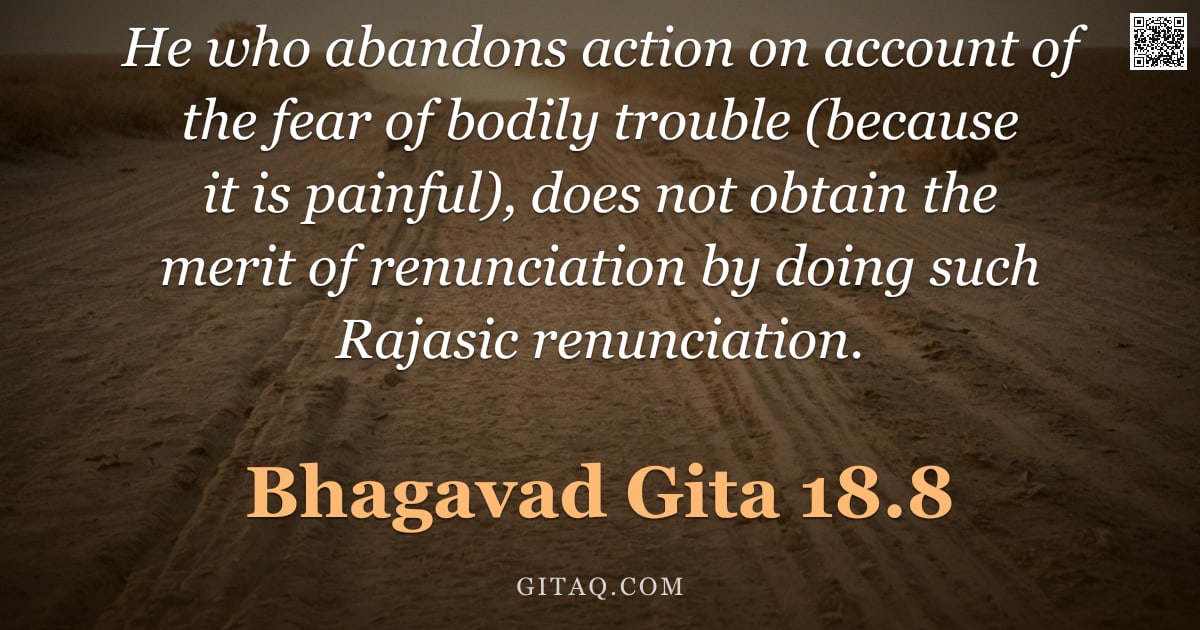
In this verse, Lord Krishna speaks to Arjuna about the danger of avoiding responsibilities simply because they feel difficult or painful. He explains that quitting a duty due to fear of physical effort is not true renunciation but rather an act driven by laziness and passion (Rajas). Such avoidance does not lead to spiritual liberation; instead, it reinforces negative mental patterns without yielding any positive results.
The Teaching Behind It
This verse belongs to the Karma Yoga tradition within Vedanta, specifically developing the concept of 'Sattvic Tyaga' (renunciation) versus 'Rajasic Tyaga'. It teaches that true spiritual progress requires performing one's duty without attachment to results or fear of bodily discomfort, distinguishing between genuine renunciation and mere avoidance.
Word by Word
Classical Commentary
Where This Happens
This verse appears in the final chapter of the Bhagavad Gita, set on the battlefield of Kurukshetra where Prince Arjuna is paralyzed by grief and fear before a great war. Krishna has just finished explaining the three types of knowledge, action, and intellect; now he categorizes the three types of renunciation (Tyaga). He addresses Arjuna's confusion about whether to fight or flee, warning that abandoning one's duty due to fear will not bring peace.
Living It Out Today
Consider a professional who is offered a challenging promotion requiring long hours and high stress; if they reject it solely because the workload seems overwhelming rather than out of genuine lack of interest, this is Rajasic avoidance. By quitting or refusing the challenge immediately upon feeling tired, they miss the opportunity for career growth and personal mastery that comes from overcoming difficulties.
Explained for Children
Imagine you have a difficult homework assignment that makes your head hurt. If you throw the book away just because you don't want to feel tired or frustrated, you haven't solved anything and you won't learn from doing it. Krishna says this is like running away from a tough game only because playing feels hard; true bravery means sticking with it even when it's difficult so you can grow stronger.
Daily Reflection
You might find that what looks like wisdom in avoiding struggle is often just comfort seeking disguised as caution. True renunciation isn't about fleeing hardship, but engaging with duty while letting go of attachment to the result. When you choose to act despite the discomfort, you transform a Rajasic escape into a path toward liberation.
A Practice for Today
Sit quietly and observe any task you are avoiding because it feels difficult or uncomfortable. Ask yourself if your hesitation stems from a genuine need for rest or merely the fear of temporary pain.
Key Teachings
- The Trap of Avoidance
Renouncing action solely because it is painful or difficult constitutes a Rajasic (passionate) type of withdrawal. This form of avoidance binds the soul further by reinforcing fear and inertia rather than cultivating inner strength. - The Necessity of Sattvic Action
Genuine spiritual progress requires performing one's duty even when it involves bodily or mental struggle. The merit of true renunciation is found only in action performed with detachment, not in the abandonment of responsibility. - The Fruit of True Tyaga
By fleeing from difficulty due to fear, one forfeits the spiritual fruit that comes from overcoming desire and aversion. Only by embracing duty without attachment can one access the liberating power of Sanyasa.
Themes
Related Verses
Read This Next
- 2.47 — To establish the foundational principle of performing prescribed duties without attachment to results.
- 3.30 — To understand how dedicating all actions to the Divine transforms work into a means of liberation rather than bondage.
- 12.15 — To see how one who is not agitated by worldly pain or pleasure becomes dear to Krishna and attains peace.
Recommended Reading
GitaQ earns from qualifying purchases as an Amazon Associate.