Bhagavad Gita 18.78
Moksha Sanyasa Yoga · English Translation
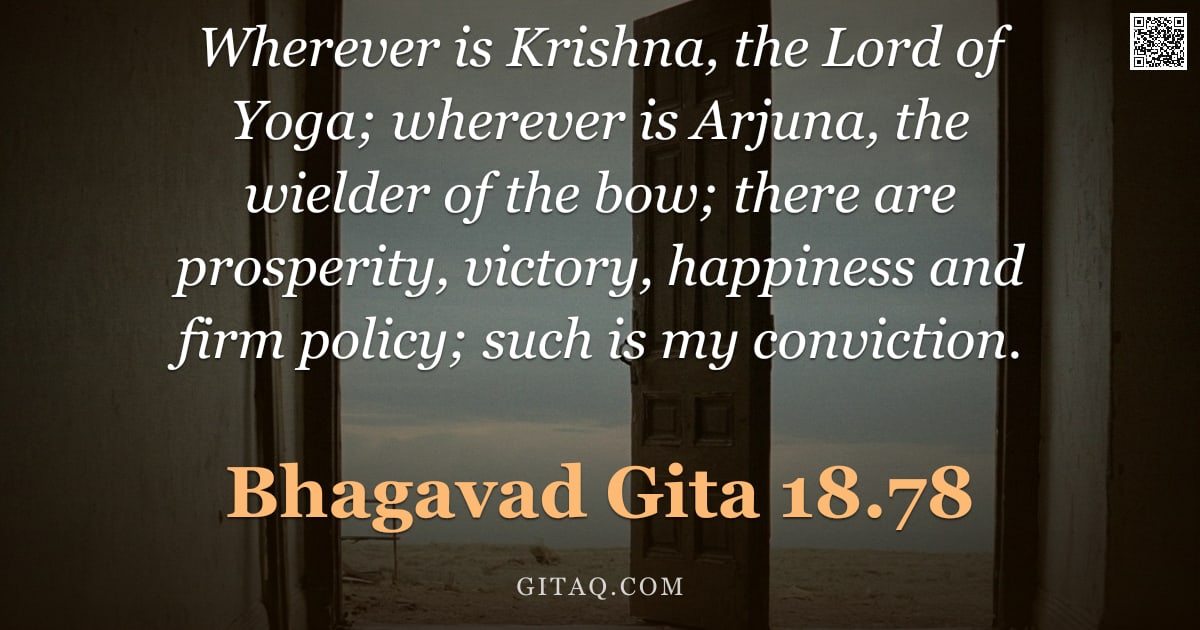
यत्र योगेश्वरः कृष्णो यत्र पार्थो धनुर्धरः | तत्र श्रीर्विजयो भूतिर्ध्रुवा नीतिर्मतिर्मम ||१८-७८||
yatra yogeśvaraḥ kṛṣṇo yatra pārtho dhanurdharaḥ . tatra śrīrvijayo bhūtirdhruvā nītirmatirmama ||18-78||
What Does This Verse Mean?
This verse serves as the concluding summary of the Bhagavad Gita, spoken by Sanjaya to King Dhritarashtra after recounting Krishna's teachings on the battlefield. It establishes a fundamental principle: wherever divine guidance (represented by Krishna) and dedicated human effort (represented by Arjuna) work together in harmony, success is inevitable. The key teaching is that prosperity, victory, stability, and right conduct are not random outcomes but guaranteed results when one aligns with higher consciousness while fulfilling their duty.
The Teaching Behind It
This verse synthesizes Bhakti Yoga (devotion to the Divine as Krishna) with Karma Yoga (selfless action performed as Arjuna). It develops the concept that spiritual realization is most potent when it manifests through active engagement in one's specific duty, rather than withdrawal from the world. The presence of 'Shri' and 'Vijaya' signifies that true success arises only at the intersection of divine will and human agency.
Word by Word
Classical Commentary
Where This Happens
This final shloka is spoken by Sanjaya, the charioteer-sage who has been describing the war's events to the blind King Dhritarashtra via divine vision. It occurs at the very end of Chapter 18, after Krishna has finished his comprehensive discourse on duty, devotion, and liberation. The listener, Dhritarashtra, is a father filled with anxiety about his sons' fate; Sanjaya offers this verse to reassure him that despite the tragedy ahead for the Kauravas (who lacked divine alignment), any path involving both wisdom and action guarantees ultimate success.
Living It Out Today
Consider a project manager facing a high-stakes deadline where their team is divided on strategy. Instead of micromanaging or guessing, they consult with senior experts to refine the plan and then empower each team member to execute their specific role with full focus. By combining that expert wisdom (Krishna) with dedicated execution by skilled individuals (Arjuna), the manager ensures not just a completed project but one marked by quality, morale, and long-term stability.
Explained for Children
Imagine you are playing a team game where the coach gives perfect advice (like Krishna) and your teammate follows it perfectly by doing exactly what is needed in their position (like Arjuna). When both the smart leader and the hardworking player work together, winning becomes certain. This verse teaches us that when we listen to wise guidance and do our best with focus, good things like happiness and success naturally follow.
Daily Reflection
You do not need to walk alone through life's challenges because where there is devotion and duty, victory naturally follows. When you align your personal efforts (Arjuna) with the higher truth within you (Krishna), prosperity becomes a natural byproduct of that harmony rather than a frantic goal to chase.
A Practice for Today
Sit quietly and visualize Krishna not as a distant figure, but as the silent consciousness witnessing your current moment of action. Imagine Arjuna standing beside you with unwavering focus, ready to release his bow only when aligned with divine will.
Key Teachings
- The Divine and The Human
True spiritual success requires the union of God's grace, represented by Krishna, with human agency and skillful action, symbolized by Arjuna. Neither divine intervention nor personal effort alone is sufficient; it is their partnership that creates a field for victory. - Victory as Inherent Quality
Prosperity (Sri) and firm policy (Niti) are not external rewards to be begged for, but inherent qualities that manifest when the divine presence dwells within an action. Success is defined by alignment with truth rather than material accumulation alone. - Unshakable Conviction
The verse concludes with 'matirmama' (my conviction), highlighting that spiritual certainty arises from witnessing the harmony of divine and human collaboration. This firm belief transforms uncertainty into a steady path toward liberation.
Themes
Related Verses
Read This Next
- 2.47 — Read this next to understand Arjuna's duty as a 'wielder' without attachment to results.
- 3.30 — This verse explains the act of surrendering all actions to Krishna, deepening the theme of divine partnership.
- 12.15 — Read this final chapter's wisdom on how a devotee becomes dear to God through compassion and steady conduct.
Recommended Reading
GitaQ earns from qualifying purchases as an Amazon Associate.