Bhagavad Gita 18.72
Moksha Sanyasa Yoga · English Translation
कच्चिदेतच्छ्रुतं पार्थ त्वयैकाग्रेण चेतसा | कच्चिदज्ञानसम्मोहः प्रनष्टस्ते धनञ्जय ||१८-७२||
kaccidetacchrutaṃ pārtha tvayaikāgreṇa cetasā . kaccidajñānasammohaḥ pranaṣṭaste dhanañjaya ||18-72||
What Does This Verse Mean?
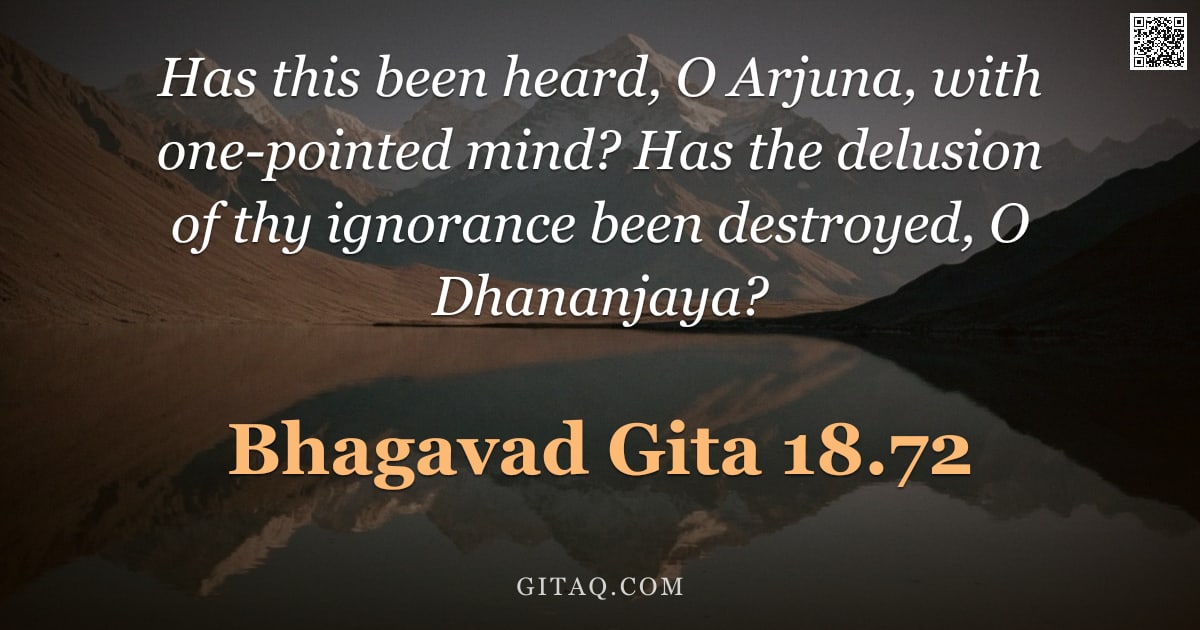
In this final verse, Lord Krishna asks Arjuna if he has truly listened to the teachings with a focused mind and if his confusion about right action is now gone. Spoken by Krishna directly to Arjuna at the end of their conversation on the battlefield, it serves as a check for genuine understanding rather than just hearing words. The core teaching emphasizes that spiritual knowledge must be internalized deeply through concentration to remove the delusion caused by ignorance.
The Teaching Behind It
This verse belongs primarily to Jnana Yoga (the yoga of knowledge) and marks the transition from intellectual understanding to realized wisdom. It develops the concept that true liberation comes when 'Agyanam' (ignorance), which manifests as delusion about one's duties and identity, is completely destroyed by focused contemplation.
Word by Word
Classical Commentary
Where This Happens
This verse appears at the very conclusion of Chapter 18, immediately after Lord Krishna has finished explaining complex topics like renunciation, knowledge, and devotion to Prince Arjuna on the battlefield of Kurukshetra. The sun is setting over the war-torn field as the dialogue nears its end, leaving Arjuna in a state of emotional turmoil that needs resolution before he can fight his cousins. Krishna pauses here not just to speak, but to verify if the heavy wisdom imparted has taken root in Arjuna's heart and cleared away his previous doubts.
Living It Out Today
Consider facing a major career decision where conflicting advice from family and colleagues is causing you severe anxiety and indecision. After reading through various books or listening to mentors for days, take a moment of deep silence to ask yourself: 'Do I truly understand the path forward now?' If your confusion remains, it means you were distracted by noise rather than focusing on one clear truth; if clarity has arrived, proceed with confidence.
Explained for Children
Imagine you are learning how to ride a bike and your coach asks, 'Are you listening carefully? Do you understand now?' That is what Krishna does here with Arjuna. He wants to make sure that all the confusing thoughts about fear and duty have disappeared from Arjuna's mind so he can feel strong and ready again.
Daily Reflection
You might find that even after hearing profound truths, a subtle shadow of uncertainty remains in your mind today. Yet, true faith is not just about knowing words but allowing those words to completely transform how you see yourself and the world around you. When Arjuna's delusion was cleared by Krishna's teaching, his path became clear; similarly, when your own ignorance fades through sincere listening, clarity follows naturally.
A Practice for Today
Settle your mind with one-pointed focus, quieting the noise to truly listen to wisdom as Krishna speaks. In this stillness, invite the light of understanding to dissolve any lingering fog of doubt or confusion within you.
Key Teachings
- The Power of One-Pointed Attention
Divine wisdom requires a focused mind free from distraction to be fully absorbed. Without this singular concentration (ekāgreṇa cetasā), the depth of spiritual truth remains superficial. - The Nature of Ignorance as Delusion
Ignorance is not merely a lack of information but an active state of confusion that obscures our true nature. The ultimate goal of this teaching is to ensure the total destruction (pranaṣṭa) of this mental fog. - Verification of Spiritual Progress
True learning is measured by the transformation of the listener rather than just the recitation of verses. Krishna checks for results, asking if the delusion has truly vanished before considering the teaching complete.
Themes
Related Verses
Read This Next
- 2.47 — To understand the foundation of action without attachment, which prepares the mind for such deep listening.
- 3.30 — To see how dedicating all actions to the Divine supports the destruction of ignorance through surrender.
- 12.15 — To learn about the qualities of a devotee who has achieved peace and is free from distress, reflecting the state after delusion ends.
Recommended Reading
GitaQ earns from qualifying purchases as an Amazon Associate.