Bhagavad Gita 18.4
Moksha Sanyasa Yoga · English Translation
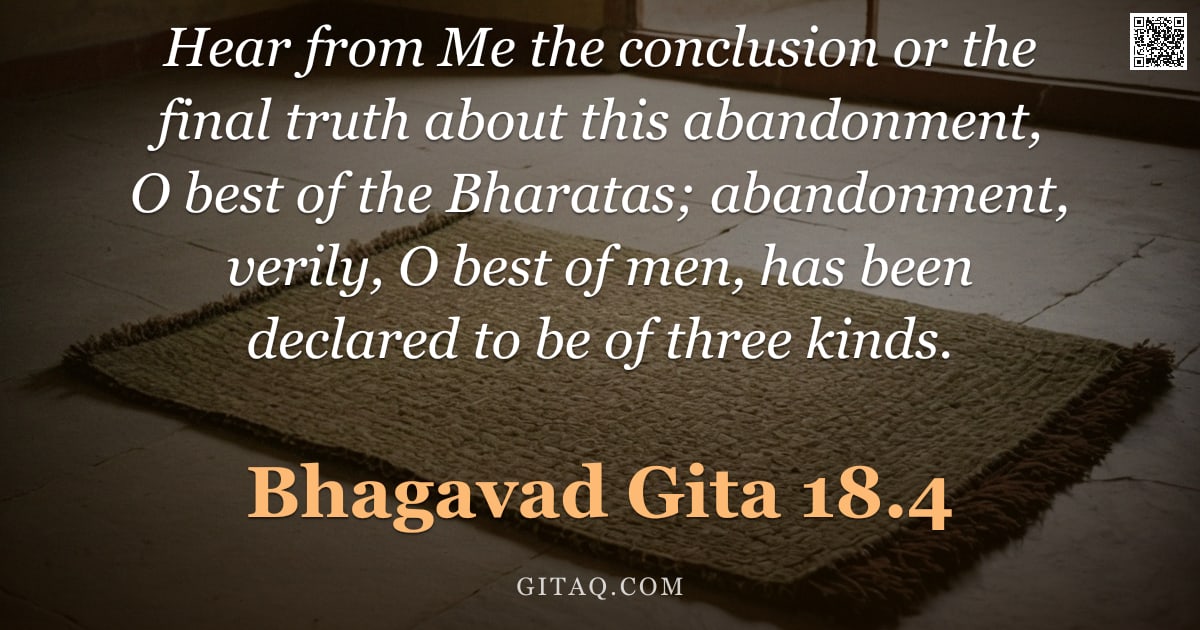
निश्चयं शृणु मे तत्र त्यागे भरतसत्तम | त्यागो हि पुरुषव्याघ्र त्रिविधः सम्प्रकीर्तितः ||१८-४||
niścayaṃ śṛṇu me tatra tyāge bharatasattama . tyāgo hi puruṣavyāghra trividhaḥ samprakīrtitaḥ ||18-4||
What Does This Verse Mean?
In this verse, Lord Krishna responds to Arjuna's request for clarity on the concept of renunciation. He addresses Arjuna as the best among the Bharata lineage and promises to reveal the definitive truth about 'tyaga' (abandonment). The core teaching is that true abandonment is not a single act but exists in three distinct forms, each with different motivations and results.
The Teaching Behind It
This verse introduces the foundational framework of Karma Yoga within Vedanta by categorizing action and inaction based on the state of consciousness (Sattva, Rajas, Tamas). It bridges Sankhya philosophy's analysis of qualities with practical spiritual discipline, preparing the ground for Krishna to explain which form of abandonment leads to liberation.
Word by Word
Classical Commentary
Where This Happens
This verse occurs during the critical discourse between Prince Arjuna and Lord Krishna on the battlefield of Kurukshetra, right after Arjuna expresses his confusion regarding the nature of renunciation. Having just heard that one should perform duties without attachment to results (Chapter 18), Arjuna seeks a deeper definition: what exactly constitutes 'tyaga' or abandonment? As the best warrior and leader of their lineage, Krishna prepares to dismantle common misconceptions by categorizing this spiritual practice into three distinct types.
Living It Out Today
Consider an employee who wants to quit a toxic job. They might leave out of anger (passion), believing it is the only way; they might stay in fear of losing their income despite knowing it harms them, which Krishna classifies as ignorance; or they might hand over responsibility with calm dedication because the role no longer aligns with their values, representing true renunciation. Understanding these three types helps you distinguish between running away from a problem and making a conscious choice to let go for higher growth.
Explained for Children
Imagine you have a big box of old toys. You might throw them away because they are broken, or maybe just to clean your room, or perhaps because you want to give the good ones to someone else who needs them more. Lord Krishna is telling us that saying 'I will stop doing something' isn't just one thing; it can be done in three different ways depending on why we do it and how our heart feels about letting go.
Daily Reflection
Today, notice how often you hesitate to let go because you fear losing something tangible. The verse invites you to see that true renunciation isn't about abandoning life itself, but releasing your rigid attachment to specific outcomes or titles. When you shift from 'I must keep this' to 'I will offer this,' a profound lightness replaces the heavy weight of expectation.
A Practice for Today
Pause and ask yourself what you are currently holding onto that feels like it defines your security or identity. Visualize gently placing those burdens down, not as a loss of self, but as a release into the clarity of purpose described by Krishna.
Key Teachings
- The Complexity of Renunciation
Krishna clarifies that giving up action or possessions is not as simple as it seems, requiring discernment to distinguish between true spiritual surrender and mere laziness. This verse sets the stage for a nuanced exploration where abandonment can be pure, mixed with passion, or rooted in ignorance. - The Threefold Nature of Tyaga
The text declares that renunciation manifests in three distinct modes based on one's inner disposition and motivation. Understanding which type dominates your actions is the first step toward transforming a mechanical duty into spiritual liberation. - Divine Discernment Required
Only through divine wisdom can one correctly categorize their renunciation, as human judgment alone often mistakes avoidance for sacrifice. This teaching demands an honest audit of our intentions before we claim to be 'renunciates' in the true sense.
Themes
Related Verses
Read This Next
- 2.47 — Read this next to understand the foundational principle of acting without attachment to results, which underpins all forms of renunciation.
- 3.30 — This verse complements 18:4 by showing how one should mentally dedicate actions and their fruits entirely to the Divine as a practical form of tyaga.
- 12.15 — After analyzing the types of renunciation, read this verse to see the ultimate fruit: becoming dear to God through selfless conduct and equanimity.
Recommended Reading
GitaQ earns from qualifying purchases as an Amazon Associate.