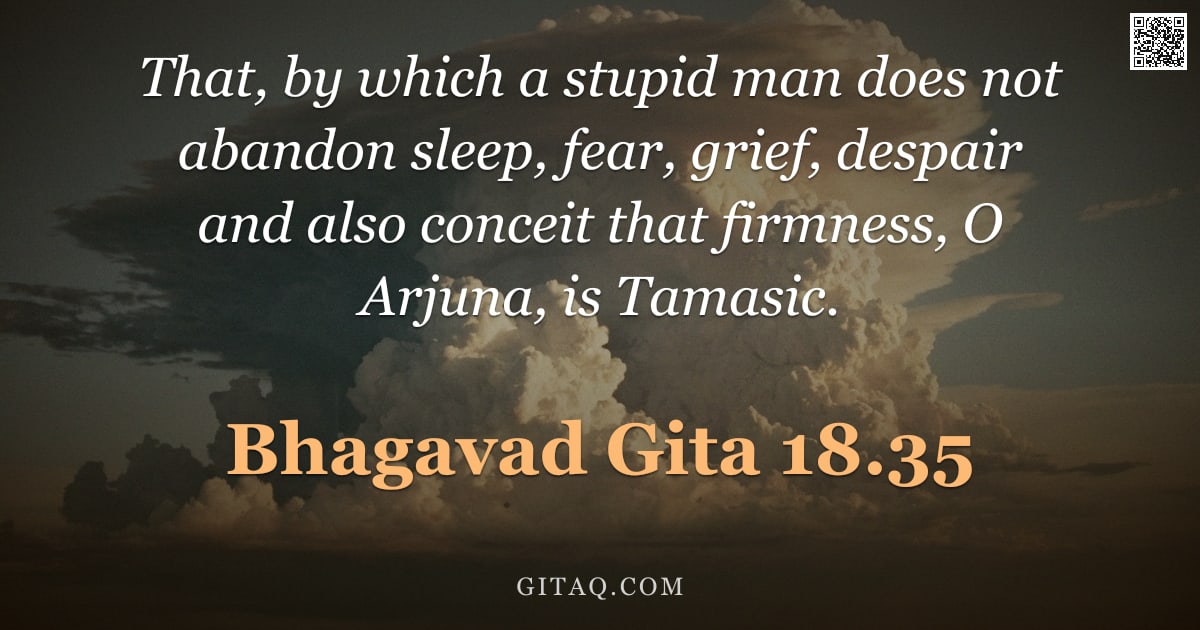
Bhagavad Gita 18.35
Moksha Sanyasa Yoga · English Translation
यया स्वप्नं भयं शोकं विषादं मदमेव च | न विमुञ्चति दुर्मेधा धृतिः सा पार्थ तामसी ||१८-३५||
yayā svapnaṃ bhayaṃ śokaṃ viṣādaṃ madameva ca . na vimuñcati durmedhā dhṛtiḥ sā pārtha tāmasī ||18-35||
What Does This Verse Mean?
In this verse, Lord Krishna describes the lowest quality of human resolve or steadfastness as 'Tamasic,' meaning dark and ignorant. He explains that a person with poor judgment holds onto negative states like excessive sleep, fear, grief, despair, and arrogance instead of letting them go. This type of firmness traps the individual in suffering rather than leading to liberation. Krishna is speaking directly to Arjuna on the battlefield of Kurukshetra.
The Teaching Behind It
This verse belongs to the philosophical framework analyzing the three Gunas (Sattva, Rajas, Tamas) that govern all human behavior and consciousness. It specifically develops the concept of Dhriti (firmness or willpower), showing how resolve can be a source of bondage if it is rooted in ignorance rather than clarity.
Word by Word
Classical Commentary
Where This Happens
This teaching occurs on the battlefield of Kurukshetra during the Mahabharata war, where Prince Arjuna has collapsed in despair at having to fight his own relatives. After Krishna begins explaining the nature of action and renunciation in Chapter 18, he is now categorizing different types of resolve (Dhriti) based on the three gunas or qualities of material nature. At this specific moment, Arjuna is shifting from confusion to understanding how to distinguish between spiritual strength and ignorance.
Living It Out Today
Consider a professional who stays in a toxic job for years not out of duty, but because they are paralyzed by fear of unemployment (fear), overwhelmed by stress (grief/despair), or unable to admit their mistakes due to pride (conceit). A 'Tamasic' mindset here is the refusal to let go of these emotions and seek a new path. True strength in this scenario would be having the courage to accept reality, release the anxiety, and make a difficult but necessary change.
Explained for Children
Imagine a child who refuses to let go of their toys even when it's time for bed, or gets so scared they won't try new games because they might fall down. That stubbornness isn't actually being brave; it just keeps them stuck in the dark. This verse is like saying that holding onto scary thoughts, sad feelings, or thinking you are better than everyone else stops us from growing up and feeling happy.
Daily Reflection
Today, notice where your own firmness has turned rigid or heavy; perhaps you are refusing to let go of a fear or an old grief because it feels like part of who you are. This verse invites you to see that such stubborn clinging is not strength but a Tamasic fog that dulls your spirit and keeps the light out. When you catch yourself in this state, offer yourself kindness rather than judgment, knowing that awareness alone can begin to melt these frozen patterns.
A Practice for Today
Sit quietly and observe how your mind clings to the heaviness of sleep, fear, or self-importance as if these were essential truths rather than passing clouds. Gently release this grip on the 'durmedha' (stupidity) that binds you, recognizing that true steadiness arises not from holding onto darkness but from letting it dissolve into awareness.
Key Teachings
- The Trap of Rigid Firmness
True strength is often mistaken for stubbornly holding onto negative states like fear or sleepiness. The verse identifies this specific type of unyielding attachment as 'Tamas,' a quality that binds rather than liberates. - The Five Bonds of Ignorance
Sleep, fear, grief, despair, and conceit are listed not merely as emotions but as the specific anchors of an unawakened mind. These five elements form a cohesive web that keeps the 'durmedha' or dull-witted person trapped in cycles of suffering. - The Nature of Tamasic Steadiness
While the Gita praises firmness (dhriti), it clarifies that this particular quality is only virtuous when aligned with wisdom and light. When a person's resolve serves to maintain their own delusion or suffering, that 'firmness' becomes an obstacle to Moksha.
Themes
Related Verses
Read This Next
- 2.47 — Read this next to understand the Gita's definition of rightful action and how it contrasts with the attachment described in verse 18.35.
- 3.30 — This verse offers the practical method of surrendering actions, which is essential for dissolving the conceit and despair mentioned here.
- 12.15 — After identifying Tamasic qualities, read this to learn how a devotee who causes no distress becomes dear to Krishna, representing the Sattvic ideal of steadiness.
Recommended Reading
GitaQ earns from qualifying purchases as an Amazon Associate.