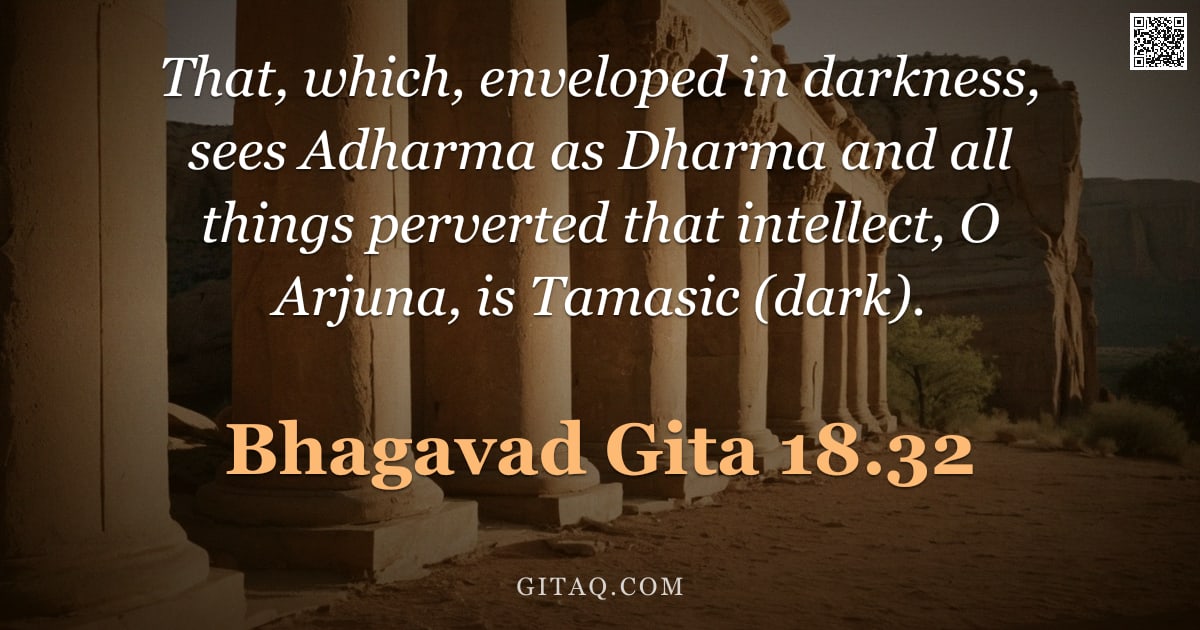
Bhagavad Gita 18.32
Moksha Sanyasa Yoga · English Translation
अधर्मं धर्ममिति या मन्यते तमसावृता | सर्वार्थान्विपरीतांश्च बुद्धिः सा पार्थ तामसी ||१८-३२||
adharmaṃ dharmamiti yā manyate tamasāvṛtā . sarvārthānviparītāṃśca buddhiḥ sā pārtha tāmasī ||18-32||
What Does This Verse Mean?
In this verse, Lord Krishna tells Arjuna that an intellect clouded by ignorance mistakes wrong actions for right ones and sees everything upside down. This state is called 'Tamasic' because it is shrouded in darkness, much like trying to see clearly through a thick fog. The key teaching warns us not to trust our initial judgment if we are driven by confusion or selfish motives rather than clear wisdom.
The Teaching Behind It
This verse belongs to Jnana Yoga (the path of knowledge) within the broader framework of Sankhya philosophy as presented in the Gita. It develops the concept that true wisdom requires distinguishing between reality and illusion, asserting that an intellect distorted by ignorance cannot lead to liberation or right action.
Word by Word
Classical Commentary
Where This Happens
This verse occurs on the battlefield of Kurukshetra during the great Mahabharata war, where Arjuna is overwhelmed by grief and moral confusion. Krishna has just finished explaining the three types of knowledge (Sattvic, Rajasic, Tamasic) in verses 18.20-31 to help Arjuna discern right from wrong. As a warrior prince paralyzed by doubt about fighting his own relatives, Arjuna needs this specific warning against intellectual confusion that could lead him to abandon his duty.
Living It Out Today
Consider a manager who believes cutting corners on safety is 'smart business' because it boosts short-term profits; they are seeing Adharma (harm) as Dharma (duty). This Tamasic thinking blinds them to the long-term consequences and ethical violations, leading to eventual failure. The lesson here is that before making high-stakes decisions, we must pause to check if our judgment is clouded by greed or fear rather than clear conscience.
Explained for Children
Imagine putting on sunglasses that make everything look backwards—like thinking eating candy for dinner is healthy and good! Krishna tells Arjuna that when our mind gets clouded like this, it forgets what is truly right. Just as you need to take off the dark glasses to see clearly again, we must clear away confusion in our hearts to know the difference between doing a bad thing and a good one.
Daily Reflection
Today, I invite you to gently examine the choices you make in moments of uncertainty; often we mistake our comfort for safety and our impulsive reactions as necessary actions. When your intellect is wrapped in this darkness, it leads you down paths that feel right but ultimately bring confusion or pain to yourself and others. Let us ask Krishna today to guide our discernment so we can see the true nature of things clearly.
A Practice for Today
Sit quietly and observe where your mind currently perceives right from wrong, asking if this judgment is clouded by fear or confusion rather than clarity. Invite the light of wisdom to dissolve any dark habits that have confused duty with desire or harm as a path forward.
Key Teachings
- The Fog of Ignorance
Tamasic intellect is not merely a lack of knowledge, but an active state where one's vision is completely obscured by spiritual darkness. This condition causes the mind to lose its ability to distinguish between what is beneficial and what is harmful. - The Great Reversal
A defining characteristic of this lower consciousness is seeing Adharma (unrighteousness) as Dharma, effectively inverting the moral order. This reversal leads individuals to justify destructive behaviors or selfish desires under the guise of duty. - The Call for Clarity
Recognizing this state is the first step toward liberation from the cycle of confusion and suffering described in the Gita. By identifying these darkened tendencies, one can begin to cultivate a Sattvic intellect that sees reality as it truly is.
Themes
Related Verses
Read This Next
- 2.47 — To understand the balance of action and detachment that counters tamasic confusion.
- 3.30 — For guidance on how to surrender actions to the Divine rather than acting out of egoistic darkness.
- 12.15 — To learn about the qualities of a devotee who is free from such delusions and firmly established in goodness.
Recommended Reading
GitaQ earns from qualifying purchases as an Amazon Associate.