Bhagavad Gita 18.30
Moksha Sanyasa Yoga · English Translation
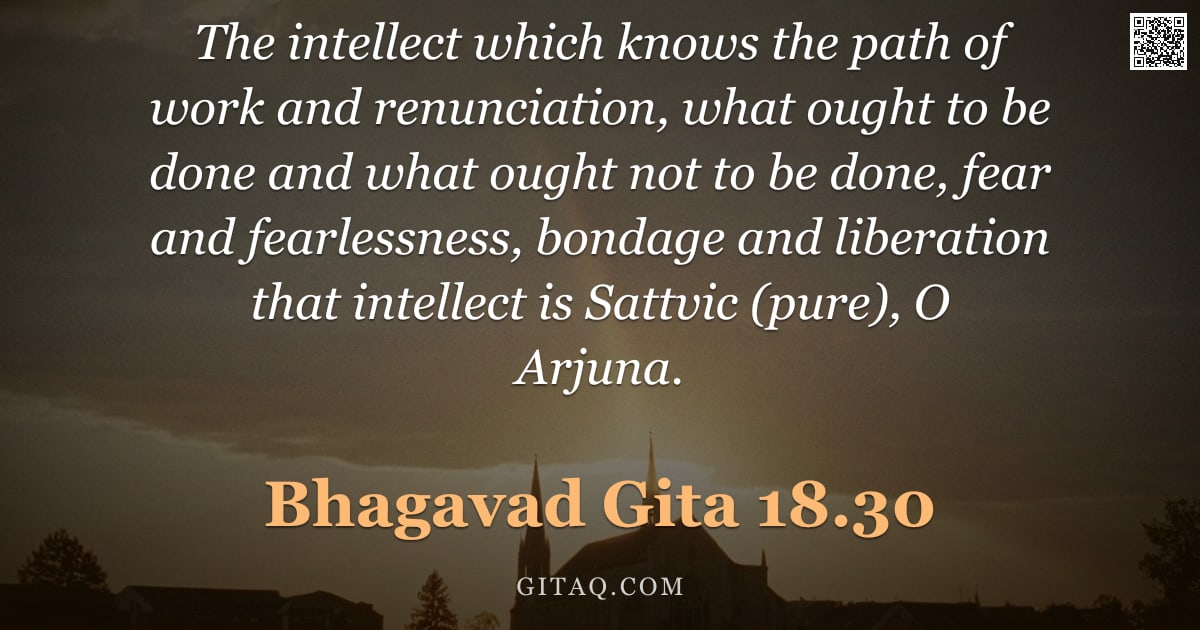
प्रवृत्तिं च निवृत्तिं च कार्याकार्ये भयाभये | बन्धं मोक्षं च या वेत्ति बुद्धिः सा पार्थ सात्त्विकी ||१८-३०||
pravṛttiṃ ca nivṛttiṃ ca kāryākārye bhayābhaye . bandhaṃ mokṣaṃ ca yā vetti buddhiḥ sā pārtha sāttvikī ||18-30||
What Does This Verse Mean?
In this verse, Lord Krishna describes the qualities of a pure and wise mind to Arjuna on the battlefield. He explains that true wisdom involves understanding when to act and when to stop, distinguishing between right and wrong actions, recognizing fear versus courage, and knowing what binds us or frees us. This balanced perspective is called 'Sattvic' intelligence because it leads one toward clarity and liberation rather than confusion.
The Teaching Behind It
This verse belongs primarily to Jnana Yoga (the yoga of knowledge) and Sankhya philosophy, as it focuses on the discriminative power of the intellect (buddhi vichara). It develops the concept that true wisdom is not just knowing facts, but having the discernment to distinguish between the transient results of action and the eternal state of freedom.
Word by Word
Classical Commentary
Where This Happens
This verse appears at the climax of Lord Krishna's discourse on the battlefield of Kurukshetra, just before he concludes his teachings and urges Arjuna to make a final decision. The context follows a long discussion where Krishna has categorized human nature into three modes: Sattva (goodness), Rajas (passion), and Tamas (ignorance). Arjuna is currently in a state of deep confusion and sorrow, having just witnessed his relatives arrayed for war, so Krishna provides this definition to help him cut through the fog of doubt with pure understanding.
Living It Out Today
Consider a professional facing a critical ethical dilemma at work where their boss pressures them to falsify data. A Sattvic intellect allows them to see that doing nothing (renunciation) is not an option for growth, but committing fraud (wrong action) leads to future bondage and fear of exposure; conversely, they recognize the courage required to report the truth as a path to liberation from guilt. By applying this wisdom, they choose integrity over immediate comfort, realizing that true success comes from aligning their actions with moral clarity rather than anxiety.
Explained for Children
Imagine you are playing a game where sometimes running fast helps you win, but other times stopping to think carefully is better. A smart player knows exactly when to run (action) and when to wait (renunciation), understands the rules of what they can do versus what they shouldn't, and isn't scared even in tough moments because they trust their skills. This kind of clear thinking helps you feel free from worry instead of getting stuck, which is like having a super-smart brain that always makes good choices.
Daily Reflection
Today, notice how often your mind creates shadows out of thin air, mistaking imagined fears for real dangers or confusing bondage with necessary discipline. When you feel stuck between doing nothing and acting impulsively, remember that a Sattvic intellect acts as a clear mirror, reflecting exactly what needs to be done without the distortion of anxiety. You are invited to trust this inner clarity today, knowing that every right choice moves you gently toward freedom rather than adding weight.
A Practice for Today
Sit quietly and observe your mind as it evaluates today's challenges, asking if you are distinguishing between action driven by clarity or fear-driven avoidance. Invite a moment of stillness where the intellect rests in its natural state, recognizing that true wisdom sees both the duty to act and the grace of letting go without confusion.
Key Teachings
- The Clarity of Right Action
True wisdom distinguishes clearly between what is beneficial and harmful in any situation. It removes the gray area where hesitation often breeds, allowing one to act with certainty based on duty rather than desire. - Understanding Fearlessness
A pure intellect does not shrink from challenges nor cling blindly to comfort; it perceives reality as it is. This vision transforms fear into courage and identifies true bondage in attachment while recognizing liberation in detachment. - The Balance of Renunciation
Renunciation is not merely the abandonment of work but the renunciation of selfish results attached to action. The wise mind understands that both engagement (pravritti) and withdrawal (nivritti) have their place in the spiritual journey.
Themes
Related Verses
Read This Next
- 2.47 — Read this to understand the foundational principle of performing action without attachment to results.
- 3.30 — Explore how surrendering all actions to the Divine purifies the intellect and leads to liberation.
- 12.15 — See how a person who is free from fearlessness and distress embodies the Sattvic qualities described in this verse.
Recommended Reading
GitaQ earns from qualifying purchases as an Amazon Associate.