Bhagavad Gita 18.14
Moksha Sanyasa Yoga · English Translation
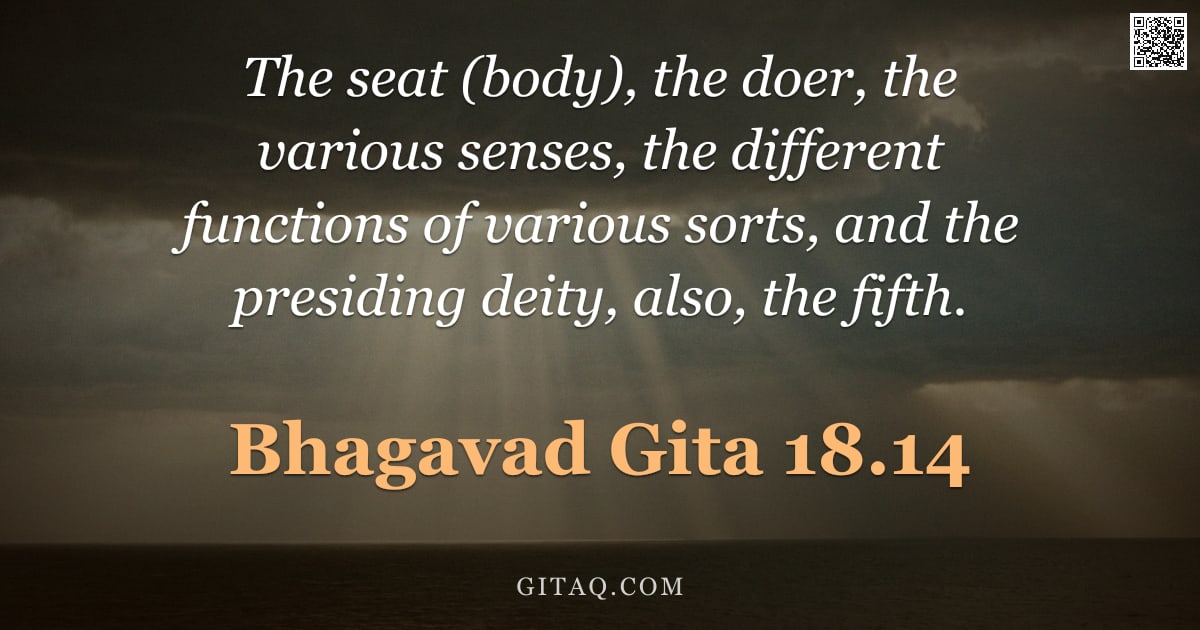
अधिष्ठानं तथा कर्ता करणं च पृथग्विधम् | विविधाश्च पृथक्चेष्टा दैवं चैवात्र पञ्चमम् ||१८-१४||
adhiṣṭhānaṃ tathā kartā karaṇaṃ ca pṛthagvidham . vividhāśca pṛthakceṣṭā daivaṃ caivātra pañcamam ||18-14||
What Does This Verse Mean?
In this verse, Lord Krishna explains to Arjuna that every action involves five essential components working together. These include the physical body as the base, the individual who acts, the various senses and tools used, the specific effort made, and finally, a divine force or destiny beyond our control. The key teaching is that human agency is just one part of a larger cosmic process; we cannot claim total ownership over results because fate plays an equal role.
The Teaching Behind It
This verse belongs primarily to Karma Yoga and Sankhya philosophy, specifically developing the concept of 'Pancha-karaṇīya' (five factors). It bridges the gap between individual free will and divine determinism by categorizing the mechanics of action into a holistic framework.
Word by Word
Classical Commentary
Where This Happens
This verse occurs near the end of the Bhagavad Gita during the final chapters on the battlefield of Kurukshetra. Arjuna has just listened to Krishna's detailed teachings and is now asking for clarification on how one attains true renunciation (Sannyasa). As a warrior prince paralyzed by duty, he seeks to understand exactly which parts of action belong to him versus what belongs to fate or God.
Living It Out Today
When facing a difficult work project that fails despite your best efforts, remember this verse: you controlled the effort and tools, but factors like market changes (divine force) were beyond your control. Instead of spiraling into self-blame for not 'doing enough,' acknowledge that five elements contributed to the outcome. This realization allows you to accept the result with peace while focusing on improving only what is within your power next time.
Explained for Children
Imagine you are baking a cake with your family. You have the kitchen (the body), you and your mom who mix the batter (the doers), the bowl and spoon (the senses/tools), your stirring motion (the effort), and maybe the special recipe or luck that makes it rise perfectly (divine force). Just like you can't bake a cake all by yourself without help from ingredients, tools, and sometimes good timing, nothing in our lives happens because of just one person; there are always five things working together to make something happen.
Daily Reflection
Today, you might feel overwhelmed by the sheer number of tasks demanding your attention or the complexity of your relationships. Remember that just as this verse reminds us, there is always a fifth element at play—the Divine Will—that holds everything together even when we cannot see it. You are not alone in carrying these burdens; you are supported by a grand design where every sense and function has its purpose under divine guidance.
A Practice for Today
Sit with your body as a sacred vessel, acknowledging it not as 'you' but as the seat where life unfolds. Observe how your senses and actions arise from a source greater than your individual will, inviting a quiet surrender to the divine presence that orchestrates every movement.
Key Teachings
- The Five Instruments of Action
Krishna categorizes the machinery of karma into five distinct components, ranging from the physical body to the subtle cosmic will. This framework helps us understand that action is never a solitary event but a convergence of multiple causes and effects. - The Illusion of the Solo Doer
By listing 'the doer' alongside other factors, the verse gently challenges our egoic sense of being the sole author of every deed. It invites us to see that while we act, we are instruments within a larger cosmic play. - Divine Order in All Endeavors
The inclusion of 'daiva' or destiny as the fifth factor assures us that no action exists outside of divine law and timing. Recognizing this allows for a shift from anxiety about results to trust in the underlying harmony of existence.
Themes
Related Verses
Read This Next
- 2.47 — To understand how to act without attachment when we recognize our role as just one part of a larger whole.
- 3.30 — To learn the practical instruction on surrendering all actions and their fruits specifically to the Divine, aligning with the 'fifth factor' mentioned here.
- 12.15 — To see how a devotee who understands this cosmic order naturally becomes dear to Krishna by being free from selfish desires and agitation.
Recommended Reading
GitaQ earns from qualifying purchases as an Amazon Associate.