Bhagavad Gita 18.15
Moksha Sanyasa Yoga · English Translation
शरीरवाङ्मनोभिर्यत्कर्म प्रारभते नरः | न्याय्यं वा विपरीतं वा पञ्चैते तस्य हेतवः ||१८-१५||
śarīravāṅmanobhiryatkarma prārabhate naraḥ . nyāyyaṃ vā viparītaṃ vā pañcaite tasya hetavaḥ ||18-15||
What Does This Verse Mean?
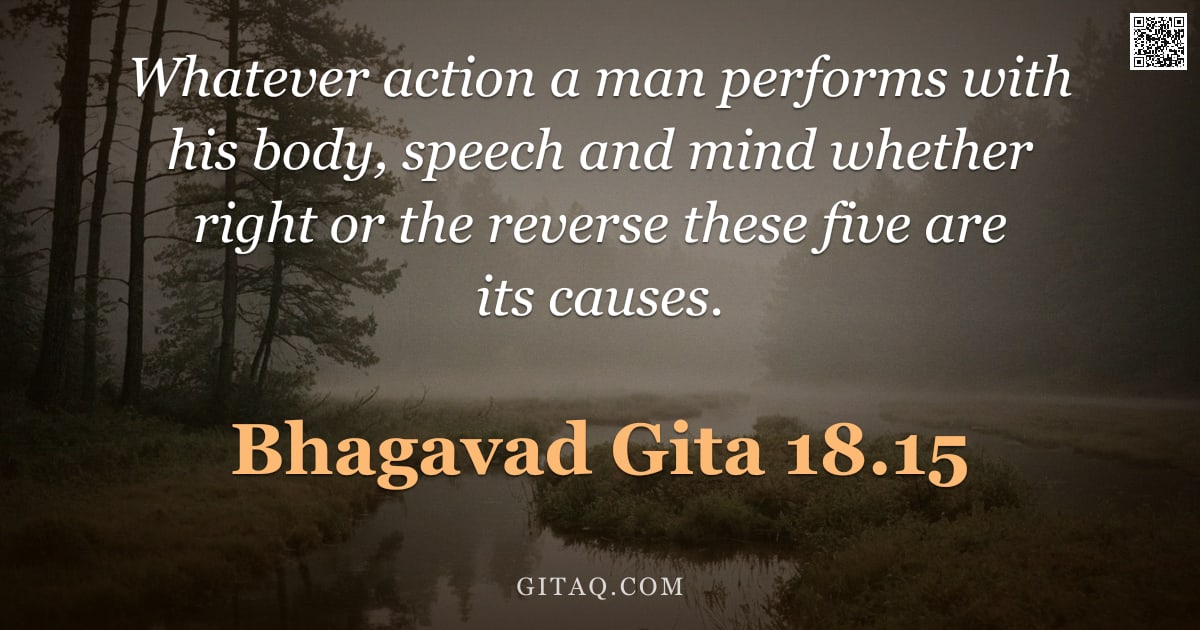
In this verse, Lord Krishna explains to Arjuna that every action we perform—whether right or wrong—is the result of five specific causes working together: our body, speech, mind, the individual performing it, and divine providence. This teaching highlights that no one acts in isolation; our physical actions are supported by how we speak, what we think, who we choose to be as an agent, and the larger forces at play. Krishna urges Arjuna to understand this complete picture of causality before he takes up his duty on the battlefield.
The Teaching Behind It
This verse belongs to the core of Karma Yoga, specifically addressing the mechanics of action and its consequences. It develops the concept that while we are responsible for our intentions and efforts (the agent), the outcome is never solely in our hands because it depends on physical, mental, verbal, and providential factors.
Word by Word
Classical Commentary
Where This Happens
This verse appears in Chapter 18 of the Bhagavad Gita, spoken by Lord Krishna to Prince Arjuna on the battlefield of Kurukshetra. Just prior to this shloka, Krishna has been explaining the three types of knowledge and action, leading up to a detailed breakdown of why people act the way they do based on their nature (gunas). Arjuna is deeply anxious about fighting his own kinsmen, seeking clarity on whether he can truly be held responsible for such a terrible duty. This verse serves as a foundational explanation that while we are agents of action, our actions arise from a complex web of causes beyond simple will.
Living It Out Today
Consider a modern scenario where you make a harsh comment to your spouse during a stressful day at work and immediately feel regretful or defensive. Instead of getting stuck in self-blame ('I am bad') or blame-shifting ('They made me angry'), this verse invites you to analyze the five causes: Did your tired body contribute? Was it an automatic reaction (mind)? What was said (speech), who is saying it, and were there external stressors acting as conditions? Recognizing these five factors helps dissolve ego-based guilt and allows for a more compassionate resolution.
Explained for Children
Imagine you want to build a big sandcastle at the beach. You need your hands (body) to dig, a voice (speech) to ask friends for help, and ideas in your head (mind) about what it should look like. But there are three other things too: you yourself choosing to do it, someone helping with the tools, and even the wind or waves that shape the sand. The Gita says this is how all our actions work; we can't blame just one thing for a result because everything together makes it happen.
Daily Reflection
Today, I invite you to pause before your next big decision and ask yourself: which of my five instruments am I relying on? Often we blame external circumstances when things go wrong, but this verse reminds us that every outcome has deep roots within our own nature. By acknowledging these internal causes with honesty rather than judgment, you reclaim the power to shape a future where right action flows naturally from wisdom.
A Practice for Today
Begin by observing how your body, speech, and mind conspire together to create the actions of this day. Notice that whether an action feels right or wrong, it is always rooted in a specific set of causes within you. Rest for a moment knowing that understanding these five internal drivers is the first step toward mastering them.
Key Teachings
- The Five Instruments of Action
Every human act is a collaboration between body, speech, and mind along with their underlying motivations. We cannot separate the physical deed from the mental intention that birthed it. - Responsibility for Right or Wrong
The verse explicitly states that causes exist for both righteous (nyāyya) and unrighteous (viparīta) actions. This removes any excuse of fate, placing the agency firmly in our own hands. - Roots Determine Fruits
Before judging the outcome of an action, one must investigate its five specific causes. True spiritual progress begins by purifying these internal sources rather than merely altering external results.
Themes
Related Verses
Read This Next
- 2.47 — This verse establishes detachment from results after performing duty, complementing the identification of causes in 18.15.
- 3.30 — It expands on dedicating actions to the Divine as a specific method for purifying the five internal instruments mentioned here.
- 12.15 — This verse describes the qualities of one who has mastered these causes and remains undisturbed by right or wrong outcomes.
Recommended Reading
GitaQ earns from qualifying purchases as an Amazon Associate.