Bhagavad Gita 17.7
Shraddhatraya Vibhaga Yoga · English Translation
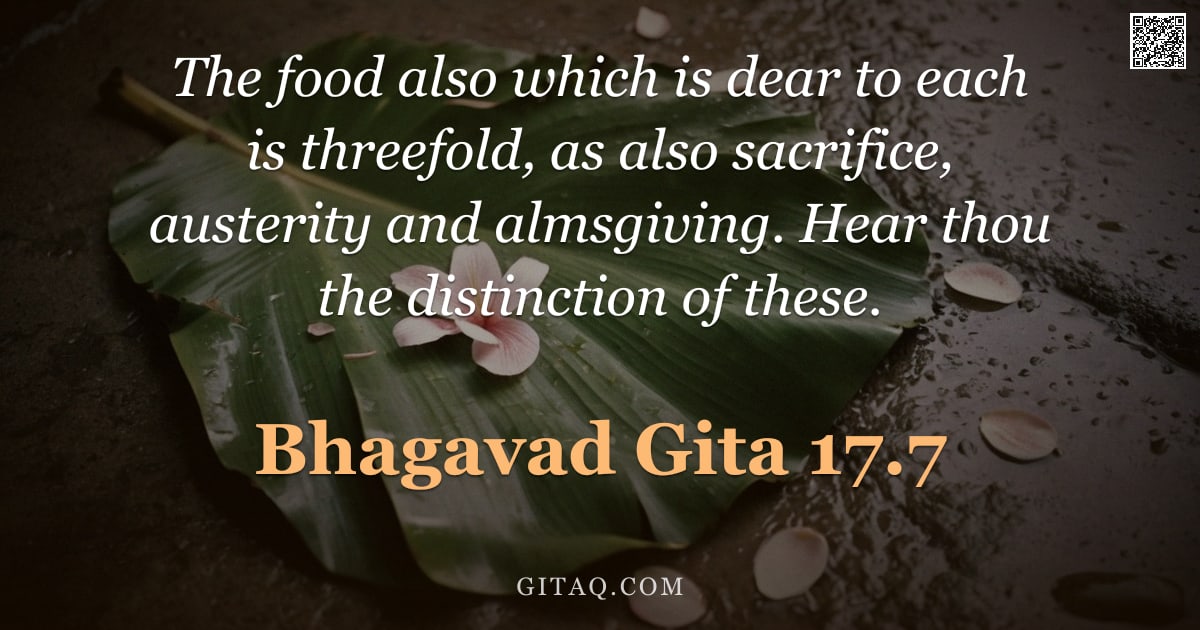
आहारस्त्वपि सर्वस्य त्रिविधो भवति प्रियः | यज्ञस्तपस्तथा दानं तेषां भेदमिमं शृणु ||१७-७||
āhārastvapi sarvasya trividho bhavati priyaḥ . yajñastapastathā dānaṃ teṣāṃ bhedamimaṃ śṛṇu ||17-7||
What Does This Verse Mean?
Lord Krishna tells Arjuna that food, sacrifice, and charity are experienced differently by everyone based on their inner nature or 'faith'. Just as what tastes delicious to one person might be repulsive to another, the spiritual value of an action depends entirely on who is performing it. The verse serves as a bridge, preparing the listener for Krishna's detailed explanation of how these three categories divide into Sattvic (pure), Rajasic (passionate), and Tamasic (ignorant) modes. It teaches that there is no single 'correct' way to eat or give; rather, one must understand their own constitution.
The Teaching Behind It
This verse anchors the Gita's psychological framework within Karma Yoga (the yoga of action), specifically introducing the concept of three modes of nature (gunas: Sattva, Rajas, Tamas). It develops the idea that spiritual merit is not inherent in the external act itself but is determined by the internal state and motivation of the doer. This shifts the focus from rigid ritualism to self-awareness as the primary driver of spiritual growth.
Word by Word
Classical Commentary
Where This Happens
This verse appears in Chapter 17 of the Bhagavad Gita during Krishna's conversation with Arjuna on the battlefield of Kurukshetra, following the war between the Pandavas and Kauravas. After explaining that faith itself is threefold (Chapter 17 starts here), Krishna now begins to categorize specific spiritual practices like eating, rituals, and charity into these same three modes. The listener, Arjuna, has just received this profound insight about human nature and is likely seeking clarity on how to apply these distinctions in his own life as he prepares for the inevitable conflict.
Living It Out Today
Consider a team leader deciding whether to host a high-energy networking mixer or a quiet reflection session after a stressful week. If they force a loud party (Rajasic) on an introverted, burnt-out staff member, it creates anxiety rather than connection; if they choose silence for everyone regardless of need, it feels isolating. The teaching here suggests the leader must assess their team's actual 'food'—their mental state and needs—and offer support that aligns with those individual natures to foster true well-being.
Explained for Children
Imagine you love eating spicy ice cream while your best friend only likes vanilla because it makes them feel sick. In the same way, what feels good for our bodies and hearts changes from person to person! Lord Krishna is teaching that just like food tastes different to everyone, doing good deeds or helping others also depends on who you are inside. He wants us to learn which things make us grow strong and happy without making anyone feel confused.
Daily Reflection
Today, consider if the food on your plate is truly dear to you in a way that uplifts your soul rather than just satisfying hunger. Just as our faith varies by nature, so does what we choose to consume; are you eating with clarity or merely out of habit? When you align your diet and daily actions like sacrifice and charity with a pure heart, even the simplest meal becomes a sacred practice.
A Practice for Today
Pause before your next meal and observe whether it brings you peace, energy, or heaviness; notice how the quality of what you eat mirrors the state of your inner faith. Allow this simple awareness to transform a routine act into an offering that nourishes both body and spirit.
Key Teachings
- The Triad of Nourishment
Krishna reveals that everything dear to us—food, worship, discipline, and giving—is filtered through our three inherent modes: goodness (sattva), passion (rajas), and ignorance (tamas). What we find 'dear' is often a reflection of our current spiritual state rather than an absolute truth. - Food as Spiritual Medicine
The verse establishes that diet is not merely biological but deeply psychological, influencing the mind's capacity for meditation and clarity. Understanding this distinction allows one to choose foods that promote longevity and vitality instead of those causing lethargy or agitation. - Unified Practice in Action
By grouping sacrifice, austerity, and charity with food, the text teaches that external rituals are meaningless without internal purity. True spiritual progress requires aligning all four areas—what we eat, how we worship, our self-discipline, and our generosity—with a steady faith.
Themes
Related Verses
Read This Next
- 17.8 — This verse immediately follows by detailing specifically which foods belong to each mode (goodness, passion, ignorance), making it the natural next step for practical application.
- 3.9 — It introduces Yajna (sacrifice) as a duty performed without attachment, providing context on how one should approach ritual action mentioned in 17.7.
Recommended Reading
GitaQ earns from qualifying purchases as an Amazon Associate.