Bhagavad Gita 17.28
Shraddhatraya Vibhaga Yoga · English Translation
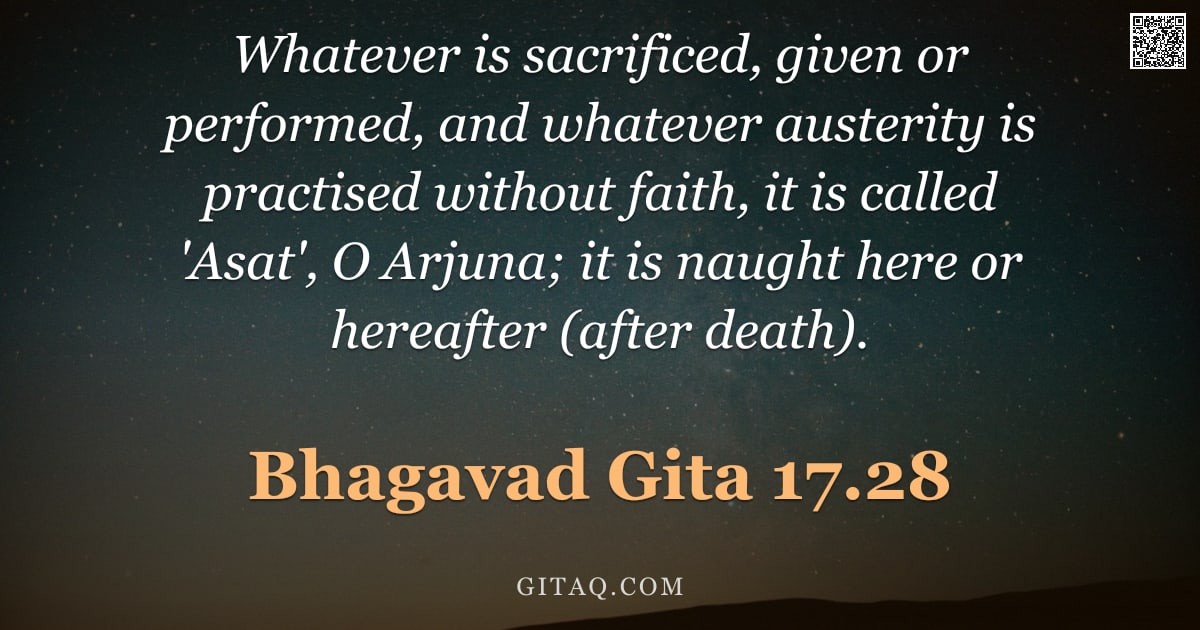
अश्रद्धया हुतं दत्तं तपस्तप्तं कृतं च यत् | असदित्युच्यते पार्थ न च तत्प्रेत्य नो इह ||१७-२८||
aśraddhayā hutaṃ dattaṃ tapastaptaṃ kṛtaṃ ca yat . asadityucyate pārtha na ca tatprepya no iha ||17-28||
What Does This Verse Mean?
In this verse, Lord Krishna tells Arjuna that any action performed without genuine faith is considered 'Asat' or non-existent in its spiritual value. This applies to acts of sacrifice, charity, and austerities done merely as rituals but lacking inner conviction. The core teaching is that the sincerity and belief behind an action determine its fruit; without faith, these actions yield no results either in this life or the next.
The Teaching Behind It
This verse anchors the concept of 'Shraddha' (faith) as the essential catalyst for Karma Yoga, distinguishing between mechanical action and spiritually potent duty. It reinforces the Vedantic view that consciousness and intention determine the reality of an outcome, asserting that actions without faith lack ontological substance in the spiritual realm.
Word by Word
Classical Commentary
Where This Happens
This verse appears in Chapter 17 during Krishna's discourse to Arjuna on the battlefield of Kurukshetra, immediately following a discussion on how faith manifests differently based on one's nature. At this point, Arjuna is still confused about which rituals and duties he should prioritize before his battle against his kinsmen. Krishna has just explained that even pious acts like charity or fasting can be useless if they are not rooted in the right kind of belief.
Living It Out Today
Consider a professional who volunteers for a company initiative only to gain favor with their boss, rather than believing in the project's value; this lack of genuine faith often leads to burnout and poor results. Similarly, when someone meditates or exercises strictly as a checklist item without connecting to the purpose, they rarely experience lasting peace or health benefits. True success comes from aligning your actions with an internal belief system that drives you forward even when external rewards are absent.
Explained for Children
Imagine you are helping someone because your mom told you to, but inside your heart, you don't really care about them at all. Even if you do a nice thing like giving a gift or cleaning up, it feels empty and doesn't make anyone truly happy. The Gita says that for any good deed—like sharing toys or being kind—to be special, you must mean it from the bottom of your heart.
Daily Reflection
I invite you to look at how much of your day is driven by actions performed without true inner faith. When we do good deeds or follow routines merely out of habit or for show, the energy remains scattered and unfulfilling. True fulfillment comes when every sacrifice, gift, or effort is infused with a heartfelt trust in its purpose.
A Practice for Today
Before offering anything today, pause to ask yourself if your action springs from genuine faith and conviction rather than habit or external pressure. Sit with the feeling of 'Asat' as a void where intention lacks a spiritual anchor, allowing you to root your next act in sincere belief.
Key Teachings
- The Primacy of Faith (Shraddha)
No external action holds spiritual value if it lacks the internal foundation of sincere faith. Without this conviction, even acts that appear virtuous on the surface are deemed 'Asat' or void. - The Scope of Spiritual Action
This verse categorically includes sacrifice (huta), charity (datta), austerity (tapas), and all deeds performed without faith. It teaches that the quality of intent defines the result more than the specific type of action. - The Consequence of Void Actions
Actions lacking faith yield no benefit in this life or the next, effectively rendering them useless for spiritual growth. The verse serves as a warning to examine the source of our motivation before engaging in any religious or selfless practice.
Themes
Related Verses
Read This Next
- 2.47 — To understand the foundation of performing duty without attachment to results before adding the element of faith.
- 3.30 — To learn how to dedicate all actions to the Divine, which is a practical expression of true Shraddha or faith.
- 12.15 — To see the qualities of those who possess supreme devotion and how their faithful nature impacts their spiritual standing.
Recommended Reading
GitaQ earns from qualifying purchases as an Amazon Associate.