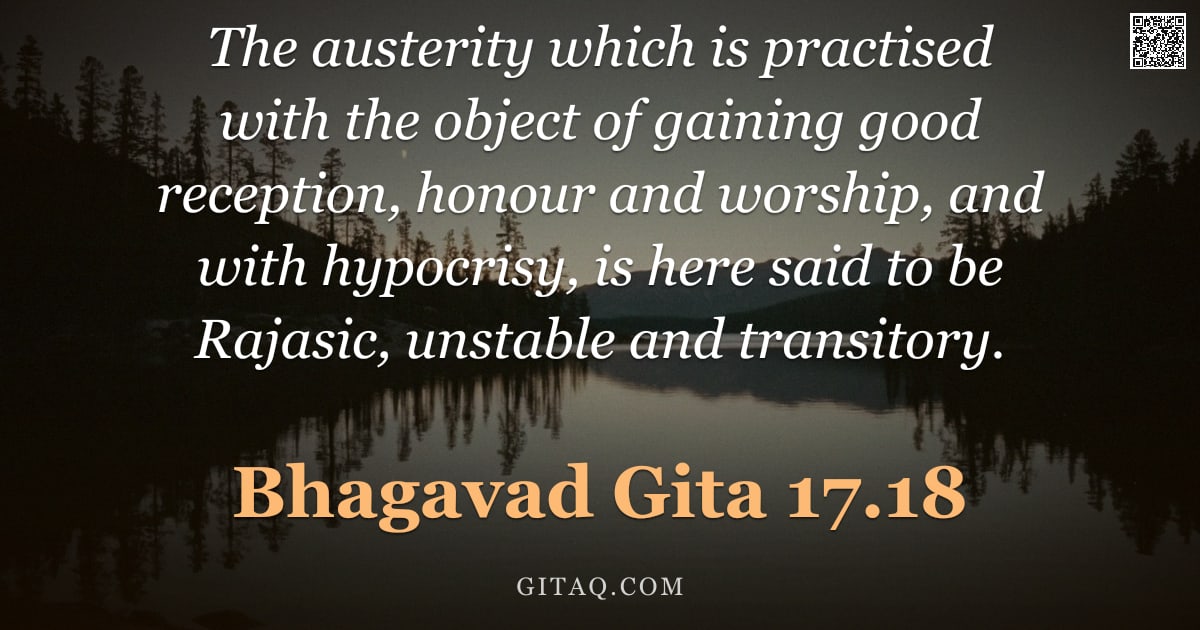
Bhagavad Gita 17.18
Shraddhatraya Vibhaga Yoga · English Translation
सत्कारमानपूजार्थं तपो दम्भेन चैव यत् | क्रियते तदिह प्रोक्तं राजसं चलमध्रुवम् ||१७-१८||
satkāramānapūjārthaṃ tapo dambhena caiva yat . kriyate tadiha proktaṃ rājasaṃ calamadhruvam ||17-18||
What Does This Verse Mean?
In this verse, Lord Krishna explains to Arjuna that spiritual practices like fasting or meditation become Rajasic if they are performed with a hidden agenda for fame, respect, or honor from others. He describes such actions as unstable and temporary because the motivation is rooted in ego rather than pure devotion or self-improvement. The core teaching warns that when action is driven by hypocrisy or a desire for external validation, it cannot lead to lasting peace or spiritual growth.
The Teaching Behind It
This verse is a cornerstone of Karma Yoga (the yoga of action) within the framework of Guna theory (Sattva, Rajas, Tamas). It develops the concept that the purity of an action depends entirely on the intention behind it rather than the external form or difficulty of the act itself. Krishna teaches that actions driven by ego and desire for fruit are bound to be unstable, contrasting them with Sattvic actions performed as a selfless offering.
Word by Word
Classical Commentary
Where This Happens
This verse occurs on the battlefield of Kurukshetra during the Mahabharata war, where Lord Krishna is imparting spiritual wisdom to Prince Arjuna, who has just surrendered his confusion and weapons. This specific teaching falls within the chapter discussing 'Shraddhatraya Vibhaga Yoga,' which categorizes faith, food, sacrifice, austerity, charity, and knowledge into three modes of nature (Sattva, Rajas, Tamas). Krishna is addressing Arjuna's deep anxiety about duty by clarifying that even noble actions like austerities can be tainted if performed with the wrong mindset.
Living It Out Today
Consider a professional who volunteers for extra projects at work solely to get noticed by their boss or gain a promotion, rather than out of genuine care for the team's success. They may put in effort initially, but this motivation is 'Rajasic' because it relies on external validation; if they don't receive immediate praise, their enthusiasm will fade and turn into resentment. The lesson here is to shift focus from seeking recognition to finding intrinsic satisfaction in doing one's duty well, which leads to sustainable career growth and inner stability.
Explained for Children
Imagine you do your best work at school just so everyone will clap and say 'Good job' instead of because you actually want to learn the lesson. If you are only doing good things like helping others or studying hard to look cool, it is called being a show-off in this story. Krishna says that kind of behavior feels exciting for a little while but then disappears quickly, just like a bubble that pops. True goodness comes from wanting to do right because it is the right thing to do, not for applause.
Daily Reflection
Have you ever found yourself doing something kind just because it looks good on social media? This verse gently reminds us that when our service is mixed with pride or a craving for honor, the joy we feel quickly fades away. True peace comes only when we act without expecting anything in return, not even gratitude from others.
A Practice for Today
Sit quietly and notice if your good deeds are driven by the desire for praise or a quiet sense of duty. Let go of the need to perform well so others will applaud, and instead anchor your actions in sincerity alone.
Key Teachings
- The Trap of Hypocritical Austerity
Spiritual practices become Rajasic (passionate and restless) when performed with a hidden agenda to gain social status or honor. This hypocrisy creates an inner instability, making the spiritual progress temporary rather than lasting. - The Instability of Ego-Driven Actions
Actions fueled by the desire for applause are inherently unstable because they depend on external validation which is fleeting. When the praise stops or changes, the motivation to continue the practice often collapses with it. - Purity of Intent as a Foundation
To transform one's nature from Rajasic to Sattvic (pure), one must purify the intention behind every act of austerity or service. The value of any spiritual effort lies not in the external reward but in the sincerity and selflessness with which it is undertaken.
Themes
Related Verses
Read This Next
- 2.47 — To understand the principle of acting on duty alone while renouncing attachment to results or rewards.
- 3.30 — To learn how surrendering all actions and their fruits leads to freedom from egoistic motivation.
- 12.15 — To discover the qualities of a devotee who is free from selfishness, hypocrisy, and the desire for recognition.
Recommended Reading
GitaQ earns from qualifying purchases as an Amazon Associate.