Bhagavad Gita 17.15
Shraddhatraya Vibhaga Yoga · English Translation
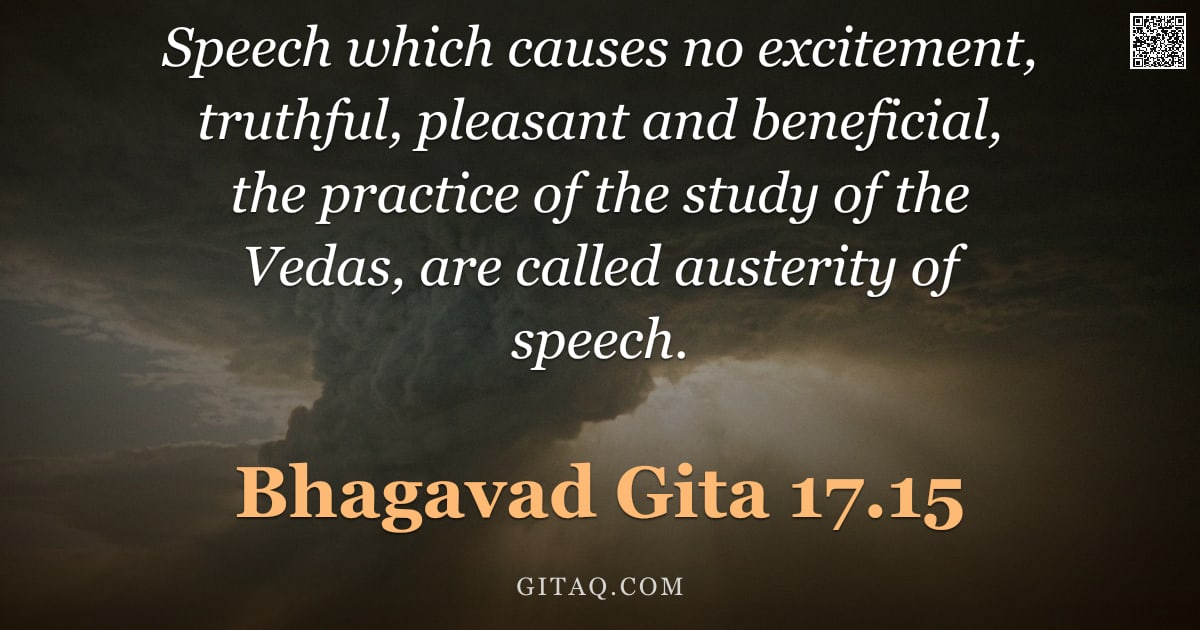
अनुद्वेगकरं वाक्यं सत्यं प्रियहितं च यत् | स्वाध्यायाभ्यसनं चैव वाङ्मयं तप उच्यते ||१७-१५||
anudvegakaraṃ vākyaṃ satyaṃ priyahitaṃ ca yat . svādhyāyābhyasanaṃ caiva vāṅmayaṃ tapa ucyate ||17-15||
What Does This Verse Mean?
In this verse, Lord Krishna describes the ideal standard for speech as part of spiritual discipline known as 'tapas'. He teaches that true austerity of words involves speaking only what is truthful, pleasant to hear, and beneficial without causing fear or agitation in others. This guidance comes from Krishna's ongoing instruction to Arjuna on how to purify one's mind through the control of body, speech, and intellect.
The Teaching Behind It
This teaching falls under the framework of Karma Yoga, specifically focusing on the purification of action through self-discipline (Tapas). It develops the concept that external actions like speech must be rooted in Sattvic qualities—clarity and harmony—to lead to spiritual liberation. The verse illustrates how controlling one's voice is a practical method for mastering the mind and aligning individual will with universal truth.
Word by Word
Classical Commentary
Where This Happens
This verse appears in Chapter 17 of the Bhagavad Gita during Lord Krishna's conversation with Arjuna on the battlefield of Kurukshetra. It follows a detailed discussion where Arjuna asks about those who perform rituals without faith or proper understanding, prompting Krishna to categorize actions based on their underlying nature (Sattva, Rajas, Tamas). At this moment in the dialogue, Arjuna is deeply engaged in seeking clarity on how his own disciplined mind and speech should align with divine will amidst the chaos of war.
Living It Out Today
Consider a workplace scenario where you must deliver feedback to an underperforming colleague; instead of speaking harshly out of frustration or remaining silent due to fear, apply this verse by choosing words that are honest yet delivered gently. By ensuring your message is beneficial for their growth and free from unnecessary agitation, you transform the conversation into a constructive tool rather than a source of conflict. This approach helps maintain professional relationships while upholding integrity during difficult decisions.
Explained for Children
Imagine your words are like seeds you plant; some make flowers grow while others create thorns that hurt people. Lord Krishna teaches us that our best 'words' should be true, kind, helpful, and never scary or upsetting to anyone who hears them. Just like practicing a musical instrument helps you play better, reading sacred stories and chanting with care is like exercise for your voice that makes it beautiful.
Daily Reflection
Today, notice how often your words arise from a place of excitement or anxiety versus calm clarity. When you speak with truth but also kindness, you transform ordinary conversation into an act of spiritual discipline. This simple shift in your voice can bring peace not only to others but to the very rhythm of your own heart.
A Practice for Today
Take three deep breaths, focusing on your next words before you speak them. Ask yourself if these words are free from agitation, honest, and truly beneficial to the listener. Rest in the quiet space where speech is offered as a sacred offering rather than just sound.
Key Teachings
- The Calm Foundation
True austerity begins when speech is free from agitation, ensuring that our words do not stir up disturbance in ourselves or others. This inner stillness allows truth to flow without the interference of emotional turbulence. - Truth with Tenderness
Honesty must always be balanced by pleasantness; a harsh word, even if true, fails the test of beneficial speech. The ideal utterance is one that heals and uplifts while remaining firmly rooted in reality. - The Austerity of Listening
This verse expands austerity beyond physical fasting to include the disciplined study of sacred texts, recognizing knowledge as a vital form of purification. By engaging deeply with wisdom literature and speaking it well, we cultivate a holy discipline that refines the mind.
Themes
Related Verses
Read This Next
- 2.47 — To understand how right action and detachment form the foundation for such disciplined conduct.
- 3.30 — To learn about offering all actions, including speech, to the Divine as a complete surrender.
- 12.15 — To see how one who is not agitated by others and does not disturb them embodies this ideal of peaceful speech.
Recommended Reading
GitaQ earns from qualifying purchases as an Amazon Associate.