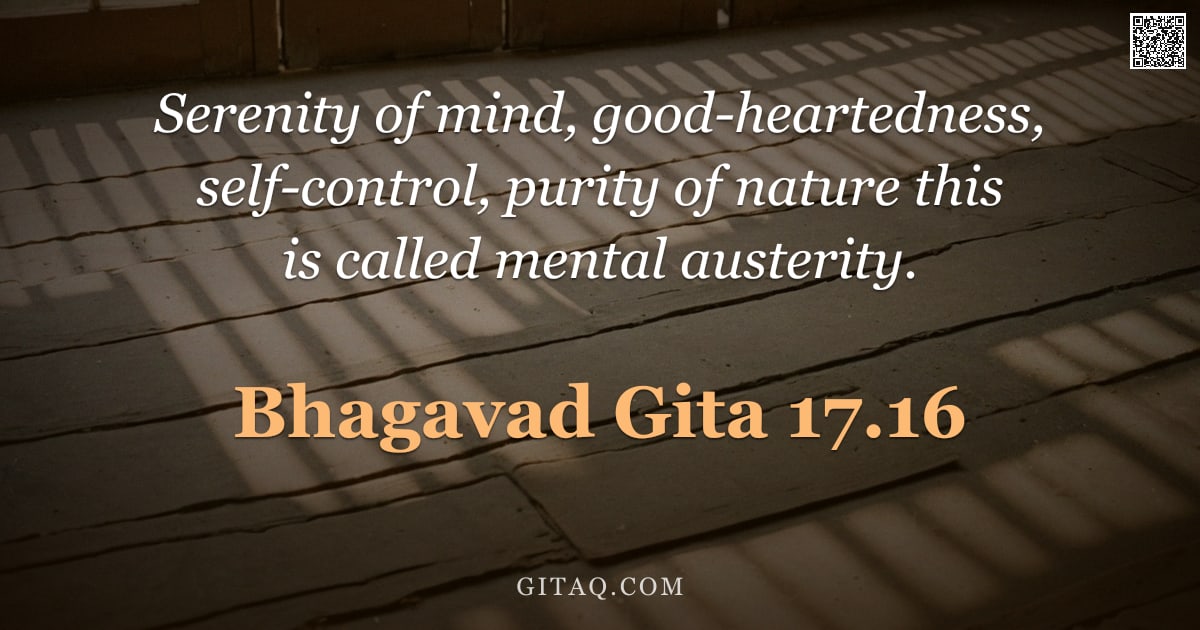
Bhagavad Gita 17.16
Shraddhatraya Vibhaga Yoga · English Translation
मनः प्रसादः सौम्यत्वं मौनमात्मविनिग्रहः | भावसंशुद्धिरित्येतत्तपो मानसमुच्यते ||१७-१६||
manaḥ prasādaḥ saumyatvaṃ maunamātmavinigrahaḥ . bhāvasaṃśuddhirityetattapo mānasamucyate ||17-16||
What Does This Verse Mean?
In this verse, Lord Krishna explains to Arjuna that true austerity is not just physical hardship but primarily a disciplined state of the mind. He defines 'mental tapas' as cultivating inner peace, kindness toward others, silence or restraint in speech, self-control over impulses, and cleansing one's intentions from negativity. The key teaching is that spiritual growth begins internally; mastering your thoughts and emotions is the most powerful form of discipline you can practice.
The Teaching Behind It
This verse belongs to the integrated teaching of Karma Yoga (the yoga of action) and Jnana Yoga (the yoga of knowledge), emphasizing that right action requires a purified mind. It develops the concept that external rituals are ineffective without internal discipline, aligning with the Sankhya philosophy where the modification of the mind is central to realizing one's true nature.
Word by Word
Classical Commentary
Where This Happens
This verse appears in the seventeenth chapter of the Bhagavad Gita during a conversation between Lord Krishna and Prince Arjuna on the battlefield of Kurukshetra. After explaining the three types of faith (Sattvic, Rajasic, and Tamasic), Krishna is now detailing how these different natures manifest through specific practices called 'tapas' or austerity. The listener, Arjuna, who has just received instructions on sacrifice, charity, and fasting, needs this clarification to understand that true discipline starts with internal purity before any external action can be effective.
Living It Out Today
Consider a high-stress situation at work where you receive harsh criticism; instead of reacting defensively or lashing out in anger, you practice 'mental austerity' by first taking a moment for inner silence (maunam) and calming your mind. You choose to respond with good-heartedness rather than resentment and ensure your intention is to resolve the issue cleanly rather than win an argument. This internal self-control transforms a potentially toxic meeting into a productive conversation, demonstrating that mastering your reaction is more powerful than trying to control others.
Explained for Children
Imagine your mind is like a calm lake on a sunny day—that is 'serenity.' This verse teaches us that being kind, staying quiet when we are angry (like holding our breath before shouting), cleaning up messy thoughts so they don't make us feel bad later, and stopping ourselves from doing things we know are wrong are all ways to be strong inside. Just like brushing your teeth keeps you healthy physically, practicing these habits makes your heart and mind happy and peaceful.
Daily Reflection
Today, I invite you to notice how often your inner world reacts with sharpness rather than kindness; true strength lies not in forcing silence but in the gentle mastery over one's own nature. When you pause to listen deeply or speak softly, you are practicing a powerful form of austerity that purifies your very essence. Remember that this quieting of the mind is the first step toward finding peace in any chaotic situation.
A Practice for Today
Begin by silently observing the surface of your mind, noting any turbulence or agitation without trying to fix it immediately. As you breathe gently, cultivate a sense of internal stillness and allow that serenity to soften your heart toward yourself and others.
Key Teachings
- The Sanctity of Mental Silence
True spiritual discipline begins not with external rituals, but with 'mauna'—the quieting of internal chatter and the cultivation of a peaceful inner state. - Purity as Self-Control
'Atmavinigraha' signifies that genuine self-mastery is an act of willpower directed inward to govern thoughts, emotions, and impulses before they manifest outwardly. - Serenity Rooted in Goodness
A serene mind naturally radiates 'saumyatva' or gentleness, creating a ripple effect where inner purity transforms one's entire nature and interactions with the world.
Themes
Related Verses
Read This Next
- 2.47 — Read this to understand how mental control (equanimity) allows one to act without being attached to the fruits of action.
- 3.30 — This verse complements the theme by teaching that dedicating all actions and thoughts to the Divine is a form of purification.
- 12.15 — Explore this next to see how a person with such mental austerity becomes pleasing to God through their non-offensive nature.
Recommended Reading
GitaQ earns from qualifying purchases as an Amazon Associate.