Bhagavad Gita 16.5
Daivasura Sampad Vibhaga Yoga · English Translation
दैवी सम्पद्विमोक्षाय निबन्धायासुरी मता | मा शुचः सम्पदं दैवीमभिजातोऽसि पाण्डव ||१६-५||
daivī sampadvimokṣāya nibandhāyāsurī matā . mā śucaḥ sampadaṃ daivīmabhijāto.asi pāṇḍava ||16-5||
What Does This Verse Mean?
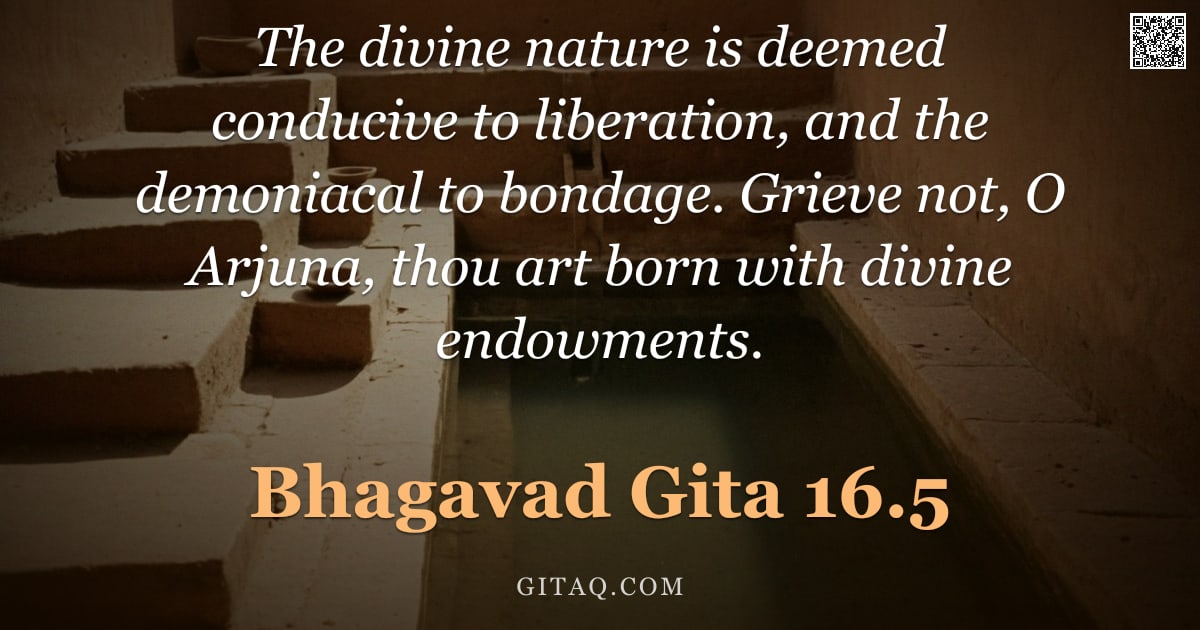
In this verse, Lord Krishna is speaking to Arjuna on the battlefield of Kurukshetra, reassuring him that his current nature and inclinations are divine rather than demoniacal. The core teaching distinguishes between two paths: a 'divine nature' characterized by virtues like truthfulness and fearlessness leads to freedom (liberation), while a 'demoniacal nature' driven by ego and aggression leads to bondage. Krishna tells Arjuna not to worry or grieve about the challenges ahead because his inherent qualities are already aligned with this liberating path.
The Teaching Behind It
This teaching belongs primarily to Jnana Yoga, as it focuses on self-knowledge and distinguishing between one's true spiritual nature (divine) and false conditioning (demoniacal). It develops the concept of 'Sattva' (purity) versus 'Tamas' and 'Rajas' (ignorance and passion), establishing that liberation is a natural result of cultivating divine qualities, while bondage results from their absence.
Word by Word
Classical Commentary
Where This Happens
This verse occurs in Chapter 16 of the Bhagavad Gita, set on the battlefield of Kurukshetra where the Pandavas and Kauravas are poised for a great war. After listing various demonic qualities that lead to destruction, Krishna has just finished describing them as characteristics of those who oppose cosmic order (dharma). Arjuna is still feeling overwhelmed by his doubts about fighting his own relatives; this verse serves as an immediate comfort from Krishna, affirming that despite the chaos around him, Arjuna's intrinsic nature remains pure and aligned with righteousness.
Living It Out Today
Consider a modern professional facing a high-stakes decision where they are pressured to cut corners or engage in unethical behavior to meet quarterly targets. In this moment of anxiety about losing their integrity versus gaining success, the verse reminds them that choosing honesty builds 'divine' resilience and long-term freedom from guilt (liberation), while compromising leads to mental bondage. The leader should not grieve over the fear of failure but recognize that they were born with an inner capacity for ethical leadership.
Explained for Children
Imagine you have two backpacks: one is light, full of happy toys like kindness and courage (the divine nature), which helps you run fast and climb mountains easily. The other bag is heavy, filled with rocks labeled 'anger' and 'fear', making it hard to move anywhere. Krishna tells Arjuna that he has already been given the light backpack because his heart is good inside. So, there is no need to cry or be scared; just trust your strong inner self!
Daily Reflection
Arjuna was told not to grieve because he had been born with the seeds of divinity; you too possess this same potential for liberation right now. When you feel overwhelmed by doubt or negativity, remember that a demoniac nature is just a habit pattern, whereas your divine nature is your true essence waiting to be acknowledged. Trust in this inherent goodness today and let it guide your choices rather than the temporary urges of bondage.
A Practice for Today
Pause and place your hand over your heart, asking yourself where you are currently leaning: toward the fear that binds or the freedom that liberates. Visualize a golden light of divine qualities filling your mind, replacing any anxiety with the quiet confidence that these traits are already within your reach.
Key Teachings
- The Nature of Destiny
Krishna establishes a cosmic law where divine qualities naturally lead to moksha (liberation) while demoniac traits create samsara (bondage). This distinction is not about punishment but the natural consequence of how our internal nature shapes our external reality. - The Remedy for Grief
The verse offers a specific antidote to Arjuna's sorrow: recognizing one's own divine birthright removes the need for anxiety about one's future or status. When you know your true nature is rooted in divinity, fear of failure dissolves into faith in your inherent capacity. - Innate Potential
Divine endowments are not something to be acquired from the outside but realized as an existing birthright that has been obscured by ignorance. The path forward is simply a matter of awakening these latent qualities rather than constructing new ones.
Themes
Related Verses
Read This Next
- 2.47 — Read this next to understand how Krishna defines duty without attachment, which is a core characteristic of divine nature mentioned in verse 16.5.
- 3.30 — This verse explains the practice of surrendering all actions to God, a practical method for cultivating the divinity Krishna praises here.
- 12.15 —
Recommended Reading
GitaQ earns from qualifying purchases as an Amazon Associate.