Bhagavad Gita 16.24
Daivasura Sampad Vibhaga Yoga · English Translation
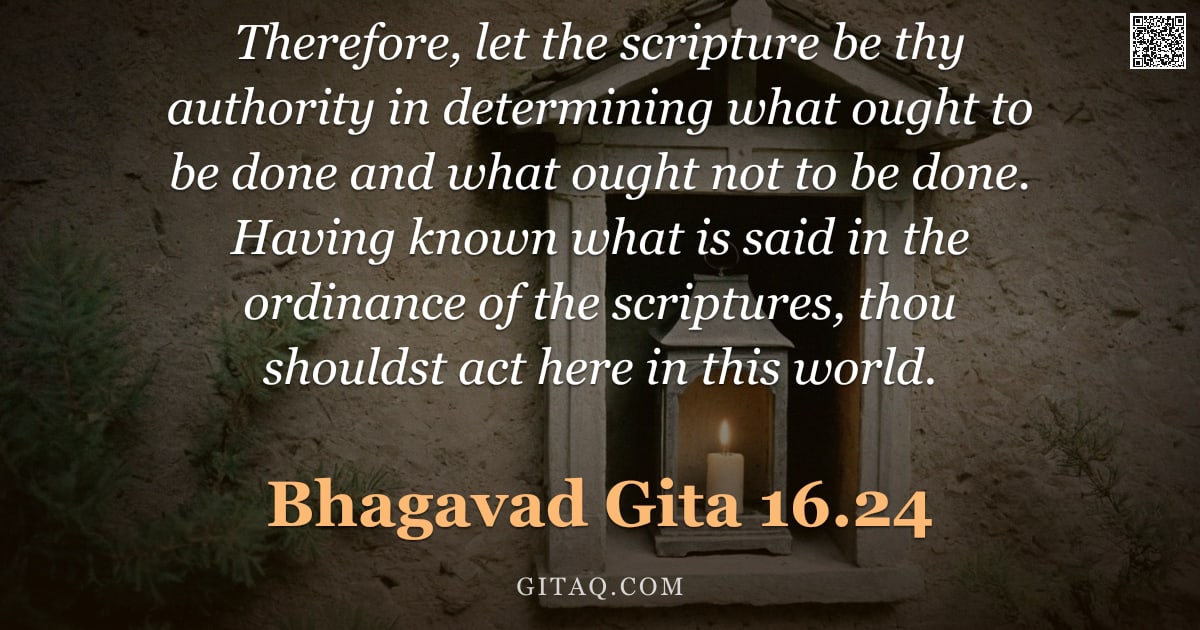
तस्माच्छास्त्रं प्रमाणं ते कार्याकार्यव्यवस्थितौ | ज्ञात्वा शास्त्रविधानोक्तं कर्म कर्तुमिहार्हसि ||१६-२४||
tasmācchāstraṃ pramāṇaṃ te kāryākāryavyavasthitau . jñātvā śāstravidhānoktaṃ karma kartumihārhasi ||16-24||
What Does This Verse Mean?
In this concluding verse of the dialogue, Lord Krishna tells Arjuna that the sacred scriptures serve as the ultimate authority for distinguishing between right and wrong actions. He advises that after understanding these timeless guidelines, one must act accordingly in daily life rather than relying solely on personal desire or confusion. This teaching establishes a balance where external wisdom guides internal decision-making to ensure righteous living.
The Teaching Behind It
This verse anchors the philosophy of Karma Yoga by defining how action should be performed without attachment. It introduces the concept of 'Shastra' (scripture) as a necessary boundary for human conduct, ensuring that individual desires are aligned with cosmic order (Dharma). This creates a synthesis where selfless action is guided not just by intuition, but by tested spiritual wisdom.
Word by Word
Classical Commentary
Where This Happens
This verse appears at the very end of Chapter 16, which Krishna has spent describing the qualities of divine versus demonic natures. Having just finished listing the terrifying behaviors associated with arrogance and anger, Arjuna is likely overwhelmed by the stark contrast between his own nature as a warrior-prince and the potential for darkness within human beings. Standing on the battlefield of Kurukshetra before the great war begins, Krishna offers this verse to provide a clear anchor: when in doubt or fear, return to the established wisdom of tradition.
Living It Out Today
Consider a modern professional facing pressure to cut corners on safety standards at work to meet an immediate deadline. Instead of making a snap decision based solely on personal ambition or peer pressure, they consult their company's ethical code and industry regulations (the 'scripture' in this context). After confirming that the shortcut violates established norms for public safety, they choose to delay the project to ensure compliance, acting with integrity despite the short-term cost.
Explained for Children
Imagine you are playing a game with very important rules written down so everyone knows how to play fairly; if you don't know the rules, you might make mistakes that hurt others. The Gita says we should look at those 'rule books' (the scriptures) first before making big choices about what is good or bad to do. Once we read and understand these wise instructions, we can go out into our world and act with confidence, just like a player who knows exactly how to win.
Daily Reflection
Today, notice how often you act on immediate desire or social pressure without checking a deeper moral compass. When faced with a difficult choice, pause and ask yourself if your action aligns with the eternal principles found in sacred wisdom rather than just what feels easy right now. This simple shift from impulse to inquiry transforms every interaction into an opportunity for spiritual growth.
A Practice for Today
Close your eyes and recall a recent decision where you felt torn between impulse and duty; pause to imagine the voice of timeless scripture gently guiding that choice toward clarity rather than confusion. Silently affirm, 'Let my actions today be rooted in wisdom that transcends fleeting emotions,' allowing this anchor to settle deeply within your heart.
Key Teachings
- The Authority of Scripture
Shastras provide the essential framework for distinguishing between duty and desire, acting as a neutral guide when our own judgment is clouded. Without this external standard of truth, human reasoning often becomes subjective and prone to error. - The Dichotomy of Action
Every action falls into one of two categories: that which ought to be done (karyam) or that which must be avoided (akaryam). The verse emphasizes that the scripture is the ultimate arbiter for making this critical distinction in daily life. - Integration of Knowledge and Deed
Knowing what is right is insufficient; one must actively integrate scriptural wisdom into immediate action here on earth. The verse calls us to move from theoretical understanding to practical application through disciplined conduct.
Themes
Related Verses
Read This Next
- 2.47 — This verse complements Gita 16.24 by clarifying that while one has a right to action, they must not be attached to the results.
- 3.30 — Read this next to understand how surrendering all actions to the Divine provides the strength needed to follow scriptural duty without ego.
- 12.15 — This verse describes the qualities of a devotee who has internalized these teachings, embodying the divine nature that 16.24 advocates for.
Recommended Reading
GitaQ earns from qualifying purchases as an Amazon Associate.