Bhagavad Gita 16.23
Daivasura Sampad Vibhaga Yoga · English Translation
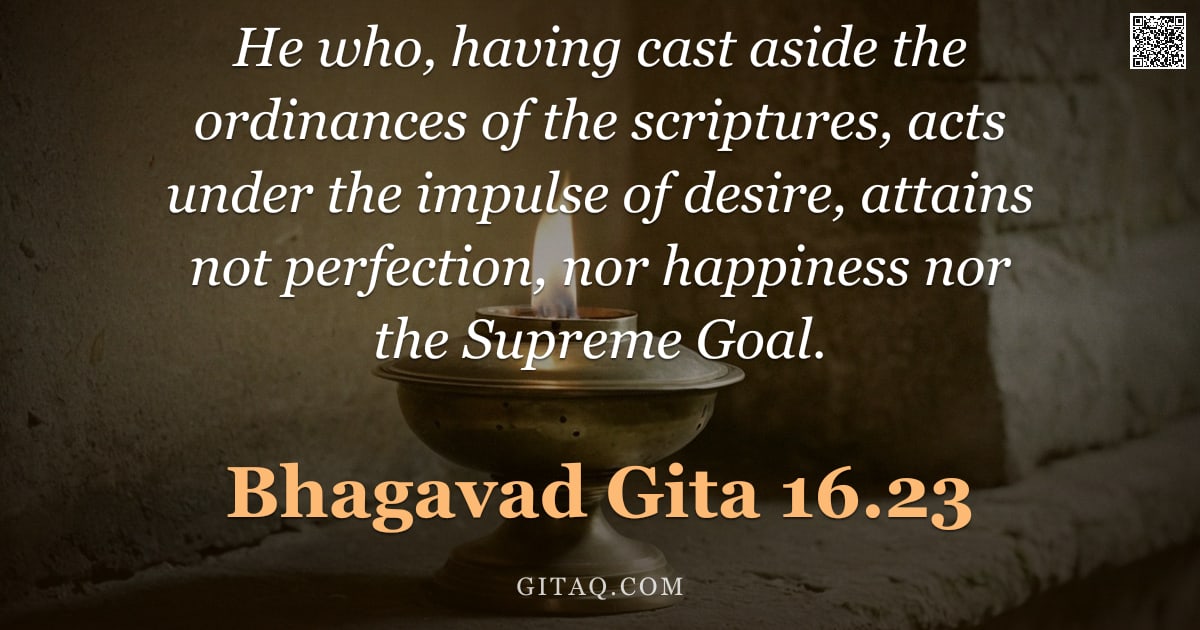
यः शास्त्रविधिमुत्सृज्य वर्तते कामकारतः | न स सिद्धिमवाप्नोति न सुखं न परां गतिम् ||१६-२३||
yaḥ śāstravidhimutsṛjya vartate kāmakārataḥ . na sa siddhimavāpnoti na sukhaṃ na parāṃ gatim ||16-23||
What Does This Verse Mean?
In this verse, Lord Krishna warns Arjuna that anyone who ignores the wise guidelines of the scriptures and acts solely on personal whims or selfish desires will never find true success, lasting happiness, or spiritual liberation. The teaching emphasizes that 'desire-driven' behavior without a moral compass leads to confusion rather than fulfillment. It establishes that following divine wisdom is not just about rules, but about aligning one's life with the natural order for ultimate well-being.
The Teaching Behind It
This verse is a cornerstone of Karma Yoga, specifically addressing the necessity of adhering to Dharma as a prerequisite for effective action. It develops the concept that true freedom (Moksha) cannot be achieved through arbitrary individual will but requires alignment with universal laws found in scripture and wisdom traditions.
Word by Word
Classical Commentary
Where This Happens
This shloka appears in Chapter 16 during the climax of Krishna's discourse on the battlefield of Kurukshetra, where he is contrasting 'Daivi Sampad' (divine qualities) with 'Asuri Sampad' (demonic qualities). Arjuna has just been overwhelmed by confusion and fear regarding his duty to fight his own kin. In response, Krishna completes his list of demonic traits—such as arrogance, anger, and harsh speech—and concludes this section by explaining the ultimate consequence: acting on impulse without scriptural guidance leads to spiritual ruin rather than victory.
Living It Out Today
Consider a professional manager who decides to cut corners on safety protocols or ignore company ethics just to meet an immediate quarterly target because they feel like it. While this might bring short-term profit, the lack of adherence to established standards will eventually lead to legal trouble, loss of trust from their team, and personal anxiety about future failures. By ignoring the 'scripture' (in this case, professional codes and ethical frameworks) in favor of immediate desire, they sacrifice long-term career success and inner peace.
Explained for Children
Imagine you are building a tall tower of blocks, but instead of looking at the instruction manual or listening to your parent's advice on how to stack them safely, you try to build it however you feel like in that moment. You might have fun for a few seconds, but eventually, the whole thing will wobble and crash down, leaving you with broken pieces and no tower left. This verse teaches us that ignoring good rules just because we want our own way leads to frustration instead of building something strong and happy.
Daily Reflection
Today, pause and examine a recent decision you made; did it stem from a genuine desire for growth or simply an urge to satisfy a momentary craving? When we cast aside timeless wisdom in favor of our own whims, we often find ourselves chasing happiness that slips through our fingers like sand. True fulfillment comes not from doing whatever feels good now, but from aligning your actions with the higher laws that guide us toward lasting peace and purpose.
A Practice for Today
Close your eyes and notice where today's actions are driven by an immediate impulse versus a deeper sense of rightness found in ancient wisdom. Ask yourself: am I following the 'scripture' of my own highest values, or merely reacting to fleeting desires? Take three deep breaths to release the need for instant gratification before making your next choice.
Key Teachings
- The Danger of Unchecked Desire
Acting solely on impulse without regard for sacred guidelines leads to a life of restlessness rather than joy. This verse warns that desire-driven action creates a cycle where perfection and true satisfaction remain out of reach. - The Role of Sacred Ordinance
Scriptural injunctions act as the compass for navigating human behavior, ensuring our actions align with cosmic order. Casting them aside is not an exercise in freedom, but a loss of direction that prevents spiritual progress. - The Threefold Loss
Discarding divine guidance results in a triple failure: the lack of perfection (siddhi), the absence of lasting happiness (sukha), and missing the ultimate goal (parāṃ gatim). This verse clarifies that true success is impossible without adherence to higher principles.
Themes
Related Verses
Read This Next
- 2.47 — This verse establishes your right to action while instructing you not to be attached to the results or driven by personal desire.
- 3.30 — It offers a practical method for dedicating all actions to the Divine, countering the impulse of selfish motivation mentioned in 16.23.
- 12.15 — This verse describes the qualities of one who has transcended desire and finds happiness within themselves through adherence to divine nature.
Recommended Reading
GitaQ earns from qualifying purchases as an Amazon Associate.