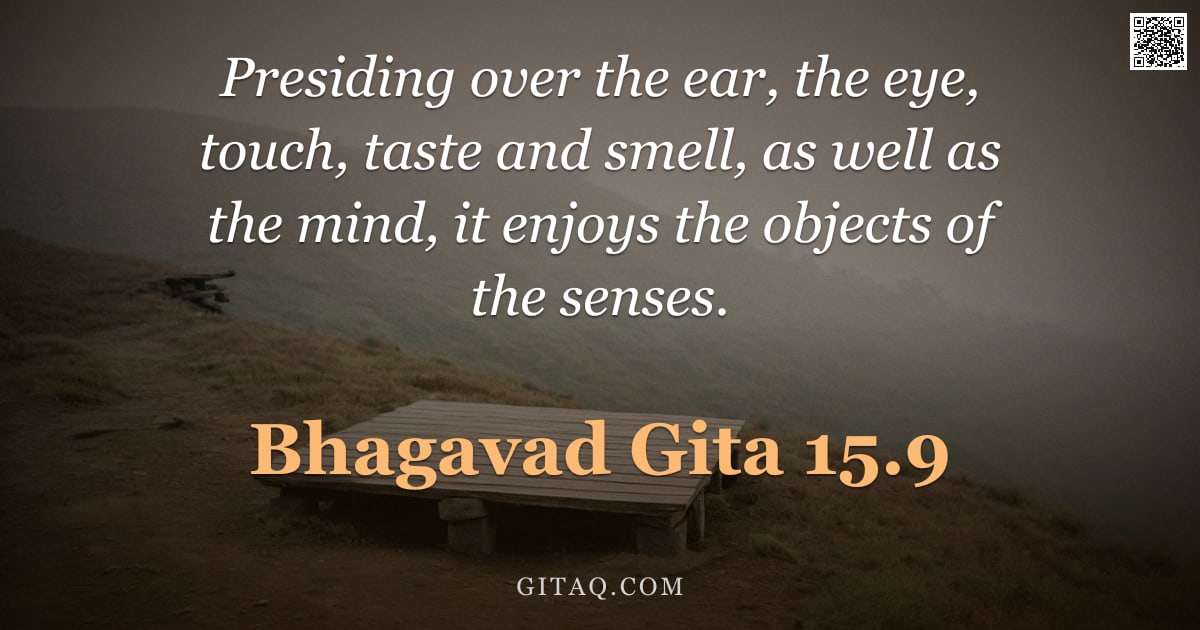
Bhagavad Gita 15.9
Purushottama Yoga · English Translation
श्रोत्रं चक्षुः स्पर्शनं च रसनं घ्राणमेव च | अधिष्ठाय मनश्चायं विषयानुपसेवते ||१५-९||
śrotraṃ cakṣuḥ sparśanaṃ ca rasanaṃ ghrāṇameva ca . adhiṣṭhāya manaścāyaṃ viṣayānupasevate ||15-9||
What Does This Verse Mean?
In this verse, Lord Krishna explains to Arjuna that the soul (Atman) resides within the body and acts as the silent observer behind all our senses—hearing, seeing, touching, tasting, smelling—as well as the mind. Just as a driver sits in a car and controls its movement without being destroyed by it, the eternal self uses these organs to experience the world of objects while remaining distinct from them. The key teaching is that we often mistake ourselves for our sensory experiences, but true wisdom lies in realizing that we are the conscious witness behind all action.
The Teaching Behind It
This verse belongs primarily to Jnana Yoga (the path of knowledge) and Sankhya philosophy, as it focuses on distinguishing the eternal Self (Purusha) from the non-sensory instruments of perception. It develops the concept of 'adhiṣṭhāna' (witnessing consciousness), teaching that while the soul uses the senses to enjoy objects, its true nature remains untouched by sensory experiences.
Word by Word
Classical Commentary
Where This Happens
This teaching occurs during the Bhagavad Gita's fifteenth chapter on the battlefield of Kurukshetra, where Lord Krishna has been systematically guiding Prince Arjuna away from his confusion. Just before this verse, Krishna described the material world as an inverted banyan tree with roots above and branches below; now he clarifies how the individual soul is trapped in that cycle by identifying it with sensory pleasures. Arjuna, who had just laid down his arms in despair over fighting his kin, needs to understand that his true identity is not the suffering body or the confused mind, but the eternal observer within.
Living It Out Today
Consider a moment when you are stuck in heavy traffic and feel your blood pressure rising; instead of identifying entirely with the anger ('I am angry'), use this verse's wisdom to step back mentally. Recognize that there is an inner 'witness' observing the frustration, hearing the honking, and feeling the heat without being consumed by it. This shift from identification to observation allows you to handle difficult family conflicts or high-pressure work deadlines with a clear mind rather than reacting impulsively.
Explained for Children
Imagine you have a very special remote control inside your head that makes everything happen; when you press it to see a bird or taste ice cream, those things seem like they belong just to you. But actually, there is a little 'you' deep inside watching through the eyes and ears, kind of like how a movie projector sits behind the screen showing all the pictures without getting wet in the rain. This verse teaches that while your body feels happy or sad about different things, the real You is safe and calm just watching it all happen.
Daily Reflection
Today, notice how often you mistake yourself for the one who tastes, touches, and sees; remember that it is actually your inner Self using these instruments to experience the world. When frustration arises from sensory overload or desire, pause and realize there is a deeper awareness behind those reactions that remains untouched by them. You are not the fleeting sensations of taste or touch, but the steady presence that allows you to know them.
A Practice for Today
Sit quietly and gently withdraw your awareness from what you see, hear, or touch around you right now. Imagine the subtle presence within these senses as a silent witness that is not entangled in them but merely observing their activity.
Key Teachings
- The Inner Controller
This verse reveals that a singular consciousness resides within all five sense organs and the mind, acting as the true seer behind every perception. It teaches us that our identity is not in the senses themselves but in this silent director managing their interactions with objects. - The Nature of Enjoyment
While we often think 'I am enjoying' or 'I am suffering,' the Gita clarifies that it is the embodied self, equipped with these faculties, engaging with sensory inputs. This distinction helps us see experience as a process rather than an absolute definition of our eternal nature. - The Trap of Identification
Suffering arises when we mistakenly believe the senses and mind are 'us' rather than tools used by the Self. Recognizing this separation is the first step toward liberation, as it shifts our focus from fleeting sensory gratification to the permanent witness within.
Themes
Related Verses
Read This Next
- 2.47 — To learn how to act in this world without being attached to the sensory results described in verse 15.9.
- 3.30 — To understand the practical method of offering all actions and their outcomes to the Divine, freeing oneself from egoic enjoyment.
- 12.15 — To discover how a devotee becomes dear to Krishna by not being disturbed by sensory dualities or worldly fluctuations.
Recommended Reading
GitaQ earns from qualifying purchases as an Amazon Associate.